
Amazon price comparison by region
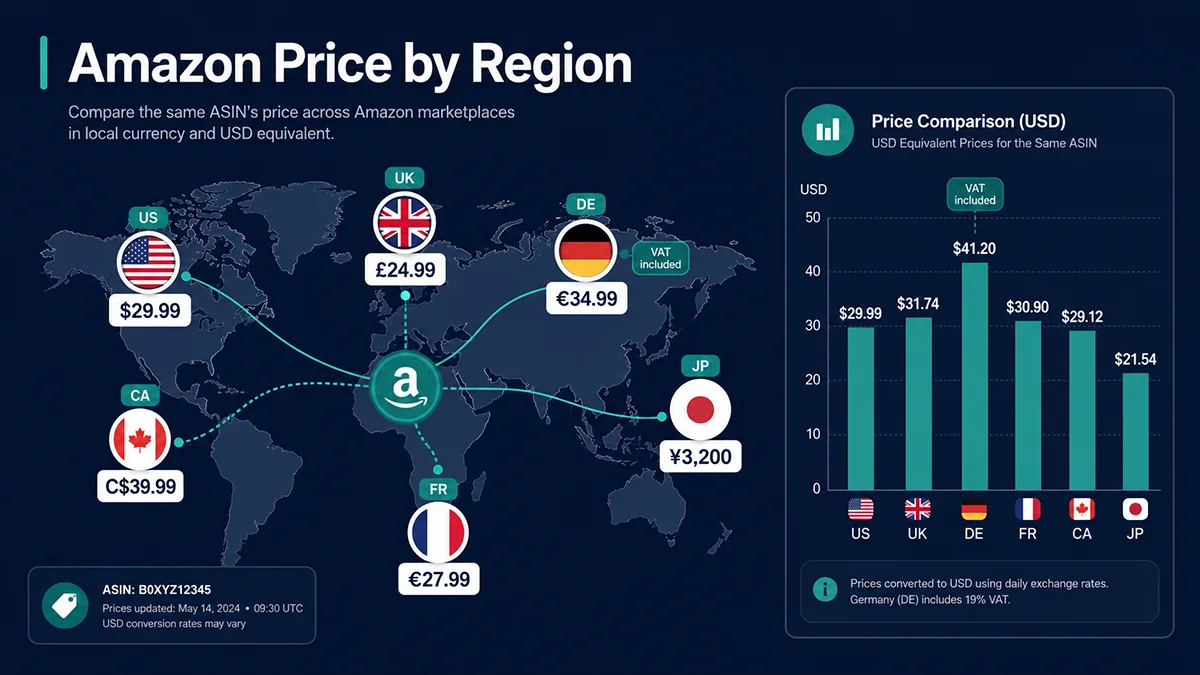
Amazon price comparison by region reveals a consistent structural pattern: the same product is 25–40% more expensive in Germany than in the US when you correctly adjust for VAT — and that gap is not a pricing mistake. It’s the predictable result of six compounding factors that affect each marketplace independently. Understanding those factors is what makes cross-regional price data actionable rather than just interesting.
This matters practically because most Amazon price monitoring systems track Buy Box prices within a single marketplace. If you’re running multi-region operations — or evaluating which marketplace to enter next — you’re making decisions without the data layer that shows where your margins are actually better, where competitors are pricing more aggressively, and where a global repricing event is underway versus a local promotional blip.
This guide covers the root causes of regional price divergence, the five technical challenges that make cross-marketplace monitoring harder than single-site monitoring, and a complete implementation using Pangolinfo’s Amazon Scraper API.
Why Do Amazon Prices Differ Across Regions? Six Root Causes
Root Cause 1: VAT Creates a Structural Price Floor in Europe
This is the biggest misunderstood factor in cross-regional Amazon price comparisons. European Amazon marketplaces display VAT-inclusive prices. Germany’s VAT rate is 19%, France and the UK are 20%, Italy is 22%, Spain is 21%. The US product page price excludes state sales tax (which is added at checkout, not displayed on the product page).
The practical implication: a €34.99 price on amazon.de contains €5.59 of tax. The actual merchant price is €29.40 — which at 1.08 USD/EUR converts to $31.75. Compare that to $29.99 on amazon.com and the real premium is about 6%, not the 17% you’d calculate from the raw numbers. Skipping the VAT removal step before currency conversion is the most common error that inflates the apparent Europe-US price gap and leads to incorrect pricing strategy conclusions.
Root Cause 2: Seller Density Differences Drive Price Level Divergence
Amazon US is the world’s most competitive single marketplace. In mature categories, dozens of sellers compete for the Buy Box, pushing prices toward commodity levels. European marketplaces — particularly Italy, Spain, and France — have significantly lower seller density in most product categories. Less competition allows sellers to sustain higher prices without losing the Buy Box.
In outdoor categories, early-entry sellers on amazon.de routinely hold the Buy Box at prices 20-30% above their US equivalent, sometimes for 12-18 months before the category reaches US-level competition density. Tracking this price premium decay curve across marketplaces is exactly the kind of strategic signal that cross-marketplace price data enables.
Root Cause 3: Exchange Rate Fluctuations Create Pricing Lag
Sellers typically set marketplace prices based on a point-in-time exchange rate and update them infrequently. The EUR/USD rate fluctuated by over 12% in 2022-2023 (including breaking parity, a multi-decade extreme). When exchange rates move significantly but seller prices don’t, the USD-equivalent price of European listings changes even though the local currency price is stable. This creates temporary windows where a European marketplace becomes either dramatically more or less competitive on a USD basis.
Root Cause 4: FBA Fulfillment Costs Are Higher in Europe
Amazon FBA fulfillment fees vary by country. European FBA costs are typically 15-25% higher than US FBA for equivalent product weight and dimensions (based on 2026 FBA fee schedules). These costs flow directly into seller pricing — a product priced to achieve a 25% margin on US FBA may require a proportionally higher European listing price to maintain the same margin after higher fulfillment costs.
Root Cause 5: Promotional Events Run Independently per Marketplace
Prime Day discounts, Lightning Deal inventory, and promotional budgets are managed independently per Amazon marketplace. US Prime Day promotional depth and competitive dynamics can be entirely different from the simultaneous UK or DE Prime Day. During these events, the US marketplace may see prices drop 20-30% while European equivalents move only 10-15%. Cross-marketplace price monitoring during major events captures these divergences in real time — one of the highest-value monitoring windows in the calendar year.
Root Cause 6: Brand MMAP Creates Cross-Marketplace Price Linkage
Brand sellers with global Minimum Advertised Price (MMAP) agreements set a USD-equivalent floor price that applies across all marketplaces. When a brand enforces a global MMAP, a price change on one marketplace often triggers corresponding adjustments across others. Monitoring US marketplace price movements can therefore serve as a leading indicator for European price shifts — which is directly useful for sellers anticipating and responding to competitor repricing events.
What Makes Amazon Regional Price Comparison Technically Hard?
Challenge 1: VAT-Inclusive vs. Exclusive Price Confusion
European Amazon pages display VAT-inclusive prices. US pages display pre-tax prices. Comparing them directly — without VAT removal before currency conversion — systematically overstates the Europe-US price gap. A monitoring system that doesn’t handle this will consistently report European prices as 15-22% higher than they actually are after tax normalization, leading to incorrect competitive positioning assessments.
Challenge 2: Exchange Rate and Price Timestamp Alignment
For a cross-marketplace price comparison to be valid, the exchange rate used must be from the same time as the price data. If your system scrapes US prices at 09:00 UTC and European prices at 15:00 UTC, and applies an end-of-day exchange rate, you’ve introduced three separate timing inconsistencies. Production systems need to: fetch exchange rates at the start of each batch cycle, tag both prices and exchange rates with UTC timestamps, and store them as a linked snapshot for reproducible historical analysis.
Challenge 3: Region-Specific IP Requirements
Amazon determines which marketplace page version to serve based on the visitor’s IP geolocation. Accessing amazon.de from a US IP address may return a redirected or degraded page that doesn’t reflect the German marketplace’s actual pricing. A cross-marketplace scraping system requires regional proxy infrastructure: German IPs for amazon.de, UK IPs for amazon.co.uk, Japanese IPs for amazon.co.jp. Building and maintaining a reliable multi-region proxy pool is a significant ongoing operational cost for self-hosted solutions.
Challenge 4: Cross-Site Selector Variation
Amazon’s marketplace sites share a common page structure but are not identical. Price field selectors, promotional label markup, and Buy Box HTML structure have marketplace-specific variations that require per-site configuration and maintenance. When Amazon updates its frontend (approximately quarterly), these variations mean that a selector fix for amazon.com may not directly apply to amazon.de — multiplying the maintenance burden by the number of marketplaces monitored.
Challenge 5: Scale and Frequency Cost Management
Monitoring 500 ASINs across 6 marketplaces at 6-hour update frequency means 12,000 page fetches per day. At the infrastructure cost of residential proxy services ($0.01-0.05 per request), this amounts to $120-600 per day in proxy costs alone — before accounting for server infrastructure and engineering maintenance time. This scale calculation often surprises teams planning self-hosted cross-marketplace monitoring systems.
Five Approaches to Amazon Regional Price Comparison Monitoring
Approach 1: Keepa Historical Price Data
Keepa supports viewing historical price trends for the same ASIN across multiple Amazon marketplaces in a single interface. For verifying that cross-marketplace price gaps exist and understanding their historical pattern, Keepa is the fastest starting point.
Best for: Spot research on <50 ASINs, historical trend validation, initial hypothesis testing.
Limitations: No bulk export or API access for raw data, no VAT normalization, historical data only (not real-time), no alerting capability.
Approach 2: Amazon SP-API
SP-API’s GetPricing and GetCompetitivePricing endpoints return pricing data for your own account’s offers, and competitive pricing only for ASINs where your account competes. For ASINs where you have no selling history, SP-API does not return competitor price data. Cross-marketplace monitoring requires separate API accounts for each regional marketplace (North America, Europe, Far East).
Best for: Monitoring your own ASIN pricing compliance across marketplaces you actively sell in.
Limitations: No competitor ASIN coverage, no coupon or deal data, no page-level effective price, multi-region API management complexity.
Approach 3: Manual + Spreadsheet
Manual lookup on each marketplace, manual VAT calculation, manual exchange rate conversion, entered into a shared spreadsheet. Feasible for very small scale but cannot be automated.
Best for: <20 ASINs, <weekly frequency, one-time research.
Limitations: Not automatable, high error rate in VAT/FX calculations, zero scalability.
Approach 4: DIY Headless Browser Scraper
Playwright or Puppeteer with a multi-region residential proxy pool, per-marketplace selector configurations, VAT rate lookup, and an exchange rate API integration. Production-ready implementation requires 3-5 weeks initial development and ongoing quarterly maintenance for selector updates.
Best for: Teams with dedicated engineering capacity, <300 ASINs/day, full data pipeline control required.
Limitations: Multi-region proxy costs ($100-300+/month), quarterly selector maintenance across multiple sites, Cloudflare silent failure handling complexity, multi-timezone scheduling overhead.
Approach 5: Pangolinfo Amazon Scraper API
Pangolinfo Amazon Scraper API handles region-specific IP routing, page rendering, and cross-marketplace selector variation server-side. The caller switches marketplaces via a single parameter and receives structured pricing fields in local currency with currency code — applying VAT removal and exchange rate conversion in the application layer.
Best for: 300+ ASINs/day, multi-marketplace coverage (5+ sites), hourly or more frequent monitoring, no dedicated scraping engineering capacity.
Advantages: Single API endpoint covers 9+ marketplaces, no proxy infrastructure management, server-side quarterly selector updates, reliable uptime without Cloudflare maintenance overhead.
Complete Implementation: Cross-Marketplace Price Comparison with Pangolinfo API
import requests
import json
import time
import logging
from datetime import datetime, timezone
from typing import Optional
from pathlib import Path

logging.basicConfig(level=logging.INFO, format="[%(asctime)s] %(message)s")

PANGOLINFO_API_KEY = "your_pangolinfo_api_key"
EXCHANGE_API_KEY = "your_exchangerate_api_key"

# VAT rates by marketplace (European sites include VAT in displayed prices)
VAT_RATES = {
    "US": 0.00, "UK": 0.20, "DE": 0.19, "FR": 0.20,
    "IT": 0.22, "ES": 0.21, "JP": 0.10, "CA": 0.00, "MX": 0.16
}

MARKETPLACE_CURRENCIES = {
    "US": "USD", "UK": "GBP", "DE": "EUR", "FR": "EUR",
    "IT": "EUR", "ES": "EUR", "JP": "JPY", "CA": "CAD", "MX": "MXN"
}


def get_exchange_rates(base: str = "USD") -> dict:
    """Fetch current exchange rates from ExchangeRate-API."""
    try:
        resp = requests.get(
            f"https://v6.exchangerate-api.com/v6/{EXCHANGE_API_KEY}/latest/{base}",
            timeout=10
        )
        resp.raise_for_status()
        return resp.json().get("conversion_rates", {})
    except Exception as e:
        logging.error(f"Exchange rate fetch failed: {e}")
        return {"GBP": 1.27, "EUR": 1.08, "JPY": 0.0067, "CAD": 0.73, "MXN": 0.050}


def remove_vat(price: float, marketplace: str) -> float:
    """Remove VAT from European marketplace prices (displayed inclusive)."""
    vat_rate = VAT_RATES.get(marketplace, 0.0)
    return round(price / (1 + vat_rate), 2) if vat_rate > 0 else price


def to_usd(price: float, currency: str, rates: dict) -> float:
    """Convert local currency price to USD equivalent."""
    if currency == "USD":
        return price
    rate = rates.get(currency)
    return round(price / rate, 2) if rate else price


def fetch_marketplace_price(asin: str, marketplace: str) -> Optional[dict]:
    """Fetch price snapshot for one ASIN/marketplace via Pangolinfo API."""
    try:
        r = requests.post(
            "https://api.pangolinfo.com/v1/amazon/product",
            headers={"Authorization": f"Bearer {PANGOLINFO_API_KEY}"},
            json={
                "asin": asin,
                "marketplace": marketplace,
                "fields": [
                    "buybox_price", "list_price", "effective_price",
                    "offer_count", "buybox_is_amazon", "buybox_seller_id",
                    "coupon_type", "coupon_value", "deal_price"
                ]
            },
            timeout=30
        )
        r.raise_for_status()
        d = r.json().get("data", {})
        d.update({"_asin": asin, "_marketplace": marketplace,
                  "_ts": datetime.now(timezone.utc).isoformat()})
        return d
    except Exception as e:
        logging.error(f"[{asin}|{marketplace}] {e}")
        return None


def cross_region_compare(
    asin: str,
    marketplaces: list[str],
    rates: dict,
    delay: float = 0.5
) -> dict:
    """
    Collect and normalize prices for one ASIN across multiple marketplaces.
    Returns comparison sorted by USD-equivalent price (ascending).
    """
    rows = []
    for mkt in marketplaces:
        snap = fetch_marketplace_price(asin, mkt)
        if not snap:
            continue

        local_price = snap.get("effective_price") or snap.get("buybox_price")
        if not local_price:
            continue

        currency = MARKETPLACE_CURRENCIES.get(mkt, "USD")
        ex_vat = remove_vat(local_price, mkt)
        usd = to_usd(ex_vat, currency, rates)

        rows.append({
            "marketplace": mkt,
            "local_price": local_price,
            "currency": currency,
            "vat_rate": VAT_RATES.get(mkt, 0),
            "price_ex_vat": ex_vat,
            "usd_equivalent": usd,
            "offer_count": snap.get("offer_count"),
            "buybox_is_amazon": snap.get("buybox_is_amazon"),
            "has_coupon": bool(snap.get("coupon_type")),
            "deal_active": snap.get("deal_price") is not None,
        })
        time.sleep(delay)

    if not rows:
        return {"asin": asin, "rows": [], "error": "no data"}

    rows.sort(key=lambda x: x["usd_equivalent"])
    cheapest = rows[0]
    most_expensive = rows[-1]
    spread_usd = round(most_expensive["usd_equivalent"] - cheapest["usd_equivalent"], 2)
    spread_pct = round(spread_usd / cheapest["usd_equivalent"] * 100, 1) if cheapest["usd_equivalent"] else 0

    return {
        "asin": asin,
        "rows": rows,
        "cheapest": {"marketplace": cheapest["marketplace"], "usd": cheapest["usd_equivalent"]},
        "most_expensive": {"marketplace": most_expensive["marketplace"], "usd": most_expensive["usd_equivalent"]},
        "spread_usd": spread_usd,
        "spread_pct": spread_pct,
    }


def monitor_loop(
    asins: list[str],
    marketplaces: list[str] = None,
    alert_threshold_pct: float = 20.0,
    output_file: str = "cross_region_prices.jsonl",
    interval_hours: int = 6
):
    """
    Scheduled monitoring loop with price spread alerts.
    Alerts when USD-equivalent price spread across regions exceeds threshold.
    """
    if marketplaces is None:
        marketplaces = ["US", "UK", "DE", "FR", "JP", "CA"]

    out = Path(output_file)
    cycle = 0

    while True:
        cycle += 1
        logging.info(f"\n=== Cycle {cycle} | {datetime.now().strftime('%Y-%m-%d %H:%M UTC')} ===")

        # Fetch exchange rates ONCE per cycle (timestamp-aligned with price data)
        rates = get_exchange_rates("USD")

        results = []
        for asin in asins:
            result = cross_region_compare(asin, marketplaces, rates)
            results.append(result)

            spread_pct = result.get("spread_pct", 0)
            if spread_pct >= alert_threshold_pct:
                c = result.get("cheapest", {})
                e = result.get("most_expensive", {})
                logging.warning(
                    f"  🚨 PRICE SPREAD ALERT: {asin} | "
                    f"Cheapest: {c.get('marketplace')} ${c.get('usd')} | "
                    f"Most expensive: {e.get('marketplace')} ${e.get('usd')} | "
                    f"Spread: {spread_pct}%"
                )

            for row in result.get("rows", []):
                logging.info(
                    f"  {row['marketplace']}: {row['local_price']}{row['currency']} → "
                    f"ex-VAT {row['price_ex_vat']} → USD ${row['usd_equivalent']} | "
                    f"Offers={row['offer_count']}"
                )

        with open(out, "a") as f:
            for r in results:
                r["_cycle"] = cycle
                f.write(json.dumps(r) + "\n")

        logging.info(f"Next cycle in {interval_hours}h")
        time.sleep(interval_hours * 3600)


if __name__ == "__main__":
    monitor_loop(
        asins=["B0CHP7BPYQ", "B09G9FPHY6"],
        marketplaces=["US", "UK", "DE", "FR", "JP"],
        alert_threshold_pct=20.0,
        interval_hours=6
    )
What Pangolinfo Returns per Marketplace
| Field | Description | VAT Status |
|---|---|---|
| buybox_price | Current Buy Box price in local currency | Inclusive (EU), Exclusive (US) |
| effective_price | Lowest consumer checkout price (incl. coupons) | Same as buybox_price |
| list_price | Crossed-out reference price (MSRP) | Same as buybox_price |
| offer_count | Number of competing sellers on this ASIN | N/A |
| buybox_is_amazon | Whether Amazon holds the Buy Box | N/A |
| deal_price | Lightning Deal price (if active) | Same as buybox_price |
| coupon_type / value | Coupon discount type and amount | Applied at checkout |
Full field reference: docs.pangolinfo.com
Frequently Asked Questions
Why are prices different across Amazon marketplaces?
Six structural factors: VAT rates (Germany 19%, Italy 22% vs. US 0% on the product page), seller density differences (European marketplaces have fewer sellers per category), exchange rate fluctuations causing delayed pricing adjustments, FBA cost differences (European FBA is 15-25% more expensive), independent promotional events, and brand MMAP agreements creating cross-marketplace price linkage.
How do I correctly compare Amazon prices across different regions?
Three steps: remove VAT from European prices (divide by 1 + VAT rate), convert the VAT-exclusive local price to USD using an exchange rate fetched at the same timestamp, and use effective_price (not buybox_price) to capture coupon discounts. The most common error is comparing European VAT-inclusive prices to US pre-tax prices directly.
Can SP-API return competitor prices across different Amazon marketplaces?
No. SP-API Pricing endpoints only cover your own account’s offers and competitive pricing for ASINs where you’re eligible to compete. Competitor ASIN price data requires page-level scraping — this is a data availability issue, not permissions-related.
What business use cases does Amazon regional price comparison data support?
Four core cases: identifying underserved marketplaces with higher prices and lower competition, MMAP compliance monitoring across global distributors, AI pricing agent inputs for cross-marketplace repricing correlation, and gray market / parallel import detection from anomalous low pricing.
How does Pangolinfo API support Amazon price comparison across regions?
Single marketplace parameter (US/UK/DE/FR/IT/ES/JP/CA/MX) covering 9+ sites with server-side regional IP routing. Returns buybox_price in local currency with currency_code, offer_count, buybox_is_amazon, and effective_price. Caller applies VAT removal and currency conversion. See docs.pangolinfo.com.
Key Takeaways
- European Amazon prices include VAT (19-22%); US prices don’t — always remove VAT before currency conversion
- The real Europe-US price premium after VAT adjustment is typically 5-10%, not the 20-30% naive comparison suggests
- Seller density, FBA costs, exchange rate lag, and MMAP all create independent pricing pressure per marketplace
- SP-API does not return competitor ASIN prices for cross-marketplace monitoring — page-level scraping is required
- At >300 ASINs/day monitoring scale, API solutions typically have lower total cost of ownership than self-hosted scrapers with multi-region proxy pools
- Exchange rates and price data must share the same timestamp — batch them together, not sequentially
🚀 Start building: Pangolinfo Amazon Scraper API | API documentation
Article Summary
This guide covers why the same Amazon ASIN costs 25-40% more in Germany than the US (six root causes: VAT, seller density, exchange rates, FBA costs, independent promotions, and MMAP linkage), five technical challenges of cross-marketplace price monitoring, comparison of five solution approaches, and a complete Python implementation using Pangolinfo Amazon Scraper API with VAT removal, real-time currency conversion, and price spread alerting.
Build your cross-marketplace price intelligence system with Pangolinfo Amazon Scraper API → Get started