
Three days after a kitchen gadget seller noticed a competitor’s product had climbed into the category Top 50, that competitor had already locked up premium ad placements, seen reviews double, and — most painfully — was running out of stock while riding the wave. The trailing seller had been using the same tools, checking the same dashboards. He just saw the signal too late.
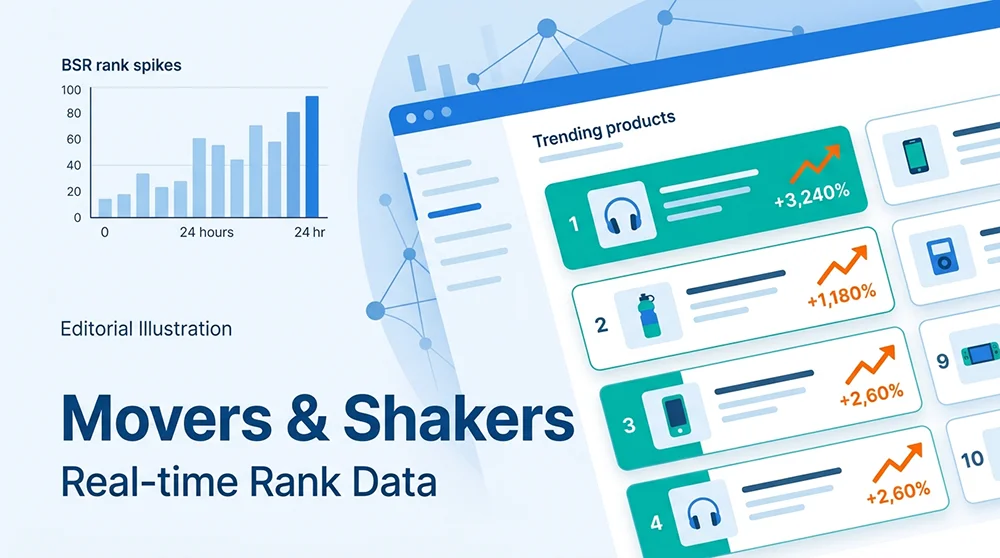
Amazon Movers and Shakers data refreshes every hour and tracks the largest BSR rank gainers in each category over the past 24 hours. A product that climbs from rank #50,000 to #5,000 in a single day represents a +900% gain — invisible in the Best Sellers list, immediately flagged in Movers and Shakers. The underlying driver is almost always real purchasing behavior: a seasonal shift, a viral TikTok post, a wave of competitor stockouts, or a media mention. Whatever the cause, MnS data is one of the few places on Amazon where you can see demand signals before they fully price into ad auctions and inventory costs.
The problem isn’t access — the list is public. The problem is how most sellers consume it: manual page refreshes, one or two categories, no historical context, and a built-in delay that turns “early signal” into “everyone already knows.” Getting Amazon Movers and Shakers data at the speed and scale it actually requires means moving beyond manual monitoring entirely.
Why MnS Data Beats BSR for Opportunity Detection
The Best Sellers Rank list rewards incumbency. Products that have dominated a category for years stay at the top, and the list changes slowly enough that checking it weekly is often sufficient. Movers and Shakers works on completely different mechanics: it measures relative velocity, not absolute position. This structural difference makes it far more useful for identifying market opportunities early.
Consider what a rank spike actually signals in competitive terms. When a product jumps 2,000% in 24 hours, it’s not just selling well — it’s experiencing demand at a rate that its current inventory position and advertising spend almost certainly didn’t anticipate. For alert competitors, that creates two windows: an advertising window (bid CPCs on related keywords haven’t caught up yet) and an inventory window (the winning competitor will likely stock out before they can reorder). Both windows are time-limited, measured in hours, not days.
The Data Coverage Gap: What Manual Monitoring Actually Misses
Amazon’s category tree contains over 30,000 nodes. Each MnS page shows 100 items per category. Even if a dedicated analyst checked ten categories twice daily, they’d cover 2,000 of the more than 3,000,000 potentially relevant product positions — less than 0.1% of the signal space. The categories they do monitor are almost always the ones they already sell in, which means cross-category opportunities (a home goods seller noticing a surge in outdoor equipment adjacent to their category) get missed entirely.
Paid tools like Helium 10 and Jungle Scout aggregate some Amazon trending products data, but their scraping cycles run on batch schedules — often updating every 4–8 hours rather than hourly. During high-velocity events like Prime Day pre-heat, Black Friday countdown, or a viral social moment, 4 hours of lag is the entire opportunity window. The data arrives after the CPC spike has already happened.
Who Actually Uses MnS Data Systematically — and How
The sellers and tool companies running systematic Movers and Shakers pipelines use the data in three distinct operational modes. The first is inventory trigger: when a product maintains Top 20 MnS rank across three consecutive hourly checks, it triggers a procurement review — not a note, an actual workflow. The second is ad entry timing: the 6-hour window after a product first appears on MnS is historically the lowest-CPC entry point for related keywords, before the ad auction adjusts to new demand levels. The third is competitive intelligence: tracking which of your direct competitors’ products appear on MnS, and with what frequency, gives you a read on their product development cadence and which of their SKUs are gaining traction.
Data service companies and SaaS tool builders have a harder requirement still: they need Amazon sales rank spike data for every category, updated at least hourly, in a format they can ingest programmatically. For this use case, the only viable path is a direct API integration that gives them access to the raw MnS data stream.
Three Data Access Paths: Speed, Coverage, and Real Costs
Choosing between manual monitoring, SaaS tools, and direct API access isn’t a matter of preference — it comes down to what your operation actually requires in terms of update frequency, category coverage, and data portability.
Manual monitoring costs nothing financially but carries a structural 4–24 hour lag (at best), covers only the categories you remember to check, and produces no queryable history. It works for casual research; it doesn’t work as an operational system.
Subscription SaaS tools offer convenience and pre-built dashboards, but their MnS data is aggregated on batch schedules that typically lag 4–8 hours. Pricing runs $1,200–$3,500/year for tiers that include reasonable category coverage, and the data stays inside the vendor’s platform — you can view it but can’t pipe it into your own systems without manual export steps.
Direct API scraping via a provider like Pangolinfo delivers data at the speed you configure — down to minutes — with coverage across any category you specify, in structured JSON that feeds directly into your ERP, selection tools, or custom dashboards. The cost structure scales linearly with request volume, which means the per-unit cost drops as you scale, the opposite of SaaS tier pricing. The trade-off is a modest technical investment upfront to build the pipeline.
The meaningful comparison isn’t cost-per-feature. It’s cost-per-actionable-hour. A system that delivers Amazon Movers and Shakers data 6 hours earlier, across 10x the categories, and feeds it directly into your decision workflow has a different economic profile than a dashboard you check manually when you remember to.
Building a Real-Time MnS Data Pipeline with Scrape API
The two technical hurdles in scraping Amazon Movers and Shakers pages are rate limiting (Amazon aggressively throttles repeated requests from the same IP) and parsing (the MnS page structure requires handling dynamic content and maintaining session state). Pangolinfo Scrape API handles both: a rotating proxy pool manages rate limit exposure, and the MnS parsing template outputs clean structured JSON without requiring custom parser development.
Here’s a production-ready Python implementation covering multi-category collection, data normalization, and spike alerting:
import requests
import json
import time
from datetime import datetime
from typing import List, Dict

# Pangolinfo Scrape API configuration
API_KEY = "your_pangolinfo_api_key"
API_ENDPOINT = "https://api.pangolinfo.com/scrape"

# Target Amazon category node IDs (Kitchen, Sports, Home Storage)
WATCH_CATEGORIES = {
    "1055398": "Kitchen",
    "3375251": "Sports & Outdoors",
    "1063498": "Home & Kitchen Storage"
}

def fetch_mns_category(category_id: str) -> List[Dict]:
    """
    Fetch Movers and Shakers data for a single category via Pangolinfo Scrape API.
    Returns a list of ranked items with ASIN, rank gain %, and current BSR.
    """
    payload = {
        "url": f"https://www.amazon.com/gp/movers-and-shakers/{category_id}",
        "parse_type": "movers_shakers",
        "output_format": "json",
        "locale": "us"
    }
    headers = {
        "Authorization": f"Bearer {API_KEY}",
        "Content-Type": "application/json"
    }
    resp = requests.post(API_ENDPOINT, json=payload, headers=headers, timeout=30)
    resp.raise_for_status()
    return resp.json().get("items", [])

def evaluate_spike(items: List[Dict], gain_threshold: float = 1000.0) -> List[Dict]:
    """
    Filter items where rank_gain_pct exceeds the threshold.
    Business logic: products crossing 1,000% gain in 24h warrant urgent review.
    """
    return [
        {
            "asin": item["asin"],
            "title": item.get("title", "")[:60],
            "gain_pct": item.get("rank_gain_pct", 0),
            "current_bsr": item.get("current_rank"),
            "review_count": item.get("review_count"),  # for competition assessment
            "price": item.get("price"),
            "flagged_at": datetime.utcnow().isoformat() + "Z"
        }
        for item in items
        if item.get("rank_gain_pct", 0) >= gain_threshold
    ]

def run_monitoring_loop(interval_minutes: int = 30):
    """
    Main monitoring loop. Runs every `interval_minutes` across all watched categories.
    Extend with Slack/webhook integration in the alert block below.
    """
    print(f"[Pangolinfo MnS Monitor] Started — checking {len(WATCH_CATEGORIES)} categories "
          f"every {interval_minutes} min")

    while True:
        timestamp = datetime.utcnow().strftime("%Y-%m-%d %H:%M UTC")
        for cat_id, cat_name in WATCH_CATEGORIES.items():
            try:
                items = fetch_mns_category(cat_id)
                spikes = evaluate_spike(items)

                print(f"  [{timestamp}] {cat_name}: {len(items)} items, "
                      f"{len(spikes)} spike alert(s)")

                for spike in spikes:
                    print(f"    ⚡ ASIN {spike['asin']} | +{spike['gain_pct']:.0f}% | "
                          f"BSR #{spike['current_bsr']} | Reviews: {spike['review_count']} | "
                          f"{spike['title']}")
                    # TODO: send_to_slack(spike) / write_to_database(spike) / trigger_erp_review(spike)

                time.sleep(3)  # inter-category delay
            except requests.HTTPError as e:
                print(f"  [Error] {cat_name}: HTTP {e.response.status_code}")
            except Exception as e:
                print(f"  [Error] {cat_name}: {e}")

        time.sleep(interval_minutes * 60)

if __name__ == "__main__":
    run_monitoring_loop(interval_minutes=30)
This pipeline is intentionally structured in three independent layers so each can be modified without touching the others: the fetch layer calls the API, the evaluate layer applies your business rules (thresholds, filters, category weights), and the alert layer sends outputs wherever your workflow requires. Teams running larger category sets have extended this to async batch collection using asyncio and aiohttp, reducing total collection time for 50+ categories from several minutes to under 30 seconds.
Pangolinfo Scrape API also supports concurrent ASIN detail fetching alongside MnS collection — so you can pull review count, price, seller count, and listing age for every flagged product in the same API session, giving you the competitive context needed to decide whether to act without a second manual lookup step. Full field documentation is available in the Pangolinfo API docs.
For teams without development resources, AMZ Data Tracker provides a visual configuration interface for the same monitoring capability — set your categories, thresholds, and notification preferences through a dashboard, no code required.
Signal Interpretation: What to Do When the Alert Fires
Not every MnS spike is an opportunity worth acting on. Three filters consistently separate actionable signals from noise:
Persistence over peak. A product appearing in MnS Top 50 across three consecutive hourly checks carries far more weight than a single #1 ranking that disappears. Single-point spikes often trace back to flash sales or coupon-driven events — real demand spikes hold for at least 2–4 hours. Build your alerting logic to track persistence, not just instantaneous gain.
Review count as a competition gate. A spiking ASIN with fewer than 100 reviews is a signal that the category entry point is still open. Above 500 reviews, the first-mover advantage window has typically closed — the time and cost required to build review velocity to match incumbents makes quick entry economically marginal. Scrape API concurrent product detail fetching makes this cross-reference automatic.
Category seasonality adjustment. In strongly seasonal categories (outdoor, gardening, holiday décor), MnS signals near seasonal peaks are structurally noisier — dozens of products spike simultaneously, reducing the discriminative value of individual entries. Cross-reference MnS data against Google Trends for the relevant keyword to separate structural demand growth from cyclical noise.
Turning a 24-Hour Edge Into a Repeatable System
Amazon Movers and Shakers data is free and public. The competitive advantage isn’t in having access to it — everyone does. It’s in the speed and consistency with which you process it. A team running hourly automated collection across 50 categories, with programmatic spike filtering and direct ERP integration, is operating in a fundamentally different information environment than one checking a handful of category pages when they remember to.
The infrastructure required to build this isn’t complex. A working pipeline using Pangolinfo Scrape API can be production-ready in an afternoon. The historical data it accumulates from day one becomes progressively more valuable — trend baselines, competitor velocity patterns, seasonal adjustment factors — none of which exist on day one of manual monitoring but compound with every hour of automated collection.
The 24-hour edge compounds. An ad placement entered at low CPC because you saw the spike first, inventory positioned because your reorder trigger fired automatically, a category exit avoided because you saw a competitor product surge in time — these aren’t one-time wins. They’re the structural output of having better data, faster. Start your free trial on the Pangolinfo Console and run your first MnS collection against a live category today.
Build your Amazon Movers and Shakers real-time data pipeline with Pangolinfo Scrape API — find trending products before your competitors do.