
Amazon review data is a self-selected, algorithmically filtered, and periodically manipulated sample rather than an objective census of customer experience; treating unverified star averages or automated sentiment scores as ground truth routinely sends product, supply chain, and listing teams in the wrong direction. In our series pillar guide, How to Analyze Amazon Reviews: A Complete SOP (2027), we established the six-step analytical workflow, the 14-field data schema, and 13 structural blind spots across the full review lifecycle. Our second playbook, How to Analyze Amazon Negative Reviews, detailed how to triage 1- to 3-star complaints through an eight-category taxonomy and 5 Whys investigation, while our third guide, Best Amazon Review Analysis Tools Compared, evaluated commercial software across sampling scope, evidence traceability, and pricing models.
This fourth guide addresses the foundational layer beneath every tool and taxonomy: data credibility and deception. Even the cleanest workflow produces flawed engineering roadmaps if the underlying review sample is distorted by self-selection bias, stripped of critical safety signals by generative AI compression, or polluted by coordinated review manipulation. Understanding exactly how Amazon review corpora deceive analysts is the prerequisite for turning customer text into reliable operational decisions.
Sampling Bias: Why Amazon Reviews Never Represent the Whole Buyer Base
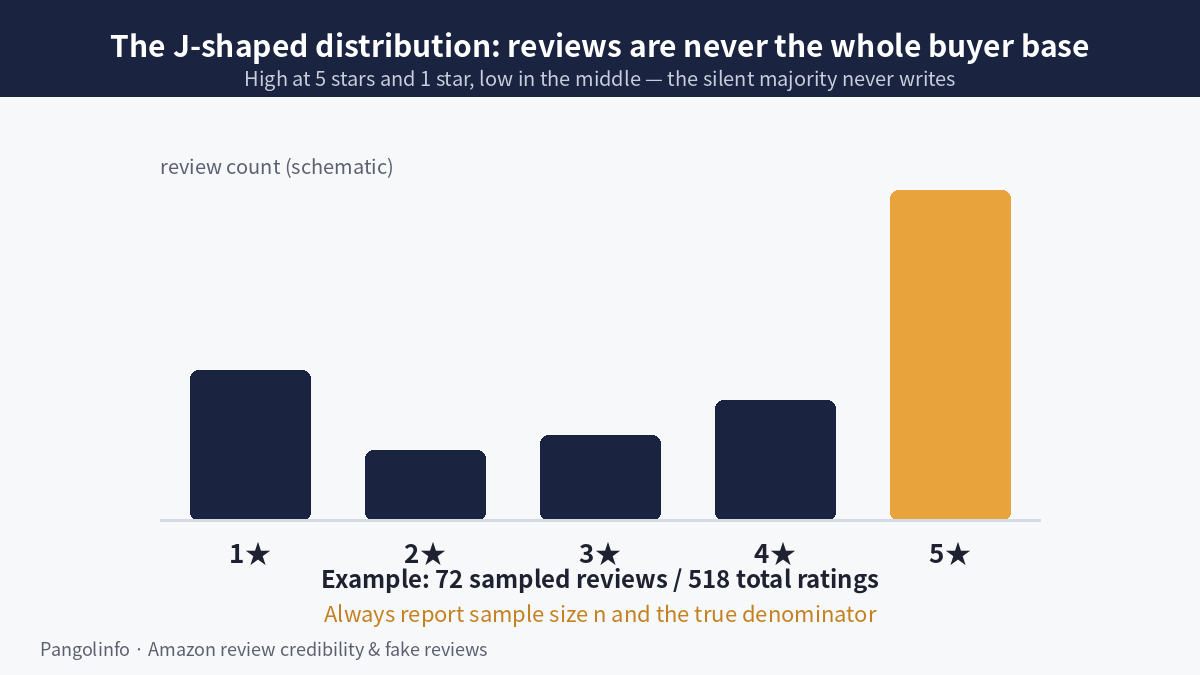
Every Amazon review corpus is a non-random, self-selected slice of your customer base, making percentage claims meaningless unless anchored to both sample size n and the true child-ASIN denominator.
The J-Shaped Distribution and the Invisible Silent Majority
Empirical e-commerce research by Hu, Pavlou, and Zhang established a foundational pattern in online product ratings: consumer reviews do not follow a bell-shaped normal distribution around a product’s true average quality. Instead, they form an asymmetric J-shaped bimodal distribution dominated by extreme 5-star praise on one end and acute 1-star anger on the other, with substantially thinner volume across 2-, 3-, and 4-star ratings.
Two overlapping selection filters create this distortion:
-
Purchasing bias: Shoppers who already expect to like a product—based on brand familiarity, price tier, or category affinity—are far more likely to buy it in the first place.
Under-reporting bias: Among buyers who complete an order, the vast majority whose expectations were simply met without dramatic delight or mechanical failure never return to leave a review. They form an invisible silent majority.
Because the silent majority leaves zero text behind, review shares never equal real-world population defect rates. If 24 percent of reviews on a portable blender are 1-star complaints about blade jamming, that does not mean 24 percent of all buyers experienced a jammed blade—it means 24 percent of the small, emotionally motivated minority who chose to write a review cited that failure. Conversely, a low 1-star share does not guarantee a trouble-free product if buyers are quietly returning items through Amazon’s automated returns portal without posting public feedback.
To prevent stakeholders from mistaking vocal minority shares for population statistics, enforce two reporting rules on every audit:
-
Always report both sample size n and the exact denominator: State the precise number of reviews analyzed alongside the total cumulative ratings on that specific child ASIN (for example, “19 out of n = 64 negative reviews, or 29.7 percent, cited lid leakage, drawn from 485 total ratings on child ASIN B0XXXXXXX”).
Never claim statistical significance for small qualitative slices: A working sample of 50 to 75 reviews is a practical operational threshold for spotting recurring failure patterns, not a statistically significant confidence interval across tens of thousands of unreviewed orders.
Page-One Sort Distortion and Single-Star Tunnel Vision
Operators who audit listings manually inside a browser introduce two additional layers of sampling bias before any analysis begins:
-
Default sort inertia (“Top Reviews”): Amazon’s default review feed ranks entries using a composite algorithm that weights historical helpfulness votes, media attachments, and review length alongside recency. Consequently, reviews written eighteen months ago—often reflecting an older factory tooling batch, superseded packaging, or an outdated listing description—frequently remain pinned to page one. An analyst who reads only the first two or three pages can easily miss a severe quality regression that began in last month’s production lot.
Single-star tunnel vision: Filtering exclusively for 1-star reviews captures maximum frustration but minimum diagnostic detail. A 1-star reviewer often posts a single angry sentence (“Junk, broke immediately, sending back”) that confirms failure without explaining the physical mechanism. By contrast, 3-star reviewers are typically measured evaluators who liked the core product enough to keep it—or seriously considered keeping it—and carefully document the exact ergonomic flaw, missing accessory, or instruction gap that blocked a higher rating. Excluding 3-star reviews discards the highest-density conversion and product-improvement telemetry in the corpus.
Cross-Variation Pooling Errors After the 2026 Variant Split
Between February 12 and May 31, 2026, Amazon rolled out category-by-category restrictions on variant review sharing, separating review pools across child ASINs that differ in functional attributes, capacities, or core hardware configurations. Despite this structural change, many internal reporting templates and third-party export scripts still roll review metrics up to the parent ASIN level.
Pooling reviews across distinct child variations after the 2026 split creates severe analytical blind spots:
-
Volume masking: A high-volume standard variation with 2,500 positive reviews easily dilutes 45 concentrated 1-star motor-failure reviews on a newly released Pro variation, making a critical SKU-level recall candidate look like minor background noise at the parent level.
Cross-spec attribution errors: Mixing feedback from a 110V North American model with a USB-C rechargeable model—or blending a slim-fit garment cut with a relaxed-fit cut—blurs defect percentages across incompatible bills of materials (BOMs), leaving engineering and merchandising teams unable to tell which SKU actually requires intervention.
Sentiment Analysis and AI Summary Limits: Four Blind Spots That Fool Teams
Automated sentiment scoring and generative AI summaries systematically misread buyer nuance, compress away low-frequency safety hazards, and completely ignore visual defect evidence embedded in customer photos and videos.
Sarcasm, Mixed Polarity, and Short-Review Misclassification
Across the Amazon analytics landscape in 2027, not a single SaaS vendor or VOC platform publicly discloses verified, reproducible accuracy benchmarks for its sentiment classification or topic-clustering models. When automated polarity models process real buyer prose, three linguistic patterns routinely corrupt their output:
-
Sarcasm and ironic praise: Buyers frequently express frustration using superficially positive adjectives (“Brilliant design—the power button fell inside the housing on day three” or “Love how it turns my countertop into a puddle every morning”). Lexicon-based and general-purpose transformer classifiers frequently score these entries as positive or neutral, burying real mechanical failures inside positive sentiment buckets.
Multi-topic mixed sentiment: Detailed 3- and 4-star reviews almost always combine genuine praise with specific defect warnings (“Fast shipping, sleek brushed aluminum shell, and great battery life, except the charging port sparks if you wiggle the cable”). Document-level sentiment averages compress opposing clauses into a bland neutral score, erasing the electrical hazard hidden in the second half of the sentence.
Low-context short reviews: Thousands of ratings consist of two- to five-word fragments (“Works as expected,” “Not what I thought,” “Okay for the price”). Automated topic models either drop these records entirely or force them into generic catch-all buckets that pad denominator percentages without adding actionable product insight.
More fundamentally, a sentiment score is not customer satisfaction or return propensity. Linguistic sentiment measures emotional tone in text, not operational risk. Ten mildly worded 2-star reviews noting that a replacement filter does not fit a standard housing carry far more commercial urgency than fifty exuberant 3-star reviews debating whether a shade of navy blue looks slightly darker indoors.
Second-Layer Compression: How AI Summaries Erase Low-Frequency, High-Severity Risks
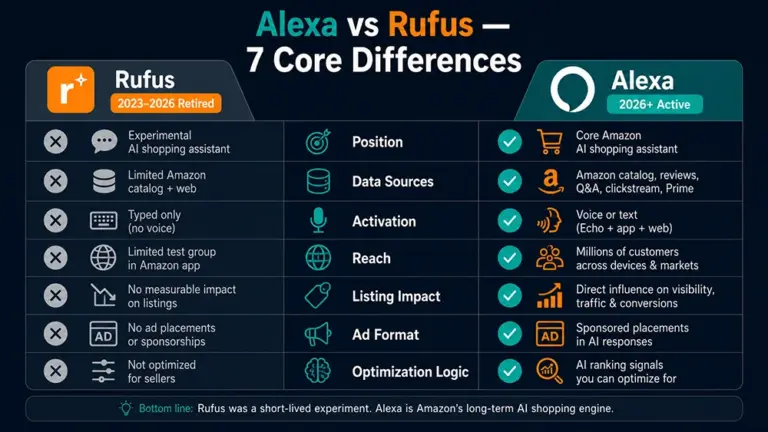
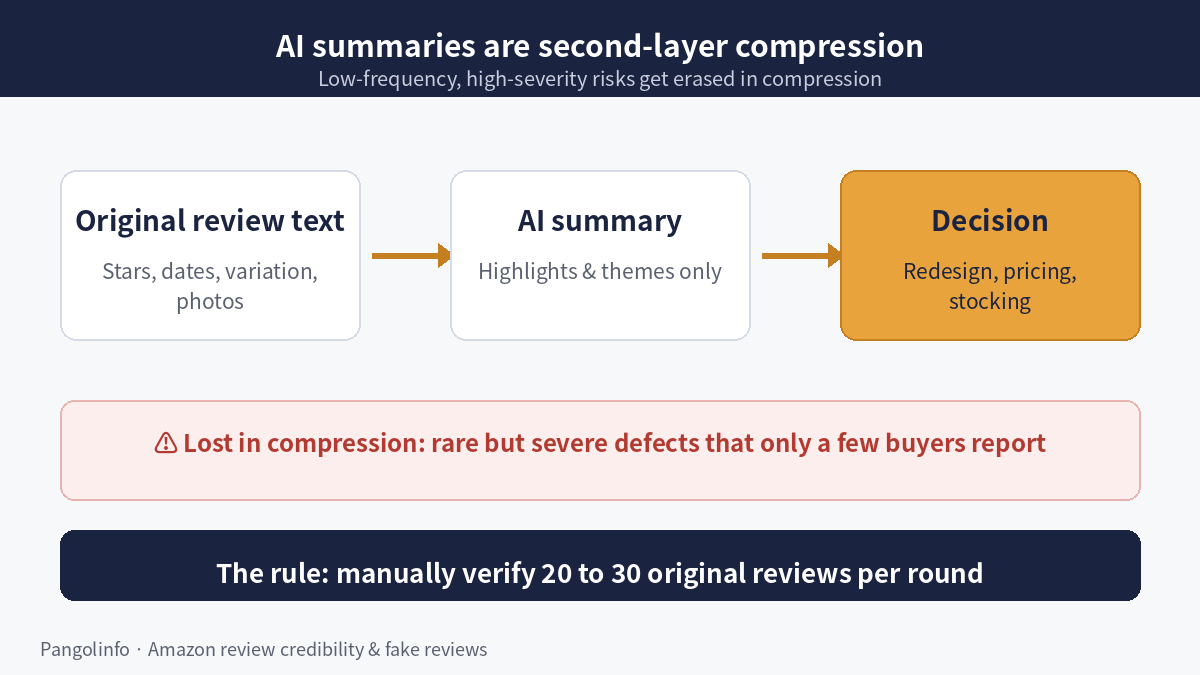
On May 13, 2026, Amazon rebranded its Rufus shopping assistant as Alexa for Shopping, expanding the prominence of AI-generated review highlights (“Customers say”) and conversational Q&A on product detail pages. Both Amazon’s on-page summaries and third-party AI clustering dashboards share a structural property: they perform second-layer compression.
-
First-layer compression: A buyer translates a complex, multi-week physical ownership experience into a short paragraph of text, inevitably omitting context they assume is obvious.
Second-layer compression: A statistical or generative language model condenses hundreds or thousands of those buyer paragraphs into three summary sentences or ten topic pills.
By mathematical design, second-layer compression rewards consensus frequency and discards statistical outliers. If 240 reviews praise a space heater’s quiet fan and compact footprint while 3 reviews report that the polarized plug grew hot enough to soften the outlet faceplate, generative summarization will spotlight quietness and size while completely omitting the thermal hazard. As emphasized in How to Analyze Amazon Negative Reviews, Safety & Health signals must always be isolated as P0 regardless of frequency. Relying on AI summaries to triage risk guarantees that low-frequency, high-severity hazards remain invisible until they trigger CPSC complaints or sudden ASIN suspension.
The Visual Blind Spot in Image and Video Reviews
Every commercial review analysis tool available in 2027 parses text strings and structured metadata—no tool automatically inspects, classifies, or extracts defect telemetry from customer-uploaded photos and unboxing videos.
In physical product categories such as home goods, consumer electronics, apparel, automotive accessories, and kitchenware, the most decisive root-cause evidence frequently lives inside buyer media rather than buyer prose. A reviewer frustrated by transit damage or poor quality control often writes five words (“Arrived like this, unbelievable”) and attaches three smartphone photos showing a crushed retail carton, an unsealed accessory pouch, or a hairline crack along an injection-mold seam. Text-only pipelines categorize that review as an uninformative short complaint, while a two-second glance at the attached photo immediately tells packaging engineering exactly which corner of the internal pulp tray failed during FBA transit.
Why Every Round Requires Manual Verification of 20 to 30 Original Reviews
Because automated classifiers cannot reliably decode sarcasm, multi-clause trade-offs, low-frequency hazards, or customer photography, every analytical cycle must enforce a non-negotiable human verification gate: manually read 20 to 30 original, unedited reviews across your top surfaced themes—and open their attached customer images and videos—before finalizing engineering or listing actions.
Spending twenty to thirty minutes reading primary-source records accomplishes what no dashboard parameter can: it calibrates whether the tool’s topic labels reflect actual buyer intent, separates user assembly errors from genuine part failures, and surfaces visual proof that product and packaging teams can act on immediately.
How to Spot Fake Amazon Reviews Without Falling for Detection Myths
Learning how to spot fake Amazon reviews requires triangulating behavioral, linguistic, and timing anomalies rather than trusting Verified Purchase badges or treating third-party checker scores as legal verdicts.
What Verified Purchase Proves—and What Checker Scores Cannot Guarantee
A widespread misconception among brand operators is that filtering a dataset exclusively for Verified Purchase reviews eliminates manipulated feedback. In reality, a Verified Purchase badge proves only one narrow technical fact: the posting account completed a paid order transaction for that ASIN on Amazon. It does not verify editorial independence or authentic consumer intent.
Coordinated manipulation networks routinely generate Verified Purchase reviews through off-Amazon rebate clubs, private messaging refund-after-review groups, gift-card inserts, and empty-box brushing schemes. Conversely, analysts must not confuse paid manipulation with legitimate early-review acquisition through Amazon Vine (where brands enroll products across Amazon’s USD 0, USD 75, and USD 200 tiers). Vine reviewers receive free units transparently through Amazon’s official program and disclose their Vine Voice status; while their critiques tend to be longer and more analytical than organic purchases, they are compliant program participants rather than fake reviewers and should simply be tagged separately in your working dataset.
At the same time, operators must maintain realistic expectations about third-party “fake review checker” browser extensions and scoring websites:
-
Checker scores are pattern clues, not verdicts: Grade letters or manipulation risk percentages generated by external checkers are heuristic estimates derived from surface signals such as reviewer overlap and posting bursts.
No 100 percent detection guarantee exists: Neither academic researchers nor commercial tool vendors can guarantee 100 percent detection of synthetic or incentivized reviews, and no commercial checker publicly discloses audited false-positive or false-negative accuracy rates. Use checker alerts solely as a triage flag to trigger closer manual inspection of suspicious ASINs—never as standalone proof to accuse a competitor or dismiss legitimate customer complaints on your own listing.
Four Empirical Recognition Signals for Manipulated Review Clusters
Drawing on peer-reviewed marketplace-integrity research and established trust-and-safety forensics, analysts can evaluate whether a target ASIN—either a competitor benchmark or an acquired catalog SKU—contains manipulated review clusters by cross-checking four observable signals:
| Signal Dimension |
Organic Buyer Baseline |
Manipulated Cluster Anomaly |
|---|---|---|
| 1. Reviewer-Profile Patterns |
Accounts show multi-year purchase histories across varied household categories, irregular review intervals, and mixed star ratings (1 to 5 stars). | Clusters of reviewer profiles created within tight date windows, posting almost exclusively 5-star reviews across the same narrow set of unrelated storefronts. |
| 2. Templated Language |
Specific nouns describing physical setup, fitment, room dimensions, trade-offs, and natural grammatical variation. | Generic, interchangeable superlatives (“Great quality, works perfect, fast delivery, highly recommend”) devoid of product-specific parts or usage context. |
| 3. Timing Clusters (Velocity Spikes) |
Daily review volume rises and falls proportionally with organic Best Sellers Rank (BSR), ad spend, and seasonal retail events. | Sudden vertical spikes in daily 5-star submissions during flat sales periods, often consisting of text-only or single-sentence entries posted hours apart. |
| 4. Anomalous Distribution Across Variations |
Review counts across child variations roughly align with category demand and inventory velocity (e.g., standard black outsells niche colors). | Discontinued models, obscure colors, or mismatched accessories hold hundreds of glowing reviews describing an entirely different product (zombie variation hijacking). |
When competitor benchmarking reveals two or more of these anomalies—such as a rival ASIN exhibiting a massive spike of templated 5-star reviews on an obsolete color variation—exclude those inflated ratings from your category baseline. Instead, anchor your product-definition research on the competitor’s detailed 2- to 4-star Verified Purchase reviews, where genuine buyers document real performance gaps.
Global Regulatory Boundaries: FTC 16 CFR Part 465 and UK CMA Commitments
Regulatory enforcement against deceptive review practices tightened substantially across major Western marketplaces ahead of 2027, turning review integrity from a platform-policy concern into a direct statutory liability:
-
United States — FTC Consumer Review Rule (16 CFR Part 465): Effective October 21, 2024, the Federal Trade Commission’s final rule formally prohibits buying or selling fake reviews, offering compensation or incentives conditioned on leaving a positive review or editing/removing a negative review, publishing undisclosed insider reviews from company employees or relatives, and using review gating or selective suppression to hide negative customer feedback. Violations carry civil penalties of up to USD 53,088 per violation.
United Kingdom — CMA Binding Commitments (June 6, 2025): On June 6, 2025, the UK Competition and Markets Authority (CMA) formally accepted legally binding commitments from Amazon to strengthen automated detection of fake reviews and catalog abuse (including review hijacking across unrelated listings), impose stricter sanctions on businesses and reviewers engaging in manipulation, and make it simpler for shoppers to report suspicious feedback.
For compliant brand operators, the operational takeaway is unambiguous: never attempt to offset a wave of negative reviews with incentivized positive reviews, never condition warranty replacements or refunds on review edits, and never deploy post-purchase funnels that divert unhappy buyers away from Amazon’s public review form. Durable rating recovery comes exclusively from fixing product defects, packaging vulnerabilities, and misleading listing claims.
Operationalizing Credibility: Audit Checklist and Uncertainty Log Template
Embedding a standardized credibility checklist and an explicit uncertainty log into every review report prevents decision-makers from mistaking directional text patterns for statistically complete market proof.
The 7-Point Review Analysis Credibility Checklist
Before circulating any review analysis deck, product requirements document (PRD), or supplier corrective action request (CAPA), audit your dataset against the seven verification checkpoints below:
| Checkpoint |
What to Verify |
Audit-Ready Reporting Standard |
|---|---|---|
| 1. Sample Size (n) |
Exact count of reviews read and coded in the working sample—never vague labels like “dozens of reviews.” | “Coded n = 72 critical reviews (1 to 3 stars) across the target audit window.” |
| 2. True Denominator |
Total cumulative ratings on the specific child ASIN at the exact timestamp of extraction. | “Sampled from 518 total ratings on child ASIN B0XXXXXXX as of January 15, 2027.” |
| 3. Time Window |
Start and end review_date boundaries, separating legacy inventory batches from post-fix production lots. | “Filtered strictly to reviews posted between July 1, 2026 and December 31, 2026.” |
| 4. Variation Isolation |
Confirmation that child-ASIN attributes were isolated following Amazon’s 2026 variant review sharing split. | “Isolated to the 32 oz Matte Black child ASIN; excluded 16 oz and Stainless variations.” |
| 5. Verified Purchase & Vine Share |
Exact percentage of Verified Purchase records plus explicit count of Amazon Vine Voice reviews. | “93.1 percent (67/72) Verified Purchase; includes 5 Vine Voice reviews tagged separately.” |
| 6. Image / Video Share |
Percentage of sampled reviews containing customer photos or videos, and whether media was manually inspected. | “26.4 percent (19/72) included buyer photos; all 19 were manually reviewed for physical defect confirmation.” |
| 7. AI-Summary vs. Raw-Text Spot Check |
Verification that 20 to 30 original reviews were read verbatim to audit automated clusters or AI highlights. | “Manually verified 25 original reviews across the top 3 themes; reclassified 3 sarcastic 5-star entries.” |
How to Write an Uncertainty Log for Executive and Engineering Reports
The fastest way to elevate the credibility of an internal analytics report is to add a concise, four-bullet Uncertainty Log at the end of your executive summary. Rather than undermining your findings, an explicit Uncertainty Log demonstrates analytical maturity and stops leadership from over-extrapolating small samples into high-risk capital commitments.
Use this structure when documenting data boundaries for product and operations stakeholders:
Uncertainty Log — Child ASIN B0XXXXXXX (Q4 2026–Q1 2027 Review Audit):
-
Self-Selection & Silent Majority Boundary: Findings are derived from n = 72 active 1- to 3-star reviews out of 518 cumulative ratings (13.9 percent of rated orders). Because non-reviewing buyers are unobservable, complaint shares represent directional theme concentration among vocal reviewers rather than population-wide defect rates or statistically significant confidence intervals.
Text-Only Mechanical Ambiguity: Among the 53 critical reviews lacking attached photos, 11 mentions of “slow charging” could not be definitively separated between defective USB-C cables and buyers using unrated low-wattage wall adapters; warehouse return teardown is required before modifying PCB specifications.
Competitor Baseline Distortion: Benchmark Competitor C exhibited an anomalous burst of 115 text-only 5-star reviews between November 10 and November 18, 2026, alongside templated phrasing patterns; those dates were excluded from competitor satisfaction comparisons, anchoring benchmarks on Competitor C’s Verified Purchase 2- to 4-star cohort.
Visual & Post-Fix Lag: Physical packaging improvements shipped to FBA on December 18, 2026, but legacy inventory sell-through overlap means reviews posted through early January 2027 still reflect mixed pre-fix and post-fix stock.
Closing the Loop With Transparent Raw Review Acquisition
Every credibility safeguard in this guide—isolating child ASINs after the 2026 variant split, filtering by exact review_date windows, tracking Verified Purchase and Vine flags, surfacing media attachments, and spot-checking 20 to 30 verbatim records—depends on having clean, un-truncated access to raw review records before any summarization takes place. When teams rely solely on closed black-box dashboards that cap ingestion at arbitrary limits or strip away child-variant metadata, auditing data credibility becomes impossible.
Reliable review analysis always presupposes solving structured review acquisition first. If your engineering or analytics team needs programmatic access to complete, un-truncated review fields—preserving exact star ratings, review dates, child-ASIN attributes, Verified Purchase badges, and media indicators—explore the Pangolinfo Amazon Review API (for current usage plans and billing details, check the official checkout page). To connect clean review extraction to your complete operational workflow, revisit our pillar guide, How to Analyze Amazon Reviews: A Complete SOP (2027), apply the defect triage matrix in How to Analyze Amazon Negative Reviews, compare platform sampling trade-offs in Best Amazon Review Analysis Tools Compared, or review technical field-collection workflows in How to Scrape Amazon Reviews for Complaint Analysis. (See the Review API reference docs.)
Frequently Asked Questions About Amazon Review Credibility and Fake Reviews
The five answers below address the most common methodological and compliance questions teams encounter when auditing review trustworthiness.
1. Does a Verified Purchase badge guarantee that an Amazon review is authentic?
No. A Verified Purchase badge proves only that the reviewer’s account completed a paid order transaction for that product on Amazon—it does not prove editorial independence or genuine consumer satisfaction. Incentivized reviews generated through off-Amazon rebate clubs, gift-card refunds, and empty-box brushing schemes still display the Verified Purchase badge. Always cross-check Verified Purchase reviews against timing clusters, reviewer profile patterns, and templated phrasing.
2. Why do AI review summaries miss critical product safety defects?
Generative AI summaries—including Amazon’s on-page “Customers say” highlights under Alexa for Shopping (renamed from Rufus on May 13, 2026) and third-party topic clusters—perform second-layer compression that amplifies high-frequency consensus and smooths out statistical outliers. If 200 buyers praise a product’s color while only 2 report an overheating plug or sharp metal edge, AI summaries routinely omit the hazard. Always audit low-frequency safety signals manually as P0 priorities.
3. Can third-party fake review checker scores prove that a competitor is cheating?
No. Third-party fake review checkers generate heuristic pattern clues based on surface anomalies such as posting velocity and reviewer overlap, not definitive verdicts. No tool offers 100 percent detection accuracy, and no vendor discloses audited false-positive rates. Treat checker scores strictly as directional flags to guide manual inspection of suspicious ASINs rather than conclusive proof of policy violations.
4. How should I report sample sizes so sampling bias does not mislead stakeholders?
Always state both the exact analyzed sample size n and the cumulative total review denominator on the specific child ASIN, alongside the collection date window and variation filter. Because reviews follow a J-shaped self-selected distribution that excludes the silent majority of satisfied buyers, never present 50 to 75 qualitative reviews as statistically significant population proof, and attach an Uncertainty Log summarizing known data limits.
5. What are the legal risks of incentivizing review edits or filtering negative feedback?
Under the U.S. FTC Consumer Review Rule (16 CFR Part 465), effective October 21, 2024, offering compensation or replacements conditioned on positive reviews or negative-review edits, posting undisclosed insider reviews, and suppressing negative reviews via review gating carry civil penalties of up to USD 53,088 per violation. In addition, Amazon’s June 6, 2025 binding commitments to the UK CMA enforce strict sanctions against review manipulation and variation hijacking.