

Choosing among the best Amazon review analysis tools is not a search for a single top-ranked software winner—it is an operational matching exercise that pairs a specific business job with the right combination of sampling scope, evidence traceability, and pricing structure. As established in our series pillar guide, How to Analyze Amazon Reviews: A Complete SOP (2027), no commercial review analysis platform on the market is scientifically complete, and not a single software vendor publicly discloses verified accuracy benchmarks for its sentiment classification or topic-clustering models. Every automated chart generated by any tool must therefore be treated as a directional triage aid backed by mandatory manual verification of 20 to 30 original customer reviews per analytical round.
While our pillar SOP defines the end-to-end six-step workflow and 14-field data architecture across all rating tiers, and our second playbook, How to Analyze Amazon Negative Reviews, details the eight-category defect taxonomy and 5 Whys investigation method for 1- to 3-star feedback, this guide focuses strictly on tool selection. In day-to-day e-commerce operations, product managers and brand operators frequently discover that running the exact same ASIN through three different review tools produces three conflicting lists of top customer complaints. Rather than declaring an artificial leaderboard, this 2027 framework shows how each major platform samples data, proves its claims with raw text, and fits into distinct operational workflows.
Why Leaderboard Rankings Fail for Amazon Review Analysis Tools in 2027
Traditional software roundups that rank review tools from first to tenth ignore structural differences in data access, sampling caps, and child-ASIN granularity that determine whether an output is trustworthy for real product decisions.
When feature checklists drive purchasing decisions, teams routinely buy multi-purpose suites whose review modules quietly truncate large review pools or obscure variant-level defects. Two major Amazon marketplace shifts in 2026 made superficial tool comparisons especially risky for 2027 brand operations.
How 2026 Platform Shifts Exposed Tool Blind Spots
Between February 12 and May 31, 2026, Amazon implemented a category-by-category split in variant review sharing, restricting cross-variation review pooling across child ASINs that differ in functional specifications, capacities, or core configurations. A defective secondary size or hardware configuration can no longer hide behind the review count of a bestselling flagship variation; its critical feedback accumulates directly on its own child detail page. Any analysis tool that aggregates reviews exclusively at the parent ASIN level—or fails to preserve child-ASIN variant attributes alongside review text—will mask acute single-SKU quality failures behind a healthy parent average.
On May 13, 2026, Amazon also rebranded its Rufus shopping assistant as Alexa for Shopping, deepening how conversational AI and on-page “Customers say” review highlights synthesize buyer feedback at the point of purchase. Shoppers now ask Alexa for Shopping targeted pre-purchase questions about durability, sizing accuracy, and component compatibility. If an analysis tool only outputs vague sentiment labels such as “mixed quality” or “poor value” without surfacing the exact physical attributes buyers mention, teams cannot align their product fixes or listing copy with the signals Amazon’s own retail assistant surfaces to shoppers.
Why Undisclosed Model Accuracy Makes “Smartest AI” Claims Meaningless
Across the Amazon SaaS ecosystem, vendors frequently market proprietary AI engines capable of decoding buyer emotion and intent. Yet as of 2027, no vendor discloses verified, reproducible accuracy metrics for its sentiment scoring or topic clustering.
This omission reflects an inherent linguistic challenge in consumer reviews. E-commerce language is heavily context-dependent: describing a winter parka as “heavy” is strong praise for insulation, whereas describing a portable travel mug as “heavy” is a portability complaint. Sarcasm (“Brilliant engineering—the lid cracked on the very first wash”) routinely fools automated polarity classifiers, and multi-topic reviews often combine 5-star praise for shipping speed with a 1-star warning about electrical overheating. Because model precision is neither standardized nor audited, a tool’s value depends far less on its AI branding than on how many reviews it actually ingests and how fast it lets a human analyst inspect the underlying source text.
The Non-Negotiable Rule: Manual Verification of 20 to 30 Original Reviews Per Round
Regardless of which software platform your team selects, every analytical cycle must include a strict quality gate: manually reading 20 to 30 original, unedited reviews across the top surfaced themes before approving engineering changes, packaging revisions, or listing rewrites. Twenty minutes of primary-source reading exposes misgrouped topics, catches sarcastic false positives, and reveals the nuanced usage conditions hidden inside 3-star reviews that automated summaries routinely flatten.
The Three-Dimension Evaluation Framework: Sampling, Evidence, and Pricing Models
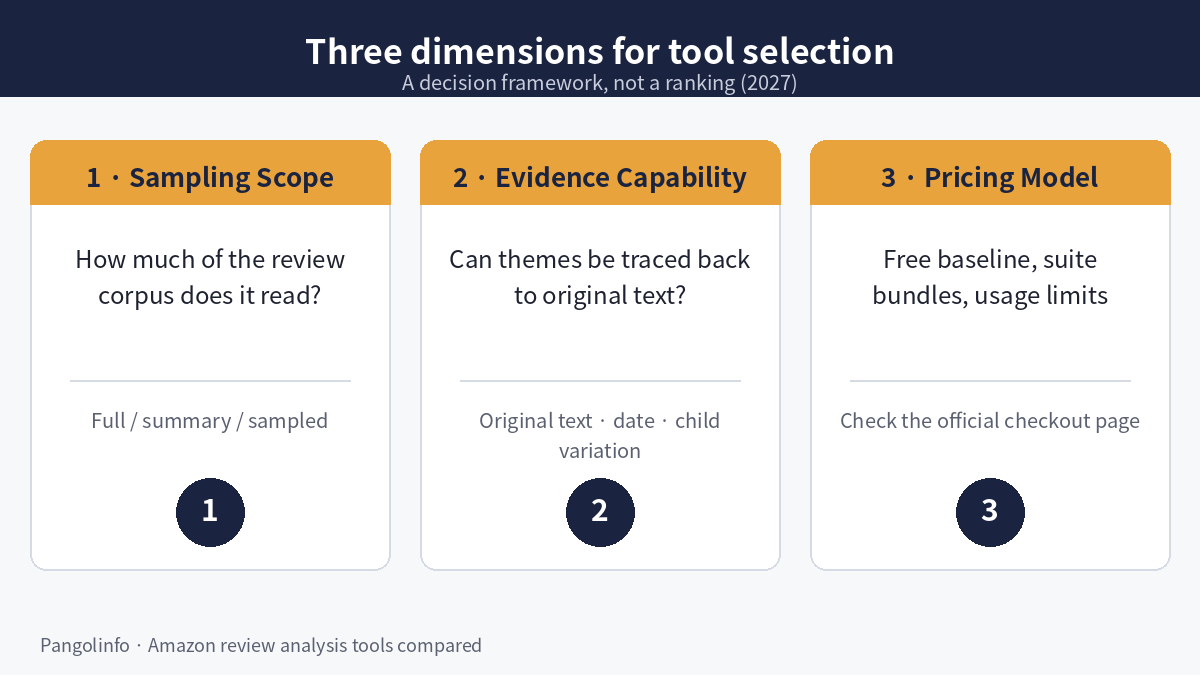
Evaluating any Amazon review analysis tool across three objective dimensions—sampling scope, evidence capability, and pricing model—immediately reveals what the software can prove and where its blind spots begin.
When assessing a tool for your team, always interrogate sampling scope first and evidence traceability second, before considering dashboard aesthetics or secondary workflow integrations.
Dimension 1: Sampling Scope (How Much of the Review Corpus Does It Read?)
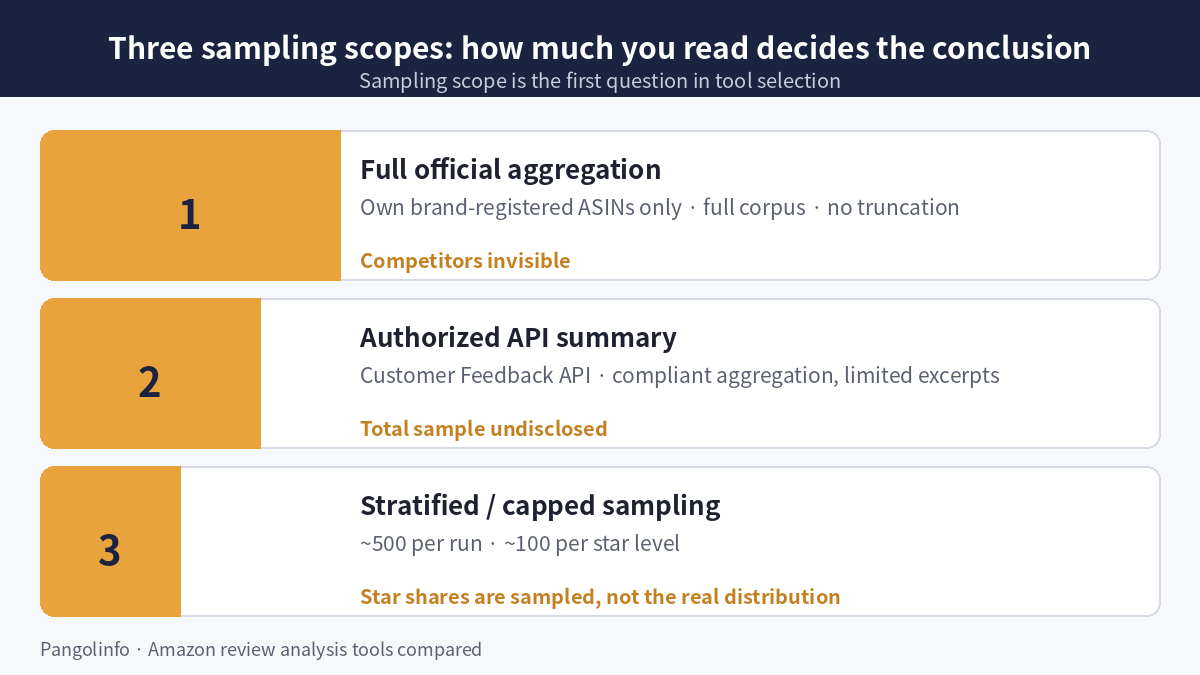
Sampling scope answers the most fundamental question in data analysis: When a tool reports that 24 percent of buyers complain about battery life, 24 percent of what? Commercial tools rely on three distinct ingestion architectures, each carrying different statistical implications:
-
Full First-Party Corpus: Available exclusively inside Amazon Seller Central for brand-registered ASINs, where Amazon computes metrics across 100 percent of historical orders, returns, and submitted reviews. There is zero external scraping truncation, but visibility stops completely at your own catalog boundary.
Official API Aggregations: Tools connected to Amazon’s official Selling Partner Customer Feedback API receive structured topic aggregations directly from Amazon. While data provenance is completely compliant and stable, Amazon’s API returns pre-aggregated topic summaries rather than raw review dumps, leaving the exact underlying review sample size undisclosed to the end user.
Capped or Stratified Scraping Slices: Many browser extensions and third-party analytics platforms do not ingest every historical review on a multi-thousand-review listing. Instead, they pull a capped working sample—for instance, reading roughly 500 reviews per run and capping collection at around 100 reviews per star rating. Stratified caps are highly effective for surfacing buried negative themes on high-rating products, but they produce an artificially flattened star distribution that must never be mistaken for an ASIN’s true overall rating mix.
Dimension 2: Evidence Capability (Can Themes Be Traced Back to Original Text?)
Evidence capability measures whether an abstract topic label can be audited, verified, and routed into cross-functional engineering or operations tickets. A high-evidence tool satisfies three criteria:
-
Direct Excerpt and Full-Text Traceability: Clicking a theme tag such as “valve leakage” should immediately display the verbatim customer quotes behind that cluster. Seeing the exact wording tells engineers whether the leak occurs at the threaded cap, the silicone gasket, or the spout hinge—distinctions no high-level tag can convey on its own.
Preservation of Critical Metadata: Reliable root-cause investigation requires knowing when a review was posted (to separate legacy defects from post-fix production batches), whether it carries a Verified Purchase badge, whether it originated from an Amazon Vine enrollment, and which specific child variation (color, size, pack count) the buyer purchased.
Structured Data Export: If findings remain locked inside a proprietary web interface, analysts cannot apply custom prioritization weights—such as the frequency-by-star-harm scoring model detailed in How to Analyze Amazon Negative Reviews—nor can they maintain longitudinal 30-day recovery logs across product iterations. CSV exports or programmatic API feeds are essential whenever findings must feed internal QA or product-management systems.
Dimension 3: Pricing Model Boundaries (Why You Must Check the Official Checkout Page)
Amazon analytics vendors package review analysis under vastly different commercial structures: zero-cost native Seller Central modules, bundled all-in-one seller suites billed by seat or monthly task credits, and enterprise VOC workspaces metered by ASIN volume or API throughput. Because vendors frequently adjust tier limits, credit allowances, and bundled add-ons, this guide never quotes fixed subscription numbers; for current plans, seat allocations, and billing terms on any commercial platform listed below, check the official checkout page.
When comparing commercial plans internally, evaluate total operational cost around three practical constraints rather than headline monthly fees: how many unique child ASINs can be analyzed per month, whether bulk CSV export is restricted to higher tiers, and how many team members can access shared workspaces without seat-level bottlenecks.
Side-by-Side Comparison of the Best Amazon Review Analysis Tools (2027)
Each major tool in the 2027 Amazon review ecosystem occupies a distinct operational niche, trading off between official first-party compliance, sampling depth, excerpt granularity, and cross-competitor reach.
The comparison matrix below summarizes verified capabilities across the six core review-analysis platforms and baselines, followed by an objective breakdown of their strengths and structural limitations. (Market-intelligence platforms DataDive and SmartScout are also useful as market-intelligence side tools for niche scoping and brand share mapping, though they are not dedicated review-text diagnostic engines.)
| Tool / Platform | Sampling Scope & Data Source | Evidence Capability & Export | Pricing Model & Core Boundary |
|---|---|---|---|
| Amazon Native Free Baseline (Customer Review Insights, Voice of the Customer, AI Review Highlights) | Full first-party Amazon corpus; most credible baseline; limited to own brand-registered ASINs (on-page highlights public) | Displays topic sentiment drivers and return/defect health; no cross-ASIN competitor analysis and no raw review export | Free inside Seller Central; best baseline anchor, unsuitable for competitor benchmarking |
| Helium 10 Review Insights | Driven by Amazon’s official Customer Feedback API; covers 7 marketplaces; tracks 6-month trends; sample size undisclosed | Themes paired with up to 3 review excerpts each; supports CSV export | Paid Helium 10 subscription; for current tiers and pricing, check the official checkout page |
| Jungle Scout Review Sentiment (Ask Cobalt + MCP) | Reads reviews at scale (specific review cap not published); supports multi-ASIN competitor comparisons | Groups feedback into complaints, praise, and feature requests; queryable via Ask Cobalt and MCP | Enterprise/brand analytics tier; for current plans and pricing, check the official checkout page |
| SellerSprite AI Review Analysis 2.0 | Reads about 500 reviews per run, at most about 100 per star level; star chart is not the full distribution | 7-layer structured breakdown (user profile, scenarios, pain points, motivators) with source review inspection | Paid SellerSprite subscription; for current tiers and pricing, check the official checkout page |
| ZonGuru Love-Hate | Extracts recurring positive and negative phrases from target ASINs; underlying sample cap undisclosed | Splits feedback into positive (“Love”) and negative (“Hate”) theme lists with associated review snippets | Paid ZonGuru subscription; for current plans and pricing, check the official checkout page |
| VOC.AI (Shulex) | Cross-ASIN clustering; vendor claims 2B+ reviews in database (unverified vendor claim—do not treat as fact) | Pain-point clustering + priority matrix, verbatim review drill-down, plus API and MCP support | SaaS and enterprise plans; for current tiers and pricing, check the official checkout page |
1. Amazon Native Free Baseline: Customer Review Insights, Voice of the Customer, and AI Review Highlights
Amazon’s native toolkit comprises three complementary first-party surfaces: Customer Review Insights inside Brand Analytics, Voice of the Customer (VOC) inside Seller Central’s Performance dashboard, and public AI Review Highlights (“Customers say”) rendered directly on product detail pages.
-
What It Does Best: This native suite is the most credible baseline available anywhere in the ecosystem. Because Amazon computes these metrics directly against complete order logs, return reasons, and 100 percent of submitted reviews, there is zero sampling distortion or scraping gap. Furthermore, following the May 13, 2026 rebrand of Rufus to Alexa for Shopping, monitoring your own detail page’s “Customers say” attribute pills shows you the exact positive and negative themes Amazon’s retail AI presents to high-intent shoppers.
Where It Falls Short: Amazon enforces a strict data boundary around its native dashboards. Beyond reading public “Customers say” summaries on rival detail pages, you get no cross-ASIN analysis to benchmark competitor defect rates, and there is no export capability to download raw review text alongside topic tags for external engineering triage or custom spreadsheet modeling.
2. Helium 10 Review Insights: Official API Stability With Strict Excerpt Caps
Helium 10’s Review Insights module is driven directly by Amazon’s official Customer Feedback API, operating across 7 marketplaces and providing 6-month trends that show whether specific customer topics are rising or declining over time.
-
What It Does Best: Because it pulls from Amazon’s authorized Selling Partner API rather than fragile front-end page scraping, data delivery is reliable, compliant, and clean. The 6-month trend view is particularly helpful after a listing update or packaging tweak, allowing operators to verify whether negative mentions of a target topic have begun trending downward. It also supports CSV export, enabling analysts to archive topic metrics into monthly reporting decks.
Where It Falls Short: Amazon’s Customer Feedback API imposes tight structural limits on raw text exposure. Each surfaced theme is accompanied by up to 3 excerpts each, and the exact underlying sample size is undisclosed. When a complex hardware or apparel SKU accumulates dozens of nuanced 2- and 3-star complaints, three illustrative snippets are rarely sufficient to diagnose multi-step failure chains without supplementing the run with direct review inspection. For current plan access and pricing, check the official checkout page.
3. Jungle Scout Review Sentiment (Ask Cobalt + MCP): At-Scale Thematic Bucketing for Competitor Comparison
Jungle Scout’s Review Sentiment capability—accessible inside Ask Cobalt and through the Jungle Scout MCP (Model Context Protocol) connector—is built for brand and category teams comparing feedback across multiple ASINs simultaneously.
-
What It Does Best: Review Sentiment reads review text at scale (Jungle Scout does not publish a specific numerical cap on reviews ingested per query) and automatically organizes unstructured feedback into three practical operational buckets: complaints, praise, and feature requests. Having a dedicated “feature requests” bucket alongside multi-ASIN competitor comparison makes it well suited for product managers scoping whitespace opportunities before committing to tooling or formulation changes. Integrating via MCP also allows analysts to query sentiment shifts inside existing AI workflows.
Where It Falls Short: Because exact ingestion boundaries and model classification accuracy are not publicly disclosed, teams cannot treat the resulting bucket counts as exact population statistics. Any major product-roadmap claim generated across competitor ASINs still requires pulling 20 to 30 underlying reviews per competitor to verify that “feature requests” reflect genuine buyer demand rather than isolated outlier wishes. For current enterprise and brand pricing, check the official checkout page.
4. SellerSprite AI Review Analysis 2.0: Deep 7-Layer Qualitative Breakdown via Stratified Sampling
SellerSprite’s AI Review Analysis 2.0 structures customer feedback into 7 analytical layers—covering user demographics, usage scenarios, unmet expectations, pain points, core purchase drivers, and product strengths—making it popular among product development teams seeking granular qualitative context.
-
What It Does Best: Its sampling architecture solves a persistent headache on mature, high-volume listings: by analyzing about 500 reviews per run capped at at most about 100 per star level, the tool guarantees that 1-star, 2-star, and 3-star reviews receive equal analytical airtime even on an ASIN buried under 8,000 five-star ratings. That balanced star slice makes it fast to extract detailed 3-star buyer reservations and edge-case failure descriptions.
Where It Falls Short (Critical Sampling Trap): Because SellerSprite caps ingestion at roughly 100 reviews per star tier, its star distribution is NOT the full distribution of the ASIN. If a product has 4,500 five-star reviews and 95 one-star reviews, a capped 500-review run will display roughly equal bars across star ratings—making a 2 percent defect rate appear visually like a 20 percent crisis. Operators must never copy the tool’s internal star-distribution chart into executive reports as a measure of true defect incidence; always record the real child-ASIN star counts separately. For current subscription details and pricing, check the official checkout page.
5. ZonGuru Love-Hate and VOC.AI (Shulex): Rapid Polarity Scans vs. Enterprise VOC Matrices
Two additional specialized tools frequently enter buyer shortlists for very different operational scales:
-
ZonGuru Love-Hate: Designed for speed and simplicity, Love-Hate distills an ASIN’s review pool into clear positive (“Love”) and negative (“Hate”) themes. It works well as a lightweight pre-launch or listing-copy check when a copywriter wants to verify which product benefits resonate most strongly with category shoppers and which recurring annoyances should be preempted in bullet points or A+ Content. Underlying sample caps and model accuracy are undisclosed; for current subscription pricing, check the official checkout page.
VOC.AI (Shulex): Built specifically around Voice-of-the-Customer workflows, VOC.AI provides automated pain-point clustering, a priority matrix mapping issue volume against rating impact, cross-ASIN competitor benchmarking, and API / MCP connectivity for automated reporting pipelines. When evaluating vendor marketing materials, maintain strict analytical discipline: the vendor claims a historical dataset of 2B+ reviews, which is an unverified vendor self-claim and must not be treated as an established fact. As with every commercial platform, verify sample boundaries on your target ASINs manually, and check the official checkout page for current plan pricing and API quotas.
Job-to-Tool Decision Matrix: Matching the Right Tool to Your Workflow
Because no single platform excels at every sampling depth and export requirement, high-performing Amazon teams assign specific tools to specific operational jobs rather than forcing one dashboard to handle everything.
Use the four workflow pairings below to match your immediate business objective to the right tool stack.
Job 1: Quick Listing Health Check and Weekly ASIN Monitoring
-
Operational Goal: Confirm whether a recent dip in conversion rate or star average stems from an emerging defect cluster, and check how Amazon’s front-end summaries characterize your child ASIN.
Recommended Stack: Start with the Amazon native free baseline—check Seller Central’s Voice of the Customer health status, review Customer Review Insights, and inspect the live detail page’s AI Review Highlights (“Customers say”). Pair this with Helium 10 Review Insights to check 6-month trends on your child ASIN and export a quick CSV snapshot for weekly tracking.
Verification Step: Sort your live product reviews by “Most recent” and manually read the latest 20 to 30 reviews rated 1 to 3 stars to confirm whether complaints point to a specific recent fulfillment batch or carrier damage.
Job 2: Deep Product Redesign and Defect Root-Cause Diagnosis
-
Operational Goal: Audit an underperforming SKU to isolate physical failure modes, misleading listing expectations, or missing accessories, and translate findings into engineering and packaging work orders.
Recommended Stack: Run SellerSprite AI Review Analysis 2.0 to pull a balanced slice (about 100 reviews per star level within its ~500-review run) across its 7 qualitative layers, ensuring 3-star analytical reviews are fully represented alongside 1-star failures. Re-classify the exported complaints into the eight standardized categories from How to Analyze Amazon Negative Reviews, rank them using frequency multiplied by star harm (locking any Safety & Health signal at P0), and execute a 5 Whys teardown.
Verification Step: Pull 20 to 30 verbatim reviews inside the #1 ranked failure cluster to verify exact usage conditions, and record the true child-ASIN total review count as your denominator rather than SellerSprite’s capped star distribution.
Job 3: Multi-Competitor Benchmarking and New Product Definition
-
Operational Goal: Analyze 3 to 5 competing ASINs prior to product sourcing or industrial design to identify category-wide complaints you can engineer out of your version.
Recommended Stack: Use DataDive or SmartScout as market-intelligence side tools to identify the true functional child-ASIN competitors in your niche. Then run Jungle Scout Review Sentiment (via Ask Cobalt or MCP) to compare complaints, praise, and feature requests across those competitors, or use VOC.AI (Shulex) to generate a cross-ASIN pain-point clustering and priority matrix. If you only need rapid copywriting hooks for listing differentiation, supplement with ZonGuru Love-Hate.
Verification Step: Following the February 12 to May 31, 2026 variant review sharing split, double-check that every competitor ASIN in your comparison matches your exact functional configuration so you do not build product specs around complaints aimed at a completely different model size or capacity.
Job 4: Multi-SKU Variant Governance and Automated Post-Fix Tracking
-
Operational Goal: Track dozens of child ASINs across monthly production batches, measuring whether post-fix buyer cohorts show a measurable drop in specific complaint shares 30 days after an engineering or packaging change ships.
Recommended Stack: Pre-built SaaS dashboards hit structural ceilings here—either because sample sizes are undisclosed, excerpts stop at 3 quotes per theme, or fixed 500-review caps cannot be filtered cleanly by exact post-fix review_date windows. At this scale, teams move from point-and-click extensions to structured raw-review ingestion pipelines connected directly to internal spreadsheets or BI tables.
Operational Guardrails and Closing the Review Data Acquisition Loop
Even the best Amazon review analysis tools deliver zero commercial return unless outputs are reported with transparent sample denominators, acted upon within strict FTC and Amazon compliance rules, and fed by clean underlying review data.
Before publishing an internal review audit or launching a post-analysis customer outreach campaign, enforce three operational guardrails across your team:
-
Report Transparent Denominators on Every Slide: Never present an unanchored percentage such as “31 percent of customers hate the power cord.” Always state the exact sample size (n), the rating filter, the child ASIN, and the full review denominator—for example: “Out of n = 65 negative reviews (1 to 3 stars) sampled from 412 total ratings on child ASIN B0XXXXXXX between July and October 2026, 20 reviews (30.8 percent) cited cord stiffness.”
Respect FTC and Amazon Review-Integrity Boundaries: Insights uncovered through review analysis must be resolved through genuine product, packaging, and listing improvements—never through review manipulation. Under the FTC Consumer Review Rule (16 CFR Part 465), which carries civil penalties of up to 53,088 USD per violation, alongside Amazon’s Customer Reviews Policy, brands must never offer refunds, replacements, or gift cards in exchange for editing or removing a negative review, never contact reviewers outside approved channels to request rating changes, and never use review gating to suppress critical feedback.
Solve Clean Review Acquisition Before Scaling Analysis: Every comparison in this guide points to the same underlying bottleneck: an analysis tool is only as reliable as the review corpus it can access. When fixed sampling caps, undisclosed API denominators, or missing child-ASIN variant tags prevent your team from auditing complete review cohorts, the constraint is no longer the clustering algorithm—it is raw data acquisition.
If your product or data engineering team needs reliable, structured review records—complete with exact star ratings, review dates, verified-purchase flags, and child-ASIN attributes—without fighting front-end extension caps, explore the Pangolinfo Amazon Review API (for current usage plans and billing details, check the official checkout page). To connect your extracted data into a repeatable monthly operating rhythm, revisit our pillar guide, How to Analyze Amazon Reviews: A Complete SOP (2027), apply the defect triage framework in How to Analyze Amazon Negative Reviews, or review technical field-extraction patterns in How to Scrape Amazon Reviews for Complaint Analysis. (See the Review API reference docs.)
Frequently Asked Questions About Amazon Review Analysis Tools
The five answers below clarify the most common methodological and purchasing questions teams ask when comparing review analysis platforms.
1. Which Amazon review analysis tool has the highest AI accuracy?
None can be ranked by accuracy because no vendor publicly discloses verified, reproducible accuracy benchmarks for its sentiment scoring or topic clustering. E-commerce reviews contain heavy sarcasm, domain-specific vocabulary, and mixed-rating nuances that cause automated models to misclassify edge cases. Treat any tool’s topic clusters as preliminary triage signals, and manually verify 20 to 30 original reviews per theme before making product or listing changes.
2. Why does SellerSprite AI Review Analysis 2.0 show a different star breakdown than the Amazon product page?
SellerSprite AI Review Analysis 2.0 ingests roughly 500 reviews per run and caps collection at roughly 100 reviews per star level. That stratified cap ensures 1- to 3-star complaints are visible even on listings with thousands of 5-star reviews, but it creates an artificially flattened star distribution. Never use that internal chart as your true defect rate; always record the child ASIN’s actual total star counts separately.
3. If Amazon provides free review insights in Seller Central, why use third-party tools?
Amazon’s native Customer Review Insights and Voice of the Customer dashboards provide the most credible first-party baseline because they compute across 100 percent of your brand’s orders and reviews. However, native tools cover only your own brand-registered ASINs, offer zero cross-ASIN competitor analysis, and do not let you export raw review text with tags for external root-cause modeling or custom prioritization.
4. What should I check first when evaluating any review analysis tool?
Check sampling scope first and evidence traceability second. Confirm how many reviews the tool actually reads per run, whether it isolates specific child ASINs after Amazon’s 2026 variant review sharing split, whether every topic cluster links back to verbatim customer quotes with review dates, and whether you can export structured CSV files for downstream engineering tracking.
5. How much do these Amazon review analysis tools cost?
Pricing structures vary widely across free Seller Central baselines, all-in-one seller suites billed by seat or monthly task quota, and enterprise VOC platforms metered by ASIN volume or API throughput, and vendors update their tiers regularly. Because specific plan limits change over time, check the official checkout page for each tool to confirm current pricing and export entitlements.