
AI Amazon Product Research
Using AI for Amazon product research and consistently receiving elaborate, well-structured advice that is completely unactionable—this is the most frequent complaint I have heard from sellers over the past six months. The root cause is not that large language models lack intelligence. It is that you have given them a supercomputer brain without supplying any reliable intelligence about current market conditions. Without real-time BSR rankings, keyword competition landscapes, or ad placement distributions, even the most capable LLM can only speculate based on outdated training data. To make AI genuinely understand Amazon and deliver executable product recommendations, the essential prerequisite is building a stable, real-time, and comprehensive data pipeline.
Why Do AI Product Research Conclusions Keep Missing the Mark?
Where Exactly Are the Knowledge Boundaries of Large Language Models?
Current mainstream LLMs operate with explicit knowledge cutoffs, typically ranging from several months to over a year behind the present moment. For a marketplace as dynamic as Amazon, this means the model possesses almost no awareness of current competitive dynamics, pricing levels, or shifting consumer preferences. When you ask GPT-4 or Claude whether stainless steel water bottles still represent a viable opportunity, the model can only construct a generic framework based on historical patterns embedded in its training data. The response inevitably includes eternally correct yet practically useless guidance like “focus on product quality” and “differentiate your offering.”
According to Jungle Scout’s 2025 Seller Survey, 78% of Amazon sellers reported experimenting with ChatGPT or similar tools for product research assistance. Yet only 12% found the AI-generated conclusions significantly helpful for actual decision-making. This massive gap exists because AI possesses remarkable reasoning capabilities but lacks the real-time factual foundation required for that reasoning to produce relevant results.
What Intelligence Does Product Research Actually Require?
A thorough product evaluation demands real-time data across at least six dimensions. First, market capacity: understanding the sales volume distribution among top BSR performers in the target category to judge the revenue ceiling. Second, competitive intensity: analyzing brand concentration, review quantity barriers, and pricing strategies among the top twenty sellers. Third, trend identification: New Releases chart movements and velocity often reveal market direction more accurately than static sales figures. Fourth, traffic structure: organic search positions and SP ad placement distribution for core keywords determine exposure difficulty and acquisition cost. Fifth, profit margin: real-time competitor pricing, promotional frequency, and FBA fees collectively form the pricing reference framework. Sixth, user feedback: review sentiment patterns, recurring pain points, and unmet needs surfacing in customer questions provide direct input for product improvement.
Missing any single dimension among these six can lead to severely skewed conclusions. The traditional approach of pasting a few competitor screenshots or text descriptions into a chat interface falls hopelessly short of covering these data requirements.
Why Can’t Traditional Product Research Tools Satisfy AI’s Data Appetite?
The Fundamental Mismatch Between Pre-Aggregated Reports and AI Analysis
Most sellers follow a heavily tool-dependent path for data acquisition. Platforms like Jungle Scout, Helium 10, and SellerSprite certainly provide rich Amazon data. However, their output is optimized for human consumption in the form of pre-aggregated reports: fixed metric dimensions, visual charts, and preset filter conditions. This format is not designed for AI consumption. You cannot simply drop a Jungle Scout competitor analysis page into a large language model and expect it to extract systematic competitive landscape insights.
Even when manually copying portions of data into an AI prompt, the process faces three structural problems. First, timeliness constraints: mainstream research tools typically refresh data on a daily or weekly cycle, which proves inadequate for tracking rapidly shifting new product opportunities. Second, data fragmentation: different tools cover different data dimensions, forcing sellers to stitch information across platforms—a process that interrupts the very workflow automation that AI excels at. Third, prohibitive interaction costs: each research cycle demands manual data export, format cleanup, prompt composition, and result interpretation, preventing the creation of reusable automated workflows.
How API Data Access Differs Fundamentally from Traditional Tools
Compared to conventional research tools, API-based data collection offers transformative advantages across three dimensions. On timeliness, professional Amazon scraping APIs can achieve minute-level updates, capturing market micro-fluctuations invisible to traditional tools. On flexibility, APIs return structured JSON data that AI can parse and analyze directly without human intermediation or format conversion. On scale, APIs support batch parallel collection, retrieving complete information for hundreds of ASINs in a single request—an efficiency level no manual operation can approach.
Yet APIs still require technical expertise to invoke and integrate. For users seeking to embed data collection deeply within AI workflows, an ideal solution would be plug-and-play integration. This is precisely the design philosophy behind the Pangolinfo Amazon Scraper Skill.
How Does Pangolinfo Amazon Scraper Skill Close the AI Product Research Data Loop?
What Is Amazon Scraper Skill?
Pangolinfo Amazon Scraper Skill is an Agent Skill built on the MCP (Model Context Protocol) that encapsulates full-dimension Amazon data collection capabilities into tools directly callable by AI Agents. In practical terms, it gives your AI assistant the ability to “read” Amazon’s real-time market state. When you ask your AI to “analyze the competitive landscape of this category,” the Agent autonomously invokes the Skill to collect current chart data, price distributions, review statistics, and ad placement information, then generates analysis based on these live intelligence feeds.
This workflow fundamentally transforms the information flow in AI-assisted product research. Instead of “human finds data, human formats data, human feeds AI, human waits for answer,” the new pattern becomes “human asks question, AI autonomously acquires data, AI analyzes and answers.” The latter approach is not only several times more efficient but also eliminates information loss and delay introduced by human intermediation.
Core Data Dimensions Covered by the Skill
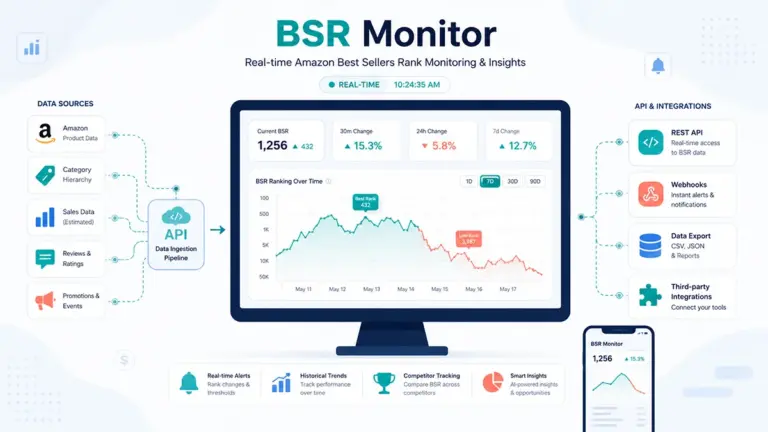
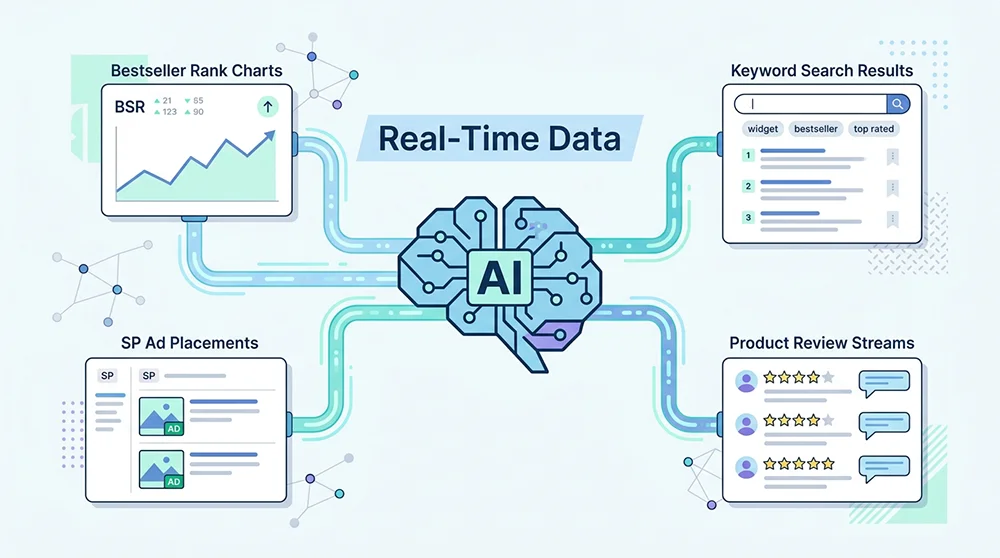
The Skill currently supports data collection across all critical dimensions required for product research decisions. At the product detail level, it captures titles, prices, inventory status, main images, variation information, bullet points, and A+ content. At the chart data level, it supports real-time BSR rankings, New Releases positions, Movers & Shakers changes, and category hierarchy structures. At the search data level, it can collect search result pages for any keyword, including organic ranking positions, Sponsored Products ad placement distribution, brand advertising displays, and Amazon’s Choice badges. At the review level, it supports complete review text, rating distributions, verified purchase indicators, and Customer Says summaries.
Particularly worth emphasizing is the SP ad placement collection capability. According to Pangolinfo internal testing, the Skill achieves a 98% recognition rate for Amazon SP ad placements, an industry-leading metric. Ad placement data is crucial for assessing the commercial competitiveness of keywords. A keyword might show only ten organic results, but sponsored placements could occupy the top four positions or more, meaning the actual cost of gaining exposure far exceeds the surface-level competition index.
Deep Integration with AI Agent Platforms
The Skill connects to various AI Agent platforms through the standardized MCP protocol, currently compatible with Claude Desktop, Cursor, Windsurf, and any custom Agent framework supporting MCP. Integration is straightforward: add the Skill’s endpoint information to your Agent configuration file, and the tools become directly callable during conversations. The Agent automatically understands each tool’s capabilities and parameter requirements, allowing users to describe needs in natural language without memorizing complex API documentation.
For engineering teams requiring deeper customization, Pangolinfo also offers the underlying Scrape API service. The API supports more granular parameter control and higher concurrency scales, suitable for building proprietary research SaaS platforms or large-scale data analysis systems. Both Skill and API share the same collection infrastructure, ensuring identical data quality and freshness.
How to Connect Your AI to Real-Time Amazon Data?
Three-Step Skill Integration
Step one: Obtain Skill configuration credentials from the Pangolinfo console. After registering, navigate to the “Agent Skills” page, locate Amazon Scraper Skill, and copy the corresponding MCP configuration JSON. Step two: Add the configuration to your AI Agent. For Claude Desktop, open the claude_desktop_config.json file and paste the Skill configuration under the mcpServers node. Step three: Restart the Agent and verify the connection. Ask “Please show me the top 20 BSR products in the Kitchen category on Amazon US”—if the Agent returns structured data, integration is successful.
The entire configuration typically completes within five minutes without writing any code. For developers using Cursor or Windsurf, the process is similar: add the same MCP configuration to the corresponding IDE Agent settings.
Typical Use Case Examples
Use case one: New product opportunity scanning. Tell your AI: “Monitor all products that entered the top 50 of the New Releases chart in Home & Kitchen on Amazon US within the past seven days. Analyze their pricing strategies, review counts, and core selling propositions. Identify potential market gaps.” The Agent automatically invokes the Skill to collect data and outputs a structured opportunity analysis report.
Use case two: Competitor monitoring. Set up a recurring task: “Every Monday, collect price, inventory, and review changes for my five tracked competitor ASINs and generate a comparison weekly report.” Once configured, this repetitive work runs fully automatically; humans only need to read the AI-generated summary.
Use case three: Keyword competition analysis. Ask: “Analyze the first page of search results for ‘portable blender.’ Count seller types (brand sellers versus resellers) at each position, median review counts, price ranges, and ad placement ratios. Assess my difficulty entering this keyword.” The AI produces a quantitative competition assessment based on live search page data.
Truly Actionable AI Product Research Starts with Data Infrastructure
The value of large language models in product research is not to replace human judgment but to liberate people from tedious data collection and elementary analysis, concentrating effort on strategic insights and decisions. Yet this value only materializes when AI receives market-synchronized data inputs. AI product research without real-time data resembles asking a top-tier analyst to make predictions in an information vacuum—regardless of reasoning prowess, the conclusions remain castles in the air.
The core value of Pangolinfo Amazon Scraper Skill lies in building a dedicated data pipeline that connects AI Agents directly to Amazon’s live market state. Through seamless MCP protocol integration, AI can finally “see” current prices, rankings, reviews, and advertising competition patterns, delivering product recommendations grounded in facts rather than speculation. If you are tired of receiving eternally correct yet practically useless product research frameworks from large models, it is time to give your AI eyes that can genuinely see the market.
Start your free trial of Pangolinfo Amazon Scraper Skill today and give your AI true visibility into Amazon market dynamics. Engineering teams can also integrate directly with Scrape API to build custom research data pipelines.
Frequently Asked Questions
Why does AI consistently produce unreliable Amazon product research conclusions?
Large language models have fixed knowledge cutoffs and cannot access real-time Amazon data such as current BSR rankings, price fluctuations, inventory levels, or advertising competition. Without live market intelligence, AI can only extrapolate from historical training patterns, producing conclusions that drift further from reality with each passing day.
Why can’t traditional product research tools feed data directly to AI for analysis?
Traditional tools like Jungle Scout and Helium 10 output pre-aggregated reports optimized for human consumption, not AI processing. Their data updates are typically daily or weekly, and the rigid report structures cannot flexibly adapt to an LLM’s analytical needs. More importantly, these tools cannot integrate seamlessly into an AI Agent’s workflow.
Which Amazon data points are most valuable for AI-powered product research?
The highest-value data includes real-time BSR rankings, New Releases chart movements, organic keyword positions alongside SP ad placement distribution, competitor pricing and inventory fluctuations, review sentiment patterns, and unanswered customer questions. Together these dimensions form a complete picture of market opportunity.
How does Pangolinfo Amazon Scraper Skill help AI acquire this data?
The Skill integrates with AI Agents via the MCP protocol, enabling minute-level collection of Amazon product details, bestseller data, keyword search results, SP ad placements, and reviews. It outputs structured JSON that LLMs can directly parse and analyze, giving your AI a live view of current market conditions.
Can non-technical users utilize Amazon Scraper Skill effectively?
Yes. Pangolinfo offers both the Agent Skill for MCP-compatible AI platforms and a no-code visualization tool called AMZ Data Tracker. Non-technical users can set up monitoring dashboards without writing code, while engineering teams can integrate the underlying API for custom AI systems at scale.Read Scrape Skill Docs