
Two News Stories, One Unavoidable Signal
In early 2026, two seemingly contradictory headlines hit the cross-border e-commerce industry within weeks of each other. The first: a fresh wave of layoffs at major e-commerce platforms, eliminating thousands of operations roles. The second: Autel Tech — a Shenzhen-based seller with annual revenues exceeding $1.4 billion — quietly announced it had formally integrated OpenClaw’s AI agent framework into its core company architecture, deploying it across product development, R&D, project management, and HR functions. The AI Agent for e-commerce era, it turns out, didn’t need anyone’s permission to begin.
For industry observers, the juxtaposition felt jarring at first. Layoffs happen for many reasons — market downturns, strategic pivots, margin pressure. But when a company Autel’s size chooses this exact moment to overhaul its operational infrastructure around an AI agent system, the timing stops being a coincidence and starts looking like a declaration.
The real anxiety these two stories triggered wasn’t “will AI replace my job?” — that question has been floating around for years without landing anywhere concrete. The new, sharper question is: “Has the displacement already started, and am I just the last to notice?” For the millions of people working in cross-border e-commerce operations, that distinction matters enormously.
The Gap Between Consumer AI and Enterprise AI Agents Is Wider Than You Think
What Autel built isn’t simply “using ChatGPT at work.” Understanding why that distinction matters requires stepping back to look at how most e-commerce companies have been using AI up to this point — and why that approach has hit a hard ceiling.
The typical AI adoption pattern in e-commerce operations goes something like this: individual team members sign up for ChatGPT or Claude accounts, use them like a smarter Google to draft copy or summarize data, and then the conversation ends. The next session starts with a blank slate. Whatever intelligence was generated in that exchange — the clever product description angle, the competitor pricing analysis framework, the customer service response logic — evaporates when the window closes. It contributes nothing to the organization’s institutional knowledge base.
Autel’s AutelClaw platform, combined with AutelSkillHub, is designed to solve exactly this problem. SkillHub functions as an organizational memory for AI capabilities: a structured repository where every useful agent skill — how to break down a product brief, how to read a bid landscape, how to escalate a logistics risk — gets encoded, versioned, and made available for reuse across the whole organization. The next new hire doesn’t start from scratch; they inherit a decade of packaged operational intelligence.
Which Roles Have E-commerce AI Agents Already Started Replacing?
The layoff data from early 2026 tells a clear story about which e-commerce automation agent scenarios are already operational. The roles being cut first share a distinctive profile: high repetition, rule-governed logic, data consumption as the core activity. Product listing uploads. Price adjustment monitoring. Ad bid optimization. Customer service first-response. Data reporting. These aren’t jobs that require creativity or relationship judgment — they’re jobs that require speed, consistency, and the ability to process large amounts of structured information without fatigue.
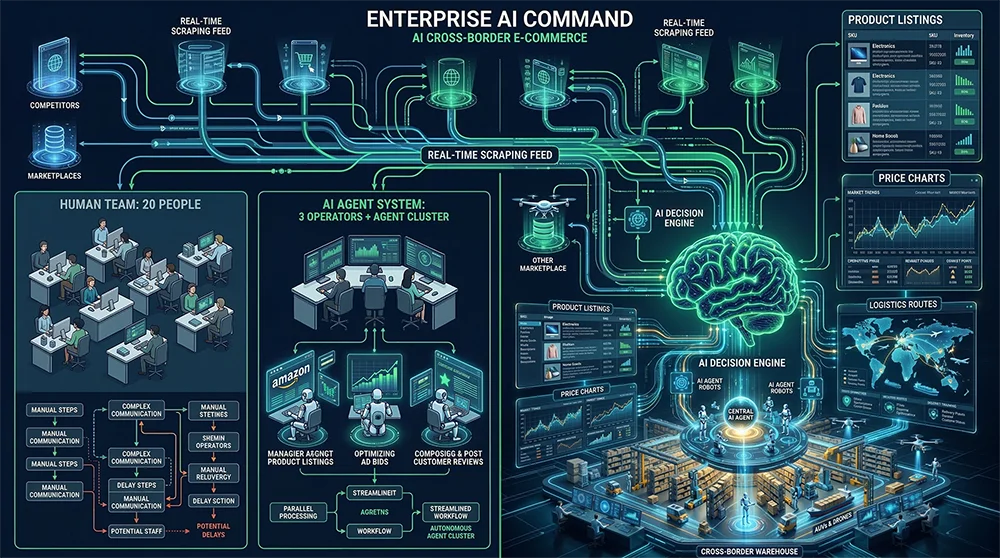
That profile is a near-perfect description of what a well-configured AI agent does better than any human team. “Previously, an operations team of 20 people could barely keep up with monitoring and adjusting our top 200 ASINs,” one cross-border seller noted. “Now five people plus an agent cluster handles twice the SKU count, with faster response times and zero errors on data entry.” The agent doesn’t take sick days, doesn’t get emotional during peak seasons, and doesn’t quit three days before a major sales event.
The governmental response to this shift has been notably aggressive. Shenzhen’s Longgang district launched its “10 Policies for Intelligent Agent Adoption,” including a 50% subsidy on data governance and annotation services used for OpenClaw development, plus a 30% hardware subsidy for AI NAS units. Meanwhile, Wuxi’s High-Tech Zone introduced “12 Policies for AI + Manufacturing,” offering up to 1 million RMB in free cloud deployment support and up to 5 million RMB for breakthroughs in embodied intelligence. This is not niche policy experimentation — it’s a coordinated national signal that intelligent e-commerce operations are the expected infrastructure of competitive businesses, not an optional upgrade.
The Part Nobody Talks About: What AI Agents Actually Need to Make Decisions
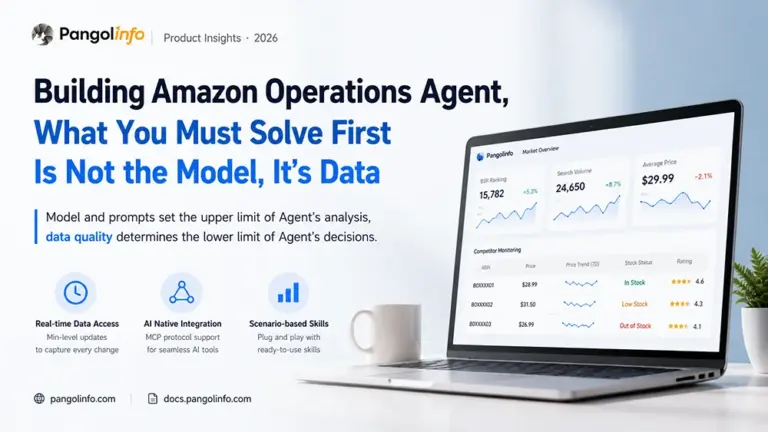
Here’s the detail that gets glossed over in most AI agent coverage: the agents themselves don’t collect data. OpenClaw, like every agent framework on the market, is a decision engine and task orchestration layer. It reasons and acts — but it cannot sense the market on its own. Every pricing recommendation, every listing adjustment, every ad bid optimization depends entirely on the quality of data flowing into the system from external sources.
This creates a fundamental quality problem that scales with the agent’s speed. A slow human analyst working from yesterday’s data makes suboptimal decisions — but the damage is limited by how many decisions they can execute per day. An AI agent running at machine speed on stale or inaccurate data can execute thousands of bad decisions before anyone notices something is wrong. The faster the intelligent e-commerce operations system, the more catastrophic lagged data becomes.
Three requirements define what qualifies as an adequate enterprise AI agent data infrastructure for e-commerce:
| Requirement | Manual Operations Team | AI Agent System (with quality data) |
|---|---|---|
| Price monitoring frequency | 1-2 manual checks per day | Automated scan every 5 minutes, instant anomaly alerts |
| Ad optimization response | Weekly retrospective review | ACOS threshold trigger → automatic bid adjustment suggestion |
| Competitor review coverage | Manual sampling, <10% coverage | Full extraction, sentiment classification, defect clustering |
| Data freshness | 24-48 hour lag | Minute-level real-time, no delay |
| Scaling marginal cost | Linear (each new SKU requires proportional headcount) | Near-zero marginal cost; SKU scale decoupled from headcount |
The Data Layer That Makes Your AI Agent for E-commerce Actually Work
Recognizing that agents need data is the easy part. Building or sourcing a data layer that can keep up with agent-speed operations is where most teams hit a wall. The requirements aren’t modest: minute-level freshness, platform-wide coverage, and output formatted to plug directly into agent pipelines without requiring a human data cleaning step in between.
Pangolinfo Scrape API was built specifically to meet this standard. It handles real-time data collection across Amazon, Walmart, Shopify, and other major platforms at a scale of tens of millions of pages per day. Output options include raw HTML, Markdown, and structured JSON — the last being particularly important for agent deployments, since structured JSON eliminates the normalization overhead that would otherwise slow down every agent decision cycle. The API’s 98% coverage rate for Amazon sponsored product ad placement data is particularly relevant for sellers whose agent strategies center on advertising optimization; getting clean, complete ad position data is the difference between a competitive bidding strategy and guesswork.
Why Review Data Is the Hidden Training Set for Your E-commerce Agents
Most sellers treat reviews as a customer satisfaction metric. In an AI agent for e-commerce context, reviews are something different: they’re an always-updating, unfiltered dataset of real buyer language, product failure modes, and competitive differentiation signals. A listing optimization agent trained on comprehensive review data doesn’t need a copywriter to guess at what resonates — it knows, because buyers said so in their own words.
A sourcing agent continuously scanning competitor reviews for recurring defect mentions can flag product improvement opportunities before they show up in your own return rate data. A content agent pulling from verified buyer feedback can generate A+ content drafts that use the exact vocabulary your target customers use when searching. None of this works at scale with sampled, manually-collected review data.
Pangolinfo’s Reviews Scraper API provides full-volume Amazon review extraction, including complete capture of Customer Says summary content — a data point that many competitor tools either miss or truncate. When this review data feeds into your agent pipeline in structured format, the “competitor insight → product iteration → listing optimization” loop becomes genuinely automated rather than nominally automated.
Keeping the Human in the Right Seat: AMZ Data Tracker for Agent Supervisors
The emergence of AI agents doesn’t eliminate the need for human judgment — it relocates it. The “agent trainer” role Autel’s SkillHub architecture implies is a job that requires macro-level strategic vision: is the agent pursuing the right objectives? Are its optimization targets still aligned with business goals as the market shifts? Is the data we’re feeding it capturing the dimensions we actually care about?
These questions can’t be answered by looking at individual agent actions. They require a dashboard-level view of market trends, competitive positioning, and product performance across time. AMZ Data Tracker provides exactly this kind of macro visibility, offering multi-dimensional Amazon market monitoring and tracking through a no-code interface that operations leads can configure without engineering support. In an agent-driven operation, this tool isn’t a replacement for agent data — it’s the instrument panel the human operator needs to steer the whole system intelligently.
For developers looking to integrate Pangolinfo’s data capabilities directly into an OpenClaw agent framework, the open-source openclaw-skill-pangolinfo repository provides complete skill module examples with detailed annotations, ready to run in production-adjacent environments.
What a Real AI Agent for E-commerce Data Workflow Looks Like
To make this concrete, here’s a simplified workflow skeleton showing how Pangolinfo API feeds into an agent decision loop for competitive pricing:
# AI Agent for E-commerce: Competitor Price Monitoring Workflow
# Data source: Pangolinfo Scrape API → Agent decision layer → Action execution

import requests

def fetch_competitor_prices(asin_list: list, marketplace: str = "amazon.com") -> list:
    """
    Pull real-time competitor pricing from Pangolinfo Scrape API.
    Returns structured JSON ready to feed directly into agent decision logic.
    """
    api_url = "https://api.pangolinfo.com/scrape/v1/product"
    headers = {
        "Authorization": "Bearer YOUR_API_KEY",
        "Content-Type": "application/json"
    }

    results = []
    for asin in asin_list:
        payload = {
            "asin": asin,
            "marketplace": marketplace,
            "output_format": "json",       # Structured output: no cleaning step needed
            "include_sponsored_ads": True  # 98% SP ad placement coverage
        }
        response = requests.post(api_url, json=payload, headers=headers)
        results.append(response.json())

    return results


def pricing_agent(competitor_data: list, my_price: float, margin_floor: float) -> dict:
    """
    Agent decision layer: evaluates market position and outputs a pricing recommendation.
    Runs on real-time data — staleness here directly degrades decision quality.
    """
    prices = [item["price"] for item in competitor_data if item.get("price")]
    avg = sum(prices) / len(prices)
    floor = my_price * (1 - margin_floor)

    target = max(floor, avg * 0.97)  # Stay competitive without destroying margin

    if target < my_price * 0.97:
        return {"action": "lower_price", "to": round(target, 2), "trigger": "competitive_pressure"}
    elif target > my_price * 1.05:
        return {"action": "raise_price", "to": round(target, 2), "trigger": "pricing_room_available"}
    else:
        return {"action": "hold", "to": my_price, "trigger": "price_in_range"}


def execute(decision: dict, require_approval: bool = True):
    """
    Execution layer — human approval gate recommended for early deployments.
    """
    msg = f"[Agent Recommendation] {decision['action'].upper()} → ${decision['to']} | Reason: {decision['trigger']}"
    if require_approval:
        print(f"[Pending Human Review] {msg}")
    else:
        print(f"[Auto-Executed] {msg}")


# Run it
if __name__ == "__main__":
    target_asins = ["B09XK8HDSG", "B0CJM3ZQWP", "B0BWJFHKN4"]
    competitor_data = fetch_competitor_prices(target_asins)
    decision = pricing_agent(competitor_data, my_price=89.99, margin_floor=0.12)
    execute(decision, require_approval=True)  # Start with human-in-the-loop
This three-step structure — data ingestion, agent reasoning, controlled execution — is the skeleton of every e-commerce automation agent workflow, whether it’s pricing, ad optimization, or inventory management. The intelligence ceiling at each step is set by the data quality at the input. You can upgrade the agent logic indefinitely, but if the data coming in is 24 hours stale or missing key fields, the optimization never reaches the level the business actually needs.
The AI Agent for E-commerce Era Won’t Wait
Autel Tech’s OpenClaw integration draws a line in the sand for the industry. On one side: companies still treating AI as a personal productivity tool, used ad hoc, leaving no organizational residue. On the other: companies building AI into the structural layer of how they operate — where every agent run makes the system smarter, and where competitive advantages compound automatically over time.
For individual operators, the picture is similarly divided. The roles that survive aren’t the ones that execute most efficiently — agents will always execute faster. The roles that thrive are the ones that define what the agents should optimize for, train the agents on accumulated domain knowledge, and maintain strategic judgment about when the agent’s outputs need a human override. These are fundamentally higher-skill, higher-leverage positions — and they require genuinely understanding data.
The AI agent for e-commerce transformation is already past its starting gun. What companies and individuals control now is how well-positioned they are to operate in the system that’s replacing the old one. Building on a weak data foundation means building an agent that’s fast at being wrong. The sellers who will dominate the next phase are the ones who couple intelligent agent frameworks with the best possible real-time market sensing — and that starts with the data layer.
Whether you’re running a standalone seller operation or building an enterprise agent platform, Pangolinfo Scrape API and AMZ Data Tracker provide the data infrastructure that intelligent e-commerce operations require. The agent decides — but only as well as what you feed it.
📊 Start building your AI agent data foundation today. Explore Pangolinfo’s real-time e-commerce data capabilities and connect your agent workflows to live Amazon market intelligence. Access the console and start your free trial →