
Your BuyBox Is Being Stolen While You Sleep
Every Amazon seller knows the sinking feeling: you open Seller Central on a Monday morning and your sales are down 60%. You dig into the numbers, and there it is—a hijacker who slipped in three days ago, quietly siphoning orders from your listing while you had no idea. Three days of advertising spend, three days of wasted PPC budget, three days of eroded customer trust—all because your Amazon BuyBox monitoring had a gap you didn’t know existed.
The scale problem makes it worse. A single seller managing 50 ASINs would need to manually check each listing multiple times a day to catch hijackers in real time. That’s an impossible workload. So most sellers rely on daily reports, weekly audits, or—most dangerously—waiting for the sales drop to tell them something went wrong. By then, the damage is done.
What makes modern hijacking particularly difficult to counter is its precision. Experienced hijackers have learned to time their entries during nights, weekends, and peak shopping windows precisely because they know seller oversight is thinnest at those moments. They move in, capture BuyBox share for a few profitable hours or days, then exit before triggering a permanent complaint. Traditional BuyBox ownership tracking is powerless against this kind of calculated behavior.
There’s a second, subtler threat that’s even harder to detect: the gradual BuyBox erosion. A competitor with slightly better logistics ratings or a marginally lower price begins to claim BuyBox impressions for 20%, then 40%, then 60% of page visits—all without triggering a traditional “hijacker alert” because they’re technically eligible sellers. This kind of quiet BuyBox loss compounds over weeks, often invisible until the revenue impact is impossible to ignore.
Why Conventional Monitoring Always Leaves You One Step Behind
The instinct to “use a tool” for Amazon BuyBox monitoring is right, but the implementation usually falls short. Most seller tools in this space share three critical limitations that undermine their value when it matters most.
The first is refresh rate. Daily or twice-daily data pulls mean your “real-time” alert is already 12-24 hours stale. For BuyBox competition dynamics—where conditions can shift every hour—that latency is the difference between catching a hijacker early and discovering them after they’ve had a full business cycle to damage your listing metrics. Effective BuyBox monitoring requires hourly data cycles, not daily snapshots.
The second limitation is notification fragmentation. A monitoring tool that sends alerts to an email inbox you check twice a day isn’t solving the response time problem—it’s just adding a step. Your Amazon BuyBox monitoring alerts need to live where your team already lives: in your primary work communication channel. For most modern e-commerce teams, that means Lark, Slack, or WeChat Work. An alert that arrives as a Lark message card in your operations channel during a meeting is one you’ll actually see and act on within minutes.
The third gap is data depth. Knowing “there are 2 hijackers on ASIN B0D6BFMNN5” is the beginning of a decision, not the decision itself. What’s their seller rating? Are they FBA or merchant-fulfilled? Is one of them an Amazon-authorized reseller—a completely different threat profile than an anonymous third-party? How does their pricing compare to your current BuyBox price? Hijacker alert automation becomes actionable only when raw detection is paired with contextual intelligence.
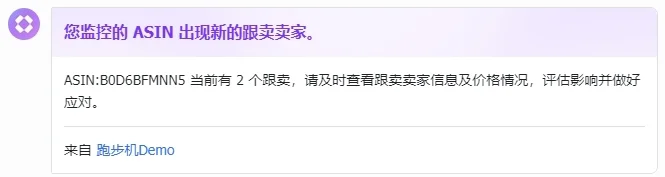
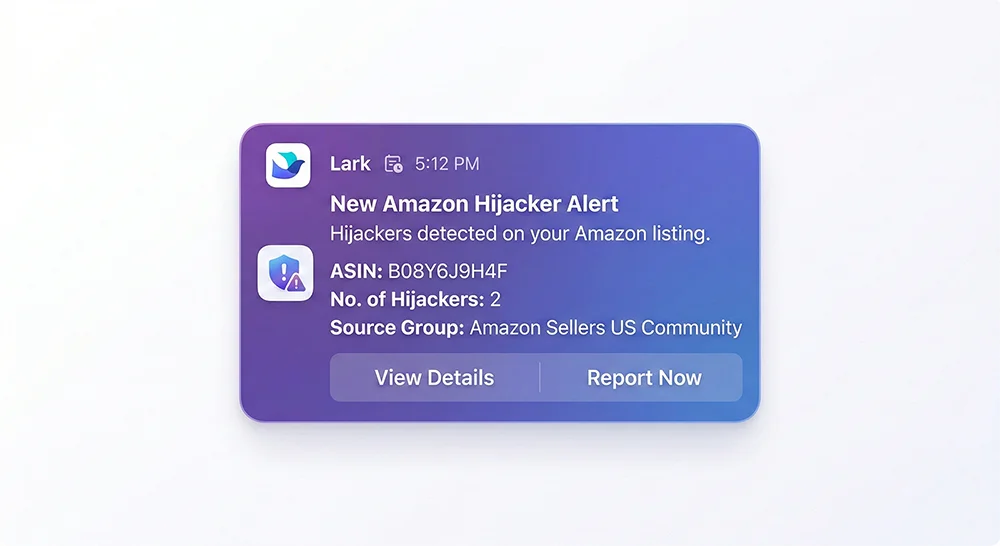
The screenshot above shows a real AMZ Data Tracker alert delivered via Lark bot. The notification arrives directly in the operations team’s communication channel, carrying the essential context needed for immediate triage: which ASIN triggered the alert, how many hijackers are now present, and which monitoring group this ASIN belongs to. It reaches the relevant seller whether they’re at their desk, in a warehouse, or in a client meeting—cutting response time from hours to minutes.
This is the fundamental shift in how Amazon BuyBox monitoring should work: instead of sellers going to check data, the data comes to sellers when it matters.
Inside the System: How Hourly Monitoring Captures Every BuyBox Shift
Let’s walk through how this hijacker alert automation works end-to-end, using the workflow that AMZ Data Tracker enables out of the box.
Layer 1: Hourly ASIN Data Collection—A Complete Competitive Snapshot Every 60 Minutes
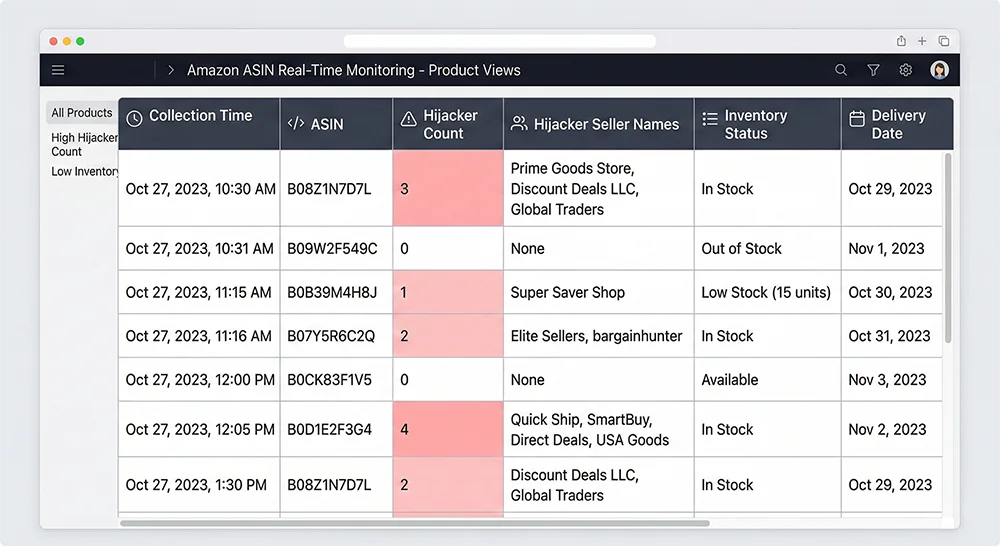
At the data layer, AMZ Data Tracker polls your monitored ASINs every hour using Pangolinfo’s Scrape API as its engine. Each collection cycle captures the full BuyBox state: current BuyBox winner, all competing sellers with their pricing, fulfillment method, seller ratings, inventory status, and estimated delivery windows. Every snapshot is timestamped and stored in an auto-organized multi-dimensional table.
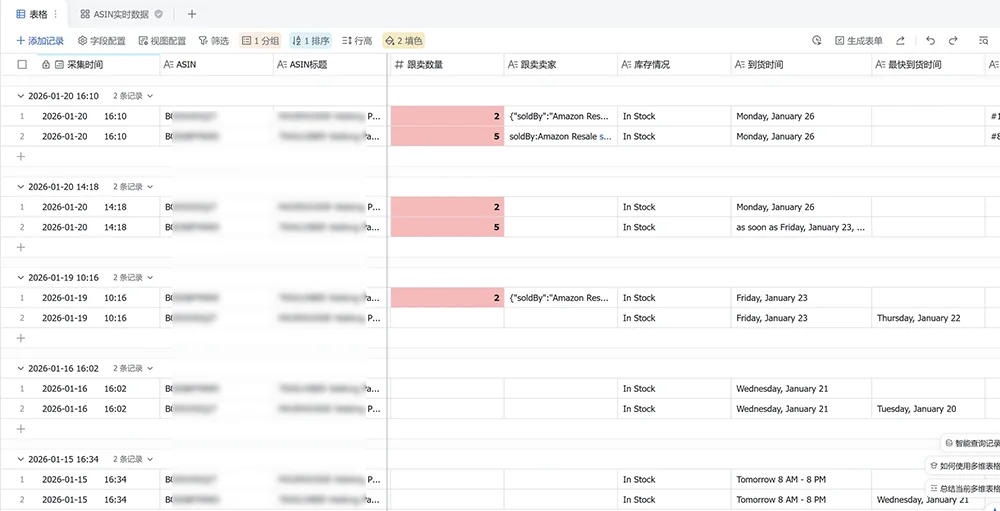
The table view is designed for speed of assessment. Rows where competing sellers appear are automatically highlighted in pink, so anomalies surface visually without requiring the operations team to sort or filter. A single scan down the table reveals which ASINs need attention, in which time period the issue appeared, and the full seller context behind each flag.
One detail worth noting: when the competing seller field contains “Amazon Resale” or “soldBy: Amazon,” the system surfaces this explicitly. An Amazon-authorized reseller or Amazon Warehouse product competing for BuyBox is a fundamentally different scenario than an unauthorized third-party seller—the appropriate response strategies differ, and your real-time Amazon BuyBox change detection should distinguish between them.
Layer 2: Lark Bot Notifications—BuyBox Ownership Tracking Delivered to Your Workflow
Immediately after each hourly collection cycle, AMZ Data Tracker runs an automated comparison between the current snapshot and the previous one. If hijacker count changes from 0 to any positive number, or if BuyBox ownership flips from the monitored seller to a competitor, an alert trigger fires and sends a formatted Lark message card to the configured channel or individual.
The notification includes: the triggered ASIN, current hijacker count, the monitoring group it belongs to (useful for multi-brand or multi-category operations), and a direct link to drill into the full data view. End-to-end latency from the moment a hijacker appears on the listing to the moment the Lark notification arrives typically runs under 3 minutes—orders of magnitude faster than any manual check cadence.
For team operations, this notification-first approach unlocks collaborative response. The alert arrives in a shared channel, giving operations, pricing, and customer success teams simultaneous visibility. Responses can be discussed in the thread of the notification itself, and action items assigned without shifting communication context. This is how Lark notification for seller hijacking becomes a force multiplier rather than just a passive information feed.
Layer 3: Historical Pattern Analysis—AI That Predicts Before Hijackers Strike
The third layer is where Amazon BuyBox monitoring transforms from reactive to predictive. As hourly snapshots accumulate over weeks and months, the data begins to reveal behavioral signatures unique to each ASIN’s competitive environment. When did hijackers historically appear? At what price points do they tend to enter? Are there weekly cycles—say, higher hijacker presence on weekends or during promotional events? Does a specific competitor consistently appear before major shopping holidays?
Feeding this timestamped historical dataset into an AI analysis workflow—whether through AMZ Data Tracker’s built-in AI features or via a connected workflow tool—makes it possible to generate actionable predictions: “Based on historical patterns, ASIN B0D6BFMNN5 has an elevated hijacking risk every Friday evening and during peak shopping windows. Consider preemptive pricing adjustments or increased PPC bids during these periods.”
This is the endpoint of effective BuyBox ownership tracking: not just knowing that a threat occurred, but having a system smart enough to warn you before the next one materializes.
AMZ Data Tracker: The Infrastructure Behind Your BuyBox Defense
The monitoring pipeline described above is built on AMZ Data Tracker, Pangolinfo’s no-code data collection and automation platform designed for Amazon sellers who need enterprise-grade intelligence without engineering overhead. It draws ASIN data directly from the Pangolinfo Scrape API, which delivers structured, parsed Amazon listing data—including full seller offer arrays, BuyBox metadata, inventory signals, and delivery estimates—at minute-level freshness.
The key design principle is operational accessibility. Setting up an Amazon BuyBox monitoring workflow in AMZ Data Tracker requires no programming knowledge: configure which ASINs to monitor, set collection frequency, define alert trigger conditions (hijacker count ≥ 1, BuyBox owner changed, etc.), and connect a Lark webhook. The whole setup takes under 15 minutes and runs autonomously from that point forward.
For teams with more complex requirements—custom threat scoring models, integration with internal ERP or pricing systems, or bulk ASIN processing at scale—Pangolinfo’s Scrape API is available as a direct integration point. Raw data is returned as clean JSON, ready for any downstream pipeline your engineering team wants to build around it.
BuyBox hijacker alert automation is one dimension of a broader seller intelligence system. The same data infrastructure that powers BuyBox monitoring can be extended to price change alerts, BSR movement tracking, review count anomalies, and new competitor product launches—all surfaced through the same Lark notification channel. The result is a unified operations intelligence feed that keeps the entire seller team situationally aware without constant manual checking.
Setting Up Your BuyBox Alert System: A Practical Three-Step Guide
For sellers ready to implement this Amazon BuyBox monitoring workflow, here’s a practical roadmap to get from zero to operational in a single afternoon.
Step 1: Prioritize your ASIN watchlist. Not every SKU needs the same monitoring intensity. Start by identifying your top 20% of listings by revenue contribution and advertising spend—these are your highest-value BuyBox positions. Set these to hourly collection. Long-tail ASINs can run at 3-4 hour intervals to balance coverage with cost efficiency. Build in a quarterly review to update the watchlist as your catalog evolves.
Step 2: Configure monitoring tasks and alert rules in AMZ Data Tracker. Log into the Pangolinfo Console, navigate to the tracking module, and create a new ASIN monitoring task. Input your ASIN list, set collection frequency, and define alert logic: hire for any new competing seller detected, or specifically when BuyBox ownership changes away from your seller account. Connect your Lark bot webhook to the notification endpoint. The system will begin its first collection cycle immediately.
Step 3: Build your response SOP before the first alert fires. Automation creates value only when paired with clear human protocols. Define in advance: who is the first responder for a BuyBox alert? What’s the decision tree for responding—price adjustment first, or direct complaint filing? Which hijacker profiles trigger immediate escalation versus a watch-and-wait stance? Document these rules, train the relevant team members, and attach the SOP to your monitoring channel’s pinned messages. When an alert arrives at 11pm on a Friday, you want the response to be automatic, not improvised.
Turn Amazon BuyBox Monitoring into a Competitive Moat
Hijacking is fundamentally an information asymmetry problem. Hijackers know when you’re not watching. With hourly Amazon BuyBox monitoring and instant Lark alerts, you close that gap—making your response speed faster than any hijacker’s ability to establish a foothold.
The AMZ Data Tracker + Lark + AI combination isn’t a complex technical project. It’s a workflow that takes an afternoon to configure and then runs silently in the background, surfacing signals only when action is needed. Every BuyBox loss it prevents translates directly into protected revenue, recovered advertising ROI, and maintained listing health scores that compound over time.
Real-time Amazon BuyBox change detection is no longer a nice-to-have for competitive Amazon sellers—it’s the minimum viable defense in a marketplace where hijacking tactics grow more sophisticated every season. The question isn’t whether to build this system, but how quickly you can have it running before your next vulnerability window opens.
📌 Start your AMZ Data Tracker free trial today and deploy your first BuyBox monitoring alert in under 15 minutes. Never find out about a hijacker from your revenue report again.