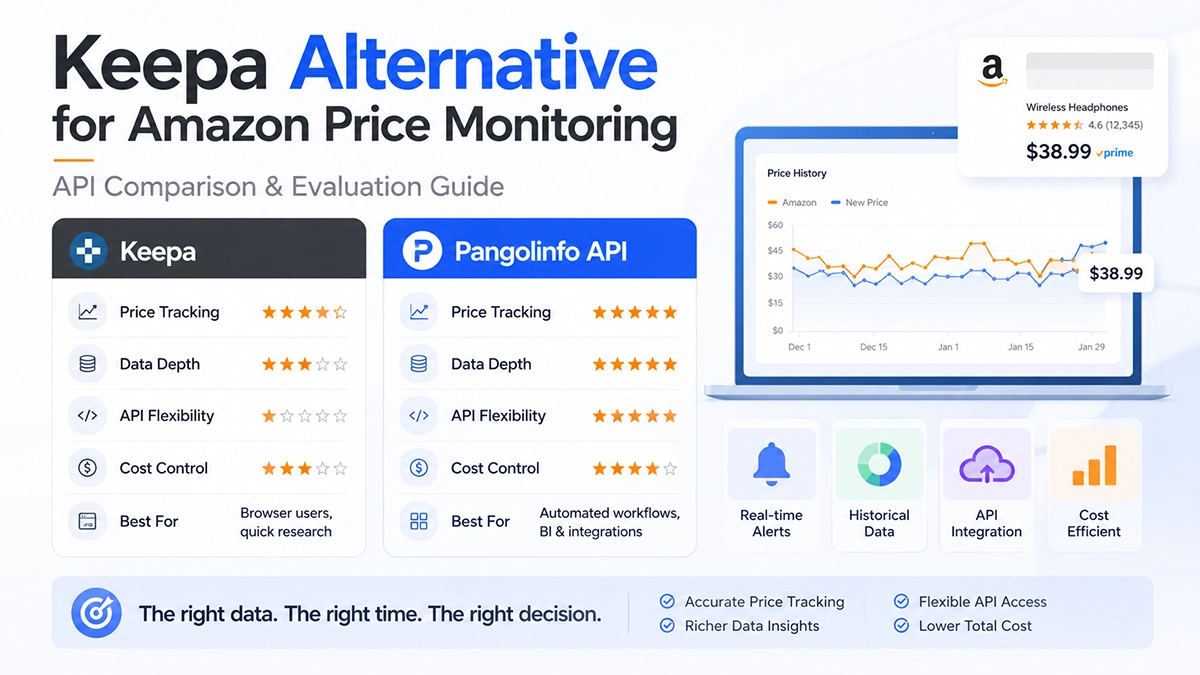
Keepa替代方案对比图:Pangolinfo API与Keepa在价格追踪、数据深度、API灵活性和成本控制方面的详细对比分析

In Amazon operations, price monitoring is crucial for maintaining competitive advantage. Keepa, as a well-known price tracking tool, has won favor among individual sellers with its intuitive price history charts and browser extension. However, as businesses scale, need to integrate price data into proprietary systems, or pursue more flexible data processing capabilities, Keepa’s limitations become apparent. An increasing number of technical teams are seeking a Keepa alternative, hoping to gain deeper data access and better cost efficiency through API interfaces.

This article provides an in-depth comparison of Pangolinfo API versus Keepa in the price tracking domain, analyzing differences in product positioning, features, target audiences, technical architecture, and cost-effectiveness from all angles, helping you determine whether to migrate from Keepa to a more flexible Amazon price tracking API solution.

What is Keepa? Core Features and Target Users

Keepa is a tool focused on Amazon price history tracking, founded in 2011, primarily serving users through a browser extension and web platform. Its core value lies in visualizing complex price fluctuation data, helping buyers find optimal purchase timing and sellers monitor competitor pricing strategies.

Keepa’s Core Features

Keepa’s feature design revolves around the concept of “simplicity and ease of use.” After installing the browser extension, users automatically see price history charts when browsing Amazon product pages, including curves for Amazon’s own prices, third-party seller prices, used item prices, and more. This instant visualization experience allows ordinary users to quickly understand price trends without any technical background.

Beyond basic price display, Keepa offers price drop alerts. Users can set target prices and receive email or push notifications when products reach those price points. For buyers needing bulk purchases or sellers monitoring specific competitors, this feature saves significant manual monitoring time.

Keepa’s web platform provides richer data query capabilities, including historical price data export, multi-product comparison, and category price analysis. Paid users can also access the Keepa API for programmatic data retrieval. However, Keepa API’s original design purpose remains serving its web platform, with certain limitations in flexibility and data depth.

Keepa’s Target User Base

From product design and pricing strategy perspectives, Keepa primarily targets three user types: ordinary consumers seeking optimal Amazon purchase timing, individual sellers and small teams needing competitor price monitoring, and analysts conducting market research. These users share common characteristics: relatively simple data needs, no requirement for deep system integration, and prioritizing tool usability over technical flexibility.

For these users, Keepa’s browser extension + web platform model is indeed an ideal choice. However, when enterprises enter scaled operations, needing to monitor hundreds or thousands of ASINs, integrate price data with ERP or BI systems, or develop automated decision systems based on price data, Keepa’s architectural limitations become bottlenecks. This is precisely why demand for Keepa replacement tools arises.

Keepa’s Core Limitations and User Pain Points

While Keepa enjoys renown in the price tracking field, its limitations have gradually emerged as user needs deepen. Through analyzing real user feedback and technical documentation, we’ve identified five core pain points driving more enterprises to seek Keepa alternatives.

Pain Point 1: Strict Token System Restrictions

Keepa API employs a token billing system where each token allows requesting data for one seller, category, or product. However, this seemingly simple system hides serious usage restrictions. First, tokens have only a 60-minute validity period and cannot be used after expiration, meaning enterprises must precisely calculate usage to avoid waste. More critically, even paid plans have strictly limited token generation rates.

Taking the most basic paid plan as an example, €49/month (approximately $54) only provides 20 tokens per minute. This theoretically allows requesting data for only 1,200 products per hour, less than 30,000 per day. For enterprises needing to monitor hundreds or thousands of ASINs, this limitation is far from sufficient. Want higher token rates? Prices escalate exponentially: 250 tokens/minute requires €459/month (approximately $505), 1,000 tokens requires €1,499/month (approximately $1,650), and the highest tier of 4,000 tokens costs €4,499/month (approximately $4,950).

More frustratingly, the free plan is virtually unusable for actual business. Free users have a 0% quota, meaning no access to the Data toolset, no ability to import or export ASIN lists, usable only for the most basic testing. This “free but unusable” design forces all users with actual needs to pay, lacking flexible trial space.

Pain Point 2: Daily Quota Limits and Anti-Scraping Mechanisms

Beyond token restrictions, Keepa implements a strict daily quota system explicitly designed to “deter extensive data scraping.” Even paid users face quota caps, with quotas replenishing at 5% per hour. At full quota, Product Viewer can import and export a maximum of 24,000 ASINs per day.

This limitation is fatal for enterprises requiring large-scale data collection. Suppose you need to analyze all products in a popular category or monitor site-wide price trends—the 24,000 ASIN daily limit is woefully inadequate. Moreover, the quota recovery mechanism means once daily quota is exhausted, you must wait hours to continue work, severely impacting data collection continuity and timeliness.

Worse still, users attempting large-scale data extraction frequently encounter various technical obstacles. Developers on Stack Overflow complain that when trying to iterate through multiple result pages, they receive “page and page limit is invalid” errors. Other users have found sales rank data inconsistent with product launch dates or review dates, raising data quality concerns. These issues receive scant mention in Keepa’s official documentation, forcing users to solve problems through trial and error.

Pain Point 3: High and Inflexible Pricing Model

Keepa’s pricing strategy represents a heavy burden for small and medium enterprises. The basic membership fee for individual users is €19/month (approximately $21), which seems reasonable but only provides access to basic web platform features. Once API access is needed, prices immediately jump to €49/month minimum, and that’s just the lowest tier with 20 tokens/minute.

According to user sharing on Reddit, some enterprises monitoring millions of ASINs spend up to €2,000 (approximately $2,200) monthly on Keepa API. This doesn’t include development and maintenance costs for API integration. More dissatisfying is Keepa’s pricing inflexibility—enterprises pay the same monthly fee regardless of business off-season or peak season, unable to adjust spending based on actual usage.

Compared to other data services, Keepa’s cost-effectiveness advantage isn’t obvious. For instance, some competitors offer per-request billing models where enterprises only pay for data actually used. While Keepa’s token system theoretically also bills by volume, due to token expiration mechanisms and strict rate limits, it actually resembles more of a “monthly subscription + throttling” hybrid model, lacking both flexibility and precise cost control.

Pain Point 4: Single Data Dimension, Inadequate for Deep Analysis

Keepa’s core value lies in price history tracking, which is also its greatest limitation. For users only needing price fluctuation monitoring, Keepa suffices. However, for enterprises requiring comprehensive competitor dynamics understanding and multi-dimensional market analysis, Keepa’s data depth is clearly insufficient.

Keepa API primarily returns price, sales rank (BSR), and basic rating information, but lacks many critical data points. For example, it cannot retrieve complete product descriptions, A+ content, Q&A, detailed variant information, inventory availability, or shipping options. These data points are crucial for competitor analysis, product research, and operational optimization, yet Keepa cannot provide them.

More importantly, Keepa doesn’t support deep review data collection. While you can see ratings and review counts, you cannot batch retrieve detailed review content, sentiment trends, or keyword distributions. For enterprises hoping to understand user pain points and optimize product descriptions through review analysis, this represents a massive gap. Additionally, Keepa’s support for advertising placement data is very limited, unable to accurately track competitors’ SP ad strategies.

Pain Point 5: Insufficient Technical Support and High Integration Complexity

On the user review platform G2, Keepa has received some harsh criticisms, including accusations of “poor security system,” “inadequate customer service,” “lack of communication,” and even “bullying and threatening customer interactions.” While these reviews may contain individual case biases, they do reflect Keepa’s shortcomings in customer support.

From a technical perspective, while Keepa API documentation covers basic functionality, it lacks guidance for complex scenarios. Developers frequently encounter various issues during integration: API request timeouts, pagination logic errors, “dead” ASINs (delisted products) returning empty data, etc. These problems receive minimal detailed explanation in official documentation, forcing users to seek help through community forums and Stack Overflow, increasing integration time costs and technical risks.

Furthermore, Keepa’s API design serves its web platform more than enterprise-level system integration. Lacking modern API standard features like Webhook callbacks, batch requests, and custom field filtering makes enterprises face numerous technical obstacles when building automated data pipelines. For enterprises needing to integrate data into ERP, CRM, and BI systems, Keepa’s integration complexity far exceeds expectations.

Real User Feedback: Why They’re Seeking Alternatives

Synthesizing user feedback from major technical communities and review platforms, we find enterprises seeking Keepa API alternatives for three core reasons:

Uncontrollable Costs: As business scales, Keepa’s monthly fees escalate from hundreds to tens of thousands of dollars, yet data quality and service levels haven’t improved proportionally. Enterprises seek more cost-effective, pay-as-you-go solutions.

Insufficient Functionality: Single-dimension price tracking cannot meet modern e-commerce operations’ complex needs. Enterprises require more comprehensive data dimensions, deeper analytical capabilities, and more flexible data processing methods.

Complex Integration: Keepa’s API design philosophy leans toward individual users, lacking technical features needed for enterprise-level integration. Development teams spend excessive time handling various edge cases and technical obstacles, yielding poor ROI.

These pain points have catalyzed strong demand for cost-effective price monitoring tools and more flexible API solutions. Next, we’ll see how Pangolinfo systematically addresses these issues.

How Pangolinfo Solves Keepa’s Core Pain Points

Targeting Keepa’s five major pain points, Pangolinfo provides systematic solutions. As an Amazon price tracking API designed specifically for enterprise-level applications, Pangolinfo demonstrates clear advantages in architectural design, pricing models, data depth, and technical support.

Solution 1: Flexible Pay-As-You-Go, No Token Expiration Limits

Unlike Keepa’s token system, Pangolinfo employs direct per-API-call billing with no token expiration concept. API call credits purchased by enterprises can be flexibly used within their validity period without waste due to 60-minute restrictions. More importantly, Pangolinfo supports true pay-as-you-go—enterprises can increase or decrease API call volumes anytime based on actual business needs, without being locked into fixed monthly packages.

Regarding pricing, Pangolinfo offers tiered discount mechanisms: higher call volumes yield lower per-call costs. This pricing model enables enterprises to enjoy economies of scale during business growth, rather than facing linear or exponential cost increases like with Keepa. According to actual calculations, for medium-scale data collection needs (500K-1M API calls monthly), Pangolinfo’s total cost typically represents only 30%-40% of Keepa’s equivalent service.

Solution 2: No Quota Restrictions, Supporting Large-Scale Concurrent Collection

Pangolinfo doesn’t impose daily quota limits similar to Keepa’s. As long as enterprises have sufficient API call credits, they can continuously collect data without forced interruptions due to arbitrary caps. This is crucial for enterprises requiring large-scale data collection—whether monitoring tens of thousands of ASINs or conducting category-wide market analysis, quota constraints won’t apply.

Performance-wise, Pangolinfo supports high-concurrency requests, processing hundreds of API calls per second. Employing distributed architecture and intelligent proxy pool technology, it maintains stable response speeds and success rates even during peak periods. More importantly, Pangolinfo supports collection scales of tens of millions of pages per day, incomparable to Keepa’s 24,000 ASIN/day limit.

Additionally, Pangolinfo’s API design fully considers practical needs for large-scale data collection. Supporting batch requests, intelligent retries, error handling, and other enterprise-grade features, developers don’t need to spend extensive time handling pagination errors, timeout issues, and “dead” ASIN edge cases as with Keepa.

Solution 3: Comprehensive Data Coverage Beyond Single Price Dimension

Pangolinfo’s Scrape API provides data dimensions far exceeding Keepa. Beyond price history, it includes:

Product Details: Complete titles, descriptions, images, videos, A+ content, brand information, variant details, etc. This data is crucial for competitor analysis and product research but unavailable from Keepa.

Inventory & Shipping: Real-time inventory availability, shipping options, Prime eligibility, estimated delivery times, etc. This information helps enterprises assess competitors’ supply chain status and operational strategies.

Review Data: Through dedicated Reviews Scraper API, batch collection of all review detailed content, ratings, Verified Purchase indicators, reviewer information, helpfulness votes, etc. Supports sentiment analysis, keyword extraction, and other advanced functions, helping enterprises deeply understand user pain points.

Advertising Placement Data: Pangolinfo achieves 98% accuracy in SP ad placement collection, far exceeding industry averages. Enterprises can precisely track competitors’ advertising strategies, keyword selections, bid levels, etc.—capabilities completely absent from Keepa.

Rankings & Categories: Supports collecting Best Sellers, New Releases, Movers & Shakers, and other ranking data, plus complete category tree structures. Helps enterprises discover market trends and emerging opportunities.

This comprehensive data coverage enables enterprises to meet all data needs through one API suite, without needing to integrate additional tools to supplement missing data dimensions as with Keepa.

Solution 4: API-First Architecture, Enterprise-Grade Integration Capabilities

Pangolinfo adopted an API-First philosophy from inception, exposing all functionality through standard RESTful APIs. This means enterprises can easily integrate data collection capabilities into any tech stack, whether Python, Java, Node.js, or other languages.

APIs support multiple output formats: structured JSON for direct database insertion and programmatic processing, raw HTML for preserving complete page information, Markdown for content analysis and display. Enterprises can select the most appropriate data format for specific scenarios rather than being constrained by Keepa’s fixed data structures.

Regarding integration convenience, Pangolinfo provides comprehensive API documentation, including complete interface descriptions, parameter definitions, error code explanations, and multi-language code examples. Documentation quality far exceeds Keepa’s, enabling developers to quickly understand API usage and avoid repeated trial and error.

Additionally, Pangolinfo supports modern API standard features: Webhook callbacks for event-driven architectures, batch requests for efficiency improvements, custom field filtering for reduced data transfer volumes. These enterprise-grade functions make system integration simple and efficient, dramatically reducing development and maintenance costs.

Solution 5: Professional Technical Support and Custom Services

In stark contrast to Keepa’s customer support shortcomings, Pangolinfo provides professional technical support teams. When enterprises encounter integration issues, they can quickly obtain help through ticketing systems, email, or online chat. Technical support teams typically respond within hours, providing detailed solutions and code examples.

More importantly, Pangolinfo offers a degree of customization services. If standard APIs cannot meet enterprises’ special requirements, technical teams can assist in developing customized data collection solutions. For example, some enterprises need to collect price data for specific postal codes or require special data format conversions—Pangolinfo can provide support.

Furthermore, Pangolinfo offers AMZ Data Tracker, a visualization tool providing no-code configuration interfaces for users without development capabilities. This “API + visualization tool” dual-track design meets both technical teams’ flexibility needs and business personnel’s usability requirements, covering a broader user base.

When Should You Choose Pangolinfo as a Keepa Alternative?

Not all users need to migrate from Keepa to Pangolinfo. Selecting the appropriate tool depends on business needs, technical capabilities, and strategic objectives. The following scenarios strongly suggest considering Keepa API alternatives.

Scenario 1: Mid-to-Large Sellers Requiring Large-Scale Price Monitoring

When enterprises manage over 100 SKUs and need to simultaneously monitor hundreds of competitors’ price changes, Keepa’s token limits and daily quotas become serious bottlenecks. Through Pangolinfo API, enterprises can build automated price monitoring systems, collecting all monitored products’ prices, inventory, and promotion information hourly, automatically triggering alerts for price anomalies, even driving intelligent pricing systems to automatically adjust prices, achieving true dynamic pricing strategies.

Scenario 2: Technology-Driven Enterprises Requiring Data Integration

If enterprises have established their own ERP, CRM, and BI systems and need to integrate Amazon data into unified data warehouses, Keepa’s closed ecosystem and limited API bring enormous integration costs. Pangolinfo’s API-First architecture makes data integration simple and direct—enterprises can automatically collect data through scheduled tasks, process it through ETL, store it in databases, correlate it with other business data, and build complete data-driven decision systems.

Scenario 3: Service Providers Developing E-commerce SaaS Products

If you’re developing SaaS products for Amazon sellers—such as intelligent pricing tools, competitor analysis platforms, or product research systems—a stable and reliable data source is your product’s core competitiveness. Pangolinfo provides not just data but scalable technical infrastructure. Through API integration, you can rapidly build product prototypes, focusing on business logic and user experience rather than expending resources on data collection technical details.

Scenario 4: Scaled Enterprises Pursuing Cost Optimization

When enterprises’ data needs reach certain scales, Keepa’s high monthly fees (€2,000+) become uneconomical. Through cost-effective price monitoring tools like Pangolinfo, enterprises can reduce costs by 50%-70% while maintaining data quality. More importantly, pay-as-you-go models enable enterprises to flexibly adjust data collection strategies according to business seasonality, maximizing cost-effectiveness while ensuring critical data timeliness.

Migrating from Keepa to Pangolinfo: Implementation Path and Best Practices

If you’ve decided to try Pangolinfo as a Keepa alternative, here’s a proven migration path and implementation recommendations.

Step 1: Requirements Assessment and POC Validation

First clarify your current Keepa usage scenarios: pure price monitoring or more comprehensive data analysis? How many ASINs need monitoring? What are data update frequency requirements? Is system integration needed?

After clarifying requirements, register a Pangolinfo console account and use free trial credits for POC (proof of concept). Select 10-20 representative ASINs, collect data using Pangolinfo API, compare data quality and timeliness with Keepa, verify API stability and response speed. This phase typically requires 1-2 weeks.

Step 2: Technical Integration and System Development

After POC validation, begin technical integration work. Pangolinfo provides detailed API documentation, including complete interface descriptions, parameter definitions, and code examples.

For price monitoring scenarios, the recommended technical architecture is: use scheduled tasks (like Cron or Airflow) to periodically call Pangolinfo API for price data collection, store in databases (like PostgreSQL or MySQL), cache hot data through Redis, and finally visualize through BI tools (like Tableau or Grafana). The entire development process typically takes 2-4 weeks with 2-3 engineers.

Step 3: Parallel Operation and Data Validation

During new system initial launch, recommend running parallel with Keepa for 2-4 weeks, comparing data consistency and stability between both systems. Focus on price data accuracy, update timeliness, system availability, and other metrics. This phase can identify potential issues for timely optimization, ensuring smooth migration transition.

Step 4: Complete Switchover and Continuous Optimization

After confirming new system stability and reliability, gradually reduce Keepa dependency and eventually complete switchover to Pangolinfo. Post-switchover, continuously monitor API usage and optimize calling strategies. For example, reduce collection frequency for products with infrequent price changes; increase monitoring density for core competitors. Through intelligent scheduling and caching optimization, further reduce API call costs while maintaining data quality.

Conclusion: Choose the Right Price Monitoring Solution

Keepa, as a mature price tracking tool, still has value for individual users and small teams, particularly those without technical capabilities needing only basic price monitoring. Its browser extension’s instant visualization experience and simple usability genuinely lower price monitoring barriers.

However, when enterprises enter scaled operations and face Keepa’s core pain points—token restrictions, quota systems, high pricing, single data dimensions, and integration complexity—choosing a Keepa alternative like Pangolinfo API becomes inevitable. Pangolinfo systematically solves Keepa’s problems through flexible pay-as-you-go, no quota restrictions, comprehensive data coverage, API-First architecture, and professional technical support, providing enterprises with more cost-effective and scalable solutions.

When selecting tools, the key isn’t which tool is better but which tool better suits your business stage and strategic objectives. If you have a technical team, manage dozens or hundreds of SKUs, and hope to build competitive advantages through data-driven approaches, Pangolinfo’s Amazon price tracking API is undoubtedly worth deep exploration.

Through reasonable requirements assessment, technical integration, and continuous optimization, enterprises can build truly proprietary price monitoring systems, maintaining agility and leadership in fierce e-commerce competition.

Get Started Now: Visit the Pangolinfo console to register an account, obtain free trial credits, and experience more flexible, powerful, and cost-effective Amazon data API services. Check the complete API documentation to learn more technical details and integration solutions.

Our solution

Protect your web crawler against blocked requests, proxy failure, IP leak, browser crash and CAPTCHAs!

With AMZ Data Tracker, easily access cross-page, endto-end data, solving data fragmentation andcomplexity, empowering quick, informedbusiness decisions.

Weekly Tutorial

Ready to start your data scraping journey?

Sign up for a free account and instantly experience the powerful web data scraping API – no credit card required.

Scan WhatsApp
to Contact

QR Code
Quick Test

联系我们,您的问题,我们随时倾听

无论您在使用 Pangolin 产品的过程中遇到任何问题,或有任何需求与建议,我们都在这里为您提供支持。请填写以下信息,我们的团队将尽快与您联系,确保您获得最佳的产品体验。

Talk to our team

If you encounter any issues while using Pangolin products, please fill out the following information, and our team will contact you as soon as possible to ensure you have the best product experience.