

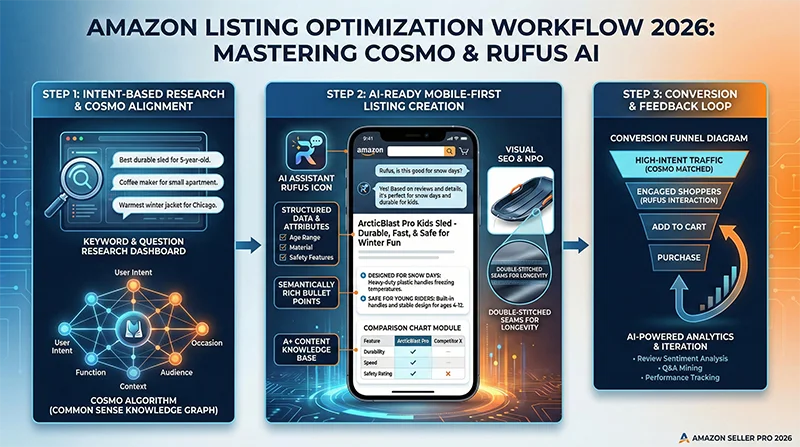
The Amazon e-commerce ecosystem in 2026 is undergoing a profound paradigm shift. While most sellers still optimize listings using five-year-old keyword stuffing tactics, Amazon’s search engine has completed a quantum leap from “lexical matching” to “semantic understanding.” The full deployment of the COSMO algorithm and deep integration of the generative AI assistant Rufus have fundamentally changed the underlying logic of traffic distribution—traditional keyword density optimization is not only losing effectiveness but may even be flagged as low-quality content by AI, resulting in ranking penalties.
What does this change mean for professional sellers? It means your competitors may be capturing traffic using completely different methodologies. They no longer simply stuff titles with keywords but construct “intent-scenario” mappings that align with AI understanding logic. Their bullet points aren’t just feature lists but carefully designed RAG retrieval material libraries. Their main images aren’t just for human eyes—they’re crafted so AI with computer vision capabilities can “read” every text annotation on the image.
This article will dissect the complete methodology for Amazon Listing Optimization in 2026 based on the latest algorithm research and real-world data. From COSMO’s common sense reasoning mechanisms to Rufus’s retrieval-augmented generation technology, from mobile-first title strategies to OCR-friendly visual marketing, from backend structured data governance to SQP-driven traffic loops—this is not just an operational manual but a systematic reconstruction of the underlying logic of Amazon product listing.
Algorithm Revolution: Understanding the New Rules of Traffic Distribution in 2026
To execute precision Amazon SEO Strategy, you must first understand the underlying code logic controlling the traffic switches. Amazon’s 2026 algorithm is powered by dual engines: COSMO for common sense reasoning and Rufus for interactive retrieval. The synergy between these two systems forms the core capability of the next-generation search engine.
COSMO Algorithm: Giving Search Engines “Common Sense”
The core breakthrough of the COSMO algorithm lies in bridging the semantic gap between “search terms” and “purchase intent.” The traditional A9 algorithm could only judge relevance based on historical click data, a method that often fails when facing new products or long-tail demands. COSMO, however, possesses human-like reasoning capabilities—it mines massive user behavior data to construct a knowledge graph containing “entity-attribute-intent” relationships.
Here’s a concrete example. When users search for “maternity shoes,” traditional algorithms mechanically look for products with both “maternity” and “shoes” in the title. But COSMO, through common sense reasoning, knows that pregnant women experience foot swelling during pregnancy and require extremely high slip-resistance for safety. Therefore, it defines attributes like “Non-slip,” “Wide fit,” and “Slip-on” as implicit core needs under this search intent. Even if your title doesn’t directly say “maternity shoes,” as long as your bullet points clearly articulate the causal chain of “widened shoe last design to accommodate pregnancy foot swelling,” COSMO can accurately capture the strong association between your product and this intent.
This brings profound implications for Amazon Listing Optimization strategy: Listing copy cannot merely list product names but must clearly articulate the causal relationship between product attributes and users’ deep needs in bullet points and A+ pages. If your listing lacks specific technical descriptions of “slip-resistance” (such as “rubber outsole tread pattern design”), even if the title is stuffed with “maternity shoes,” in COSMO’s knowledge graph, the connection strength between this product and the “maternity” intent will be extremely weak, leading to traffic loss.
Rufus Assistant: The Interactive Revolution Brought by Generative AI
Rufus is Amazon’s shopping assistant developed based on large language models, changing how users obtain information. Users no longer need to click through search results one by one to view detail pages but can directly ask Rufus: “Is this coffee machine suitable for a small kitchen?” “Will this yoga mat slip when sweaty?” Rufus will extract information fragments from listing detail pages, user reviews, and Q&A in real-time to generate answers.
This application of RAG (Retrieval-Augmented Generation) technology places new demands on listing copy. First is the enhancement of “fact density”—overly marketing adjectives (like “amazing,” “unparalleled”) are noise to AI and will be filtered out. Conversely, specific parameters (like “base width only 15cm”) and clear material specifications (like “304 food-grade stainless steel”) are “high-value data” preferred by AI. Second is the enhancement of “interference resistance”—listings must eliminate ambiguity in structure and avoid contradictions (like writing “genuine leather” in the title but selecting “PU leather” in attributes). Such data conflicts can cause AI “hallucination” risks, triggering automatic system blocking mechanisms.
More critically, Rufus’s existence has elevated the strategic importance of Q&A and Reviews to unprecedented levels. Because when Rufus answers user questions, it prioritizes citing content from these two sections. This means professional sellers need to pre-plant high-quality Q&A pairs containing core keywords through “seed questions” in the early listing stage (such as: “Can this backpack fit a 16-inch MacBook Pro?”—”Yes, the main compartment measures 45x32x15cm with a dedicated laptop sleeve with shock-absorbing padding, supporting devices up to 17 inches”). These structured Q&A pairs will be directly captured by Rufus, becoming traffic entry points.
Preliminary Preparation: Data-Driven Competitor Research System
The precision Amazon Product Listing process begins not with writing copy but with data-driven deep research. According to 2026 best practices, this stage covers everything from core keyword identification to competitor visual deconstruction.
Three Core ASIN Collection Strategies
The depth of research determines the ceiling of your listing. We need to build a comprehensive database containing traffic keywords, conversion keywords, and competitor benchmarks. Specifically, we need to collect three types of ASINs for cross-analysis, at least 10 of each type, to ensure statistical significance.
The first type is the top 10 ASINs in search rankings. For core broad keywords (like “Running Shoes”), the top 10 organically ranked products on search result pages represent current SEO weight distribution and mainstream traffic entry points. The 2026 analysis focus is no longer simply extracting their title keywords but deeply observing the noun phrase structures in their titles—for example, “Water-Resistant Trail Running Shoes for Men,” a natural language expression with modification and qualification relationships, far more aligned with COSMO’s semantic understanding logic than keyword stuffing like “Running Shoes Men Trail Water Resistant.” Also note whether they have Amazon Choice or Climate Pledge Friendly badges, as these labels often correspond to specific algorithm weighting.
The second type is the top 10 ASINs on BSR rankings. Products on the subcategory Best Sellers list represent market benchmarks with extremely high conversion rates. Analyzing their price tiers and review count growth slopes can determine whether they dominate through low-price spirals or brand premiums. This directly impacts your pricing strategy and promotion rhythm.
The third type is the top 10 ASINs on new release rankings. The New Releases list captures the latest market trends and differentiation tactics. Observing the visual style differentiation of these new products and whether they adopt new feature selling points to enter the market (such as long-tail keyword layouts optimized for Rufus) can help you avoid red ocean competition and find blue ocean opportunities.
Pain Point Mining and User Persona Profiling
In the AI era, the most valuable data is users’ authentic feedback. By using Reviews Scraper API to crawl 1-3 star negative reviews of competitors for semantic analysis, you can quickly identify high-frequency negative phrases.
For example, if competitor yoga mats commonly have “slippery when sweaty” complaints, this is not just a pain point but a core differentiation selling point for new product entry. You need to transform this pain point into a “solution” description in your listing and display it prominently in bullet points: “SWEAT-PROOF GRIP TECHNOLOGY: Unlike standard PVC mats that become slippery when wet (Competitor Pain Point), our mat features a dual-layer texture with moisture-wicking channels (Feature). This ensures stable grip even during hot yoga sessions (Context), letting you focus on your practice without safety concerns (Benefit).”
This copy based on real pain points not only directly captures customers dissatisfied with competitors but also provides Rufus with a clear “problem-solution” mapping, increasing recommendation probability.
Competitor Visual Deconstruction and Data Collection
Visuals are the core of conversion. The 2026 SOP requires pixel-level deconstruction of competitors’ main images, additional images, and A+ pages. Build a visual analysis table comparing the visual strategies of Top 10 competitors: Are main images pure white background photography or 3D renders? Does the product occupy more than 85% of the frame? Is packaging displayed?
Data shows that 3D rendered images for standard products (like 3C accessories, home goods) often have higher click-through rates (CTR) than traditional photography due to perfect light control and detail presentation. For infographics, analyze how competitors visualize abstract parameters—for example, whether they use “water droplet bounce” close-ups to demonstrate “waterproof” functionality. Since Rufus has OCR image recognition capabilities, text overlays on images must contain core keywords to be indexed by AI.
For sellers needing large-scale competitor data collection, Scrape API provides an efficient solution. It supports batch scraping of Amazon product details, ranking data, review content, and other public information, outputting structured JSON format, enabling rapid construction of competitor analysis databases to support listing optimization.
Cost Accounting and Pricing Strategy: Balancing Profit and Algorithm
In 2026, Amazon’s various fees (advertising costs, FBA shipping fees, storage fees) continue to rise, making precision cost accounting the foundation for listing survival. Before official listing, two core prices must be determined: the break-even point and the target price.
FBA Shipping Fee Optimization: The Hidden Value of Packaging Design
FBA fees are calculated based on weight and dimensional tiers. Many sellers overlook a key fact: during product development and packaging design stages, strictly comparing Amazon’s dimensional tier tables and reducing packaging thickness by 0.2 inches might downgrade it from “large standard size” to “small standard size,” saving several dollars per unit in shipping fees. This micro-adjustment of packaging volume directly determines net profit margin.
The SOP requires comparing competitor packaging dimensions to design more compact, crush-resistant packaging solutions that both reduce damage rates and optimize costs. This seemingly belongs to supply chain work but is actually a prerequisite for Amazon Listing Optimization—because only ensuring sufficient profit margin can support subsequent PPC advertising investment and promotional activities.
Price Tier and Promotional Space Reservation
Analyze BSR ranking price distributions to find price tiers with the highest order density. New product pricing strategies typically include “skimming pricing (high price, high positioning)” and “penetration pricing (low price entry).” In 2026, due to Amazon’s algorithm’s increased consideration of margin management, blind low-price spirals lead to account weight decline (due to inability to support sufficient advertising investment).
The SOP emphasizes that list prices must include sufficient “discount space.” New product promotion periods typically require coordination with Coupons or Prime exclusive discounts to boost click-through rates. It’s recommended to reserve 20%-30% gross margin space for various promotional activities (Deals) and PPC advertising spending to maintain healthy listing lifecycle operation.
Structured Copywriting: The Art of Human-AI Co-Reading
Copywriting is the core element of Amazon Listing Optimization Best Practices 2026. In 2026, copy must simultaneously satisfy two types of “readers”: human buyers (seeking emotional resonance and quick information access) and AI algorithms (seeking structured data and semantic clarity).
Mobile-First Title Strategy
With mobile shopping exceeding 70% of traffic, titles are typically truncated at 70-80 characters on search result pages. This is the origin of the “first 70 characters rule”—the SOP mandates placing brand name + core noun phrase + most compelling differentiation selling point within the first 70 characters of the title.
Wrong example: “High Quality Professional Stainless Steel Kitchen Tool for Cooking…” (too much ineffective information, core product not revealed). Correct example: “Garlic Press, Rust-Proof Stainless Steel Crusher with Peeler…” (brand + core keyword + core selling point immediately clear).
More importantly is Noun Phrase Optimization (NPO). Abandon traditional keyword stuffing. Rufus prefers natural language structures. Use noun phrases with modification and qualification relationships (like “Water-Resistant Travel Backpack for Men”) rather than scattered words (“Backpack Travel Bag Rucksack”). This not only improves readability but also better aligns with COSMO’s “intent” capture logic.
RAG-Ready Bullet Points
Bullet points are Rufus’s primary source for extracting answers. The SOP adopts a modular writing formula of “capitalized headline + pain point/scenario + feature + benefit.” Each point’s structure is as follows:
Capitalized Headline (The Hook): 3-5 words, all caps, summarizing the core selling point of that bullet (facilitating quick mobile scanning). Feature & Pain Point: Describes what specific problem the product solves. Context & Benefit: Combined with COSMO’s scenario keywords, explains the actual benefit to users.
Example: “MILITARY-GRADE DURABILITY: Unlike standard nylon bags that tear easily (Competitor Pain Point), our backpack is crafted from 1000D Cordura fabric (Feature). This ensures your gear remains secure even during rugged mountain trekking or tactical operations (Context), providing you with peace of mind in harsh environments (Benefit).”
The SOP requires naturally integrating core keywords and attribute keywords settled during the research phase into bullet points, but avoid forced insertion. Each line of description should directly respond to the Top 3 core pain points. Additionally, it’s recommended to explicitly answer the 3 most frequent questions from competitor Q&A in the bullets, preemptively eliminating buyer concerns.
Backend Structured Data: The Overlooked Traffic Switch
This is the most easily overlooked yet critically important element in 2026. AI heavily relies on structured data. Every backend attribute field (Attributes), such as material, target audience, specific uses, care instructions, etc., must be filled. Leaving blanks will be interpreted by AI as “this product does not have this attribute,” thus being filtered out in relevant searches.
Subject Matter and Intended Use must use standard values (Taxonomy Values) from the Listing Report, for example selecting “Induction Cooking” rather than manually typing “Cooking on induction.” Standard values can be instantly recognized and categorized by the system.
Backend Search Terms are limited to 250 bytes. SOP rules: Don’t repeat words already in title and bullets; focus on synonyms, common misspellings (like “pilliow”), Spanish synonyms (for US marketplace), and colloquial expressions; no need for comma separation, just use spaces.
Visual Marketing and A+ Content: Building Brand Moats
Visual content is not only for human consumers but also for AI with computer vision capabilities. How to Optimize Amazon Product Listings in 2026 must address both dimensions.
OCR-Friendly Image Strategy
Amazon’s algorithm performs OCR recognition on text in images. In infographics, core selling points must be clearly printed on images as text. For example, if the product is “double-wall vacuum insulation,” the image must prominently display the text “Double-Wall Vacuum Insulation.” This not only increases human readability but also provides AI with a secondary confirmation text signal, enhancing relevance weight.
Lifestyle images should showcase product usage in specific scenarios, corresponding to COSMO’s scenario understanding capability. Must include core demographics (like young women in gyms) and product interaction close-ups.
Strategic Value of Premium A+ Content
A+ content is the listing’s “knowledge base.” Comparison charts are the highest-converting module—by horizontally comparing different models within the brand, or (within compliance) comparing with generic products, guiding users toward upselling. Parameters in comparison charts (like battery capacity: 2000mAh vs 4000mAh) can be directly read by Rufus to answer “how is this better than that?” questions.
Every A+ image must have ALT text filled in. The SOP requires describing image content in ALT text while naturally integrating long-tail keywords. Don’t simply stuff keywords but write coherent sentences, like “Close up of waterproof zipper on black travel backpack,” helping visually impaired users and search engines understand image content.
The Brand Story module can link store-wide traffic, not only enhancing brand premium but also occupying massive visual real estate at the top of detail pages, suppressing competitor ad placements.
Full-Chain Traffic Loop: SQP-Driven Continuous Optimization
Listing launch is not the endpoint but the starting point of data optimization. The 2026 operational core lies in connecting Search Query Performance (SQP) with PPC advertising traffic loops.
Search Query Performance Report Diagnosis and Application
SQP reports provide full-funnel data from impressions to purchases, serving as the gold standard for diagnosing listing health. High impressions but low click-through rate indicates insufficient main image appeal, title’s first 70 characters missing pain points, or uncompetitive pricing—requires main image A/B testing (3D vs photography), rewriting title prefix, checking if competitors are running major promotions.
High clicks but low add-to-cart rate indicates detail page copy not addressing concerns, negative review impact, or price-value mismatch—requires checking if bullet points are clear, adding A+ comparison charts, checking for pinned negative reviews, optimizing Q&A.
High add-to-cart but low conversion rate indicates checkout stage abandonment, possibly due to shipping costs, delivery time, or final price sensitivity—can set Coupons for final push, check if FBA inventory distribution supports Prime same-day delivery.
Low brand share indicates low keyword ranking, insufficient exposure—requires increasing PPC investment intensity for that keyword (Exact match), coordinating with off-Amazon traffic for momentum building.
Synergy Between Advertising and Organic Traffic
Use PPC advertising (especially Sponsored Products) for precision targeting of core noun phrases. After sales, the system records the strong correlation between that keyword and product, thus improving organic ranking. This is PPC’s role as a “signal transmitter.”
Defensive strategy is placing ads on your own brand keywords and ASINs to prevent competitor traffic hijacking. Offensive strategy is using Product Attribute Targeting (PAT) to place ads on competitor listing pages with “obvious pain points.” If competitors are criticized for being “fragile,” your listing emphasizes “durable construction” and advertises on their page, conversion rates will be extremely high.
Q&A Keyword Planting and Review Management
User-generated content (UGC) is considered “ground truth” by Rufus. In the early listing stage, arrange users to ask questions containing core keywords (like: “Can this backpack fit a 16-inch MacBook Pro?”). When sellers reply, reconfirm the keyword and provide affirmative answers. This establishes a “Q&A pair” in the database with extremely high probability of being directly captured by Rufus as answers.
For sellers needing continuous monitoring of product performance and competitor dynamics, AMZ Data Tracker provides visualized data tracking solutions. It can monitor keyword rankings, BSR changes, review growth, and other core metrics in real-time, helping sellers promptly identify issues and adjust strategies.
Conclusion: Execution Determines Victory
This 2026 Amazon Listing Optimization guide covers the entire process from algorithm principles to pixel-level operations. It requires operators to transform from single-function “copywriters” to “data engineers” and “content architects.”
Core action checklist includes: comprehensive audit of all backend null values, eliminating “Nulls”; based on COSMO logic, upgrade keyword lists to “intent-scenario” mapping tables; introduce 3D rendering and OCR-friendly infographics to adapt to AI image recognition; weekly SQP report reviews, dynamically adjusting listings and PPC strategies based on data funnels.
In the highly transparent and intelligent algorithm environment of 2026, only extreme precision operations can establish insurmountable brand moats in fierce global competition. Executing this SOP is not just about accommodating algorithms but about precisely conveying product core value in every human-AI interaction.
For professional sellers and SaaS companies requiring large-scale data support, Pangolinfo provides complete e-commerce data solutions, from real-time data collection to visual analysis, helping you build data-driven operational systems.
Visit Pangolinfo now to access professional Amazon data collection and analysis tools to power your listing optimization journey.