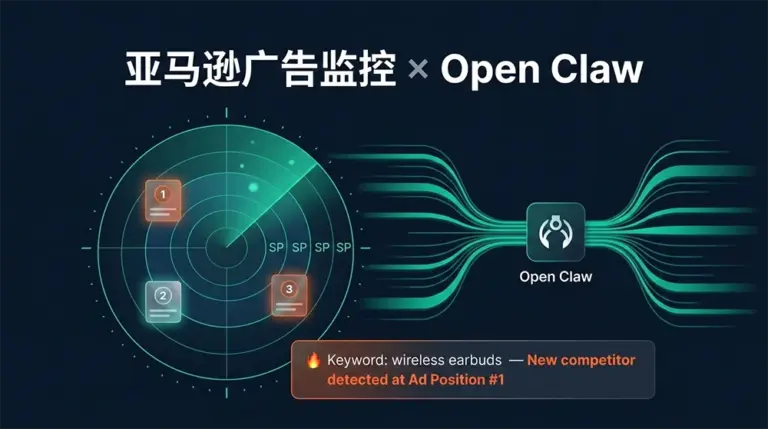

When you search for “wireless earbuds” on Amazon, the 8 Sponsored Product ad positions on the first page hide carefully designed advertising architectures from your competitors: Which keywords are worth targeting? What should the bid be for each keyword? Which time slots deserve increased budget? How can you maximize ROI through ad positioning and pricing strategies?
Traditional competitor ad analysis methods often rely on manual observation and Excel spreadsheets—time-consuming, labor-intensive, and unable to extract systematic strategic insights from massive data. But now, with the emergence of AI tools like ChatGPT and Claude, deconstructing competitor ad architecture has become unprecedentedly efficient. With the right methodology and data input, AI can complete in minutes what used to take days of deep analysis.
This article will detail how to use AI tools to quickly analyze competitor ad architecture, including a complete analytical framework, practical operational steps, and how to obtain high-quality data sources to support AI analysis.
The Five-Dimensional Framework for AI Ad Analysis
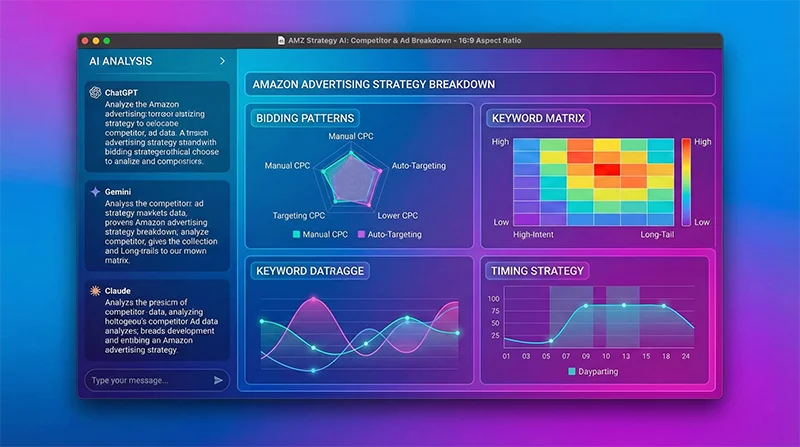
To enable AI to effectively deconstruct competitor ad architecture, we need to establish a systematic analytical framework. Based on hundreds of successful cases, we’ve distilled the “Five-Dimensional Analysis Method”: Keyword Dimension, Bidding Dimension, Temporal Dimension, Positioning Dimension, and Conversion Dimension.
Dimension 1: Keyword Layout Analysis
A competitor’s keyword layout reflects their understanding of market demand and resource allocation strategy. Through AI analysis, we can quickly identify a competitor’s core keyword matrix, long-tail keyword strategy, and priority relationships between keywords.
AI Analysis Prompt Example:
I've collected advertising placement data for competitor ASIN B08XYZ123 over the past week, including which keywords it appeared under, appearance frequency, and ad positions. Data as follows:

[Paste data table]

Please analyze:
1. What are this competitor's core keywords? (Rank by placement frequency and position)
2. Is their keyword strategy broad-net or precision-targeted?
3. Which long-tail keywords should we pay attention to?
4. Based on this data, estimate their approximate monthly advertising budget range?
AI will provide a structured analysis report based on placement frequency, ad position, keyword competitiveness, and other dimensions. For example, it might identify that a competitor concentrates 80% of their budget on 5 core keywords while using 20% to test 30 long-tail keywords—a typical application of the “80/20 rule.”
Dimension 2: Bidding Strategy Analysis
Ad position directly reflects bid levels. By analyzing a competitor’s ad position distribution across different keywords, AI can infer their bidding strategy: aggressive strategy pursuing top placement, or steady strategy prioritizing cost-effectiveness?
Real Case Study: A Bluetooth earbuds seller collected a week’s worth of ad position data for major competitors under the keyword “wireless earbuds” and found:
- Competitor A: Always occupies positions 1-2, suggesting high-bid strategy
- Competitor B: Position fluctuates between 4-6, suggesting medium bidding
- Competitor C: Position between 7-10, suggesting low-price volume strategy
After inputting this data into ChatGPT, the AI analysis suggested: Competitor A might be in a new product launch phase or have extremely high profit margins, willing to exchange high ACOS for market share; Competitor B adopts a balanced strategy, seeking optimal balance between exposure and cost; Competitor C might be an established product relying on brand recognition and price advantage, not needing top ad positions to achieve conversions.
Based on these insights, the seller adjusted their strategy: avoiding Competitor A’s dominance, concentrating firepower on positions 3-5 for precision targeting, successfully reducing ACOS from 32% to 26%.
Dimension 3: Temporal Dimension Analysis
Differences in ad placement intensity across time periods often reveal a competitor’s understanding of user behavior. By having AI analyze a competitor’s ad appearance frequency at different times of day and different days of the week, we can discover their time-slot optimization strategies.
AI Analysis Prompt:
I collected ad data for a competitor under the keyword "dog food," sampling every 2 hours for a week. Data shows:

Monday to Friday:
- 8:00-12:00: Ad appearance rate 85%
- 12:00-18:00: Ad appearance rate 95%
- 18:00-22:00: Ad appearance rate 78%
- 22:00-next day 8:00: Ad appearance rate 45%

Saturday and Sunday:
- All-day ad appearance rate: 60%

Please analyze:
1. What is the competitor's time-slot placement strategy?
2. Why do they reduce placement during certain periods?
3. What insights does this provide us?
AI analysis might point out: The competitor believes weekday afternoon periods (12:00-18:00) have the highest conversion rates, thus maintaining maximum placement intensity; they reduce placement late at night and on weekends, possibly because conversion costs are higher during these periods, or their target customers are mainly office workers who are more likely to make purchases during work hours.
Dimension 4: Positioning Strategy Analysis
By analyzing a competitor’s ad copy, main image style, and price positioning, AI can help us understand the competitor’s target customer segments and differentiation strategies.
Multi-dimensional Data Input:
Competitor ASIN B08ABC123 ad data:
- Price: $49.99
- Main keywords: "premium wireless earbuds", "noise cancelling earbuds"
- Title emphasizes: "Studio Quality Sound", "48H Battery Life"
- Review rating: 4.6 stars (8,234 reviews)
- Ad position: Mainly positions 2-4

Competitor ASIN B08DEF456 ad data:
- Price: $29.99
- Main keywords: "cheap wireless earbuds", "budget earbuds"
- Title emphasizes: "Best Value", "Affordable Price"
- Review rating: 4.3 stars (3,567 reviews)
- Ad position: Mainly positions 5-8

Please analyze the positioning differences and target customer segments of these two competitors.
AI will identify: Competitor A takes the premium route, targeting audiophiles willing to pay a premium for quality; Competitor B takes the value route, targeting price-sensitive consumers. This clear positioning differentiation provides reference coordinates for our own product positioning.
Dimension 5: Conversion Path Analysis
Combining ad position, price, and review data, AI can infer a competitor’s conversion strategy: relying on strong ad position exposure, or building trust through high ratings and review counts?
For example, if a competitor consistently occupies the top ad position but has only a few hundred reviews, it indicates they’re using ad budget to compensate for lack of social proof; conversely, if a competitor has a lower ad position but tens of thousands of reviews with high ratings, it shows they rely on word-of-mouth to drive conversions, with ads serving only as supplementary traffic.
Mainstream AI Tools for Ad Analysis Capability Comparison
ChatGPT: The Most Versatile Analysis Assistant
ChatGPT (especially GPT-4) performs most comprehensively in competitor ad analysis. Its advantages include:
- Strong data processing capability: Can directly upload Excel or CSV files, automatically recognizing data structure
- Multi-dimensional analysis: Can simultaneously consider keywords, price, ratings, time, and other dimensions
- Strategy generation: Not only analyzes current state but generates optimization recommendations based on analysis results
Practical Tip: Using ChatGPT’s Code Interpreter (now called Advanced Data Analysis) feature, you can upload CSV files containing weeks of competitor ad data, letting AI automatically perform visual analysis, generating trend charts, heat maps, etc., which are more intuitive than pure text analysis.
Claude: Excels at Long-Text Deep Analysis
Claude’s advantage lies in handling longer contexts (up to 200K tokens), meaning you can input more historical data at once for deeper trend analysis.
Use case: When you’ve accumulated months of competitor ad data and want to analyze long-term trend changes, Claude is more suitable than ChatGPT.
Specialized AI Analysis Tools
There are also some AI tools specifically for e-commerce ad analysis on the market, which typically have built-in industry knowledge bases and can provide more targeted recommendations. However, the core logic of these tools is similar to using ChatGPT—both are based on data input for pattern recognition and strategy generation.
From Data to Decisions: Complete AI-Driven Analysis Process
Step 1: Define Analysis Objectives
Before starting data collection, clarify the questions you want to answer:
- Which keywords should I target?
- What’s the reasonable bid range for each keyword?
- Which time slots have the best placement results?
- How should my product be positioned to avoid red ocean competition?
The clearer the objectives, the more targeted the AI analysis results.
Step 2: Collect Competitor Ad Data
This is the foundation of the entire process. Data you need to collect includes:
- Basic data: Competitor ASIN, keywords appeared under, ad position, price
- Temporal data: Collection time, date, time slot
- Auxiliary data: Review rating, review count, Prime badge, seller name
Recommended data collection frequency: Core keywords 2-3 times daily, continuing for at least one week to capture time-slot variations and weekend differences.
Step 3: Data Preprocessing
Organize collected raw data into a format AI can easily understand. Table format is recommended:
| Collection Time | Keyword | ASIN | Ad Position | Price | Rating | Reviews |
|---|---|---|---|---|---|---|
| 2026-01-10 08:00 | wireless earbuds | B08XYZ123 | 1 | 49.99 | 4.6 | 8234 |
| 2026-01-10 08:00 | wireless earbuds | B08ABC456 | 2 | 39.99 | 4.4 | 5621 |
Step 4: AI Analysis and Insight Extraction
Input organized data into AI tools, paired with carefully designed prompts, to have AI perform multi-dimensional analysis. The key is guiding AI not just to describe phenomena but to explain causes and provide recommendations.
High-Quality Prompt Template:
I'm an Amazon seller analyzing competitor advertising placement strategies. Here's a week's worth of competitor ad data I collected:

[Paste data]

As a senior Amazon advertising optimization expert, please perform the following analysis:

1. Keyword Analysis:
   - Identify competitor core keywords and long-tail keywords
   - Analyze keyword placement priority

2. Bidding Strategy Analysis:
   - Infer bid levels based on ad positions
   - Identify bidding strategy differences among competitors

3. Temporal Strategy Analysis:
   - Analyze placement time-slot patterns
   - Identify peak and off-peak periods

4. Positioning Analysis:
   - Based on price, keywords, ratings, etc., analyze competitor market positioning

5. Strategic Recommendations:
   - For my new product (price $45, currently 0 reviews), how should I formulate an ad strategy?
   - Which keywords are worth prioritizing?
   - Recommended bid range and budget allocation?

Please provide specific, actionable recommendations with reasoning.
Step 5: Strategy Formulation and Execution
Based on AI analysis results, formulate specific ad placement plans:
- Keyword selection: From AI-recommended keyword list, select 10-15 for initial placement
- Bid setting: Reference AI-provided bid ranges to set initial bids
- Time-slot adjustment: Based on competitor time-slot patterns, set ad time-slot adjustment coefficients
- Budget allocation: Distribute budget to different keywords according to AI-recommended ratios
Step 6: Continuous Monitoring and Optimization
After ad placement, continue collecting data, conducting AI review analysis weekly, adjusting strategy based on actual performance. This creates a closed loop of “data collection → AI analysis → strategy adjustment → data collection.”
Real Case Study: Using AI to Deconstruct Competitor Ad Architecture, Optimizing ACOS in 3 Weeks
A kitchenware seller had a new product with ad ACOS as high as 45%, far exceeding industry average. They decided to systematically analyze competitor ad strategies using AI.
Week 1: Data Collection and Preliminary Analysis
They selected 3 main competitors, targeting 20 related keywords, collecting ad data three times daily (morning, afternoon, evening). After one week, they accumulated 420 data records.
After inputting data into ChatGPT, AI identified:
- Competitor A concentrates 70% of budget on 5 high-conversion keywords
- Competitor B adopts broad-net strategy, targeting 50+ keywords but with low budget for each
- Competitor C only places ads on weekdays, completely stopping on weekends
Week 2: Strategy Adjustment
Based on AI analysis, the seller made three key adjustments:
- Cut 15 low-efficiency keywords, concentrating budget on AI-recommended 8 core keywords
- Following Competitor A’s successful experience, increased bids on these 8 core keywords to compete for top 5 positions
- Reduced weekend ad budget by 50%, adding saved budget to weekdays
Week 3: Results Validation
Third week after adjustments, data showed:
- ACOS decreased from 45% to 34%
- Ad sales increased 18%
- Core keyword conversion rate increased 25%
More importantly, through this process, the seller established a reusable AI analysis workflow that can be quickly replicated when launching new products.
The Prerequisite for AI Analysis: Obtaining High-Quality Competitor Ad Data
By now, you’ve probably realized: AI tools are indeed powerful, but their analysis quality completely depends on the quality of data you input. As mentioned earlier, AI is the “knife,” data is the “ingredients”—even the best knife can’t make a good dish without fresh ingredients.
This raises a critical question: How do you obtain real-time, accurate, and complete competitor ad data?
Limitations of Traditional Methods
Most sellers try the following methods:
Manual Recording: Arranging team members to regularly search keywords and manually record ad position information. Problems with this method: extremely low efficiency, one person can record at most 20-30 keywords per day; inaccurate data, because Amazon’s ad display is personalized—what you see may differ from what real buyers see; can’t scale, when you need to monitor hundreds of keywords, labor costs rise sharply.
DIY Scrapers: Technically capable sellers try to automate collection using Python and other tools. But this faces high technical barriers and large maintenance costs. Amazon’s page structure changes frequently, each adjustment potentially causing scraper failure; moreover, Amazon has strict anti-scraping mechanisms, improper handling can easily lead to blocking. More critically, generic scrapers typically achieve only about 70% accuracy in identifying SP ad positions, meaning you’ll miss 30% of competitor information.
Professional Data Collection Solution: Pangolinfo Scrape API
Since AI analysis requires high-quality data support, the most efficient solution is using professional data collection services. Pangolinfo Scrape API is specifically optimized for Amazon advertising data collection, solving core pain points of traditional methods.
Core Advantage 1: 98% SP Ad Position Recognition Accuracy
The Pangolinfo team has developed specialized parsing templates for Amazon SP ad positions, accurately identifying all ad positions at the top, middle, and bottom of search results pages, as well as recommended ad modules on product detail pages. 98% accuracy means if a keyword has 8 ad positions, Pangolinfo can accurately capture 7.8 of them (statistically speaking), while generic scrapers might only capture 5-6.
That extra 28% of data is often information about the aggressive competitors you most need to watch.
Core Advantage 2: Real-Time Data Collection
Pangolinfo uses real-time collection architecture. When you make an API request, the system immediately accesses Amazon’s frontend to obtain current moment’s latest data, rather than returning cached historical data. This means you can achieve minute-level competitor ad monitoring, promptly discovering competitor strategy changes.
For example, you can set up automatic data collection every 2 hours, giving you 12 time-point snapshots per day, sufficient to analyze competitor time-slot placement patterns.
Core Advantage 3: Complete Multi-Dimensional Data
The API returns not just ad position information but also ASIN, product title, price, main image URL, review rating and count, seller name, Prime badge, and other complete data, all output in structured JSON format, directly importable to Excel or inputtable to AI tools for analysis.
Furthermore, Pangolinfo supports specifying zip codes for collection, meaning you can analyze competitor ad placement differences across regions, obtaining more granular competitive intelligence.
Core Advantage 4: API Calling Method, Seamless AI Workflow Integration
Unlike traditional SaaS tools, Pangolinfo provides services through API calling, meaning you can integrate data collection directly into your AI analysis workflow:
# Simple Python example
import requests

# Call API to get data
response = requests.post(
    "https://api.pangolinfo.com/scrape/amazon/search",
    json={"keyword": "wireless earbuds", "marketplace": "US"},
    headers={"Authorization": "Bearer YOUR_API_KEY"}
)

data = response.json()

# Extract SP ad positions
ads = [item for item in data['items'] if item['is_sponsored']]

# Directly input to ChatGPT for analysis
# Or save as CSV file to upload to AI tools
The entire process can be fully automated: scheduled API calls to collect data → automatically organize into AI-required format → input to AI tools to generate analysis reports → adjust ad strategy based on reports.
Visualization Solution: AMZ Data Tracker
If your team lacks API integration capabilities, Pangolinfo also offers AMZ Data Tracker, a no-code solution. Built on the same Scrape API but providing a friendly graphical interface, it lets you implement competitor ad monitoring without writing any code.
In AMZ Data Tracker, you simply input the keyword list you want to monitor, set collection frequency, and the system automatically collects data and displays it in chart form. All data supports export to Excel format, directly uploadable to ChatGPT for AI analysis.
Conclusion: AI + Data, Building a Complete Competitor Ad Analysis Loop
Using AI to quickly deconstruct competitor ad architecture centers on building a complete loop of “data collection → AI analysis → strategy optimization”:
- Define analysis objectives: Determine specific questions you want to answer
- Collect high-quality data: Use professional tools (like Pangolinfo Scrape API) to obtain accurate, real-time, complete competitor ad data
- AI multi-dimensional analysis: Apply the five-dimensional framework, having AI analyze competitor strategies from keyword, bidding, temporal, positioning, and conversion perspectives
- Formulate optimization plans: Based on AI insights, adjust your own ad placement strategy
- Continuous iterative optimization: Regular reviews, forming a data-driven decision cycle
AI tools make competitor ad analysis unprecedentedly efficient, but the prerequisite is having a reliable data source. As stated at the article’s beginning: AI is the sharp knife, data is the fresh ingredients—both are indispensable.
Now you’ve mastered the complete AI analysis methodology. The next step is establishing your competitor ad data monitoring system, allowing AI’s analytical capabilities to truly shine.
Take Action Now
Technical Team Route: Visit Pangolinfo API Documentation to learn how to obtain competitor ad data through API calls, integrating data collection into your AI analysis workflow.
Non-Technical Team Route: Use AMZ Data Tracker visualization tool to configure monitoring tasks through graphical interface, export data, then input to ChatGPT for analysis.
Starting today, let AI and data become your winning weapons in Amazon advertising competition!
Key Article Takeaways
- AI tools (ChatGPT/Claude) can quickly deconstruct competitor ad architecture—key is mastering the right analytical framework
- Five-dimensional analysis method: keywords, bidding, temporal, positioning, conversion—systematically analyze competitor strategies
- Complete workflow: objective definition → data collection → AI analysis → strategy formulation → continuous optimization
- AI analysis prerequisite is high-quality data sources; Pangolinfo Scrape API provides 98% accuracy real-time data
- Through API calling or visualization tools, can build “data collection → AI analysis” automated loop
Ready to optimize your advertising strategy with AI?
Visit Pangolinfo official website to learn about data collection solutions, or go directly to the console to start your free trial!