
Why Amazon Sellers Need Off-site Data: Three Blind Spots of Single Data Source
While most Amazon sellers remain focused on on-site data analysis—monitoring BSR rankings, tracking competitor prices, and following review growth—the market’s most astute sellers have already shifted their attention off-site. They’ve discovered a universally overlooked fact: relying solely on Amazon platform internal data is like viewing the world with one eye closed; you can never obtain a complete market picture.
This limitation in data perspective manifests in three critical blind spots. First is the missing consumer decision journey. Today’s shoppers conduct an average of 12 searches before making a purchase, with over 60% of these searches occurring on Google rather than Amazon. When users search “best wireless earbuds 2026” on Google, what do they see? Which brands appear in AI Overview recommendations? Which products get Featured Snippet placement? These critical pieces of information directly influence which keywords users ultimately search on Amazon and which products they click, yet Amazon on-site data knows nothing about this.
Second is the lag in market trend prediction. Amazon on-site data reflects market changes that have “already happened”—when you notice a keyword’s search volume surging, competitors may have been positioning for three months. However, Google data scraping helps you capture earlier signals: changes in search interest shown by Google Trends, growth in YouTube product review video views, and increased Google Maps searches for physical stores. These are all leading indicators of emerging market demand. Mastering this off-site data means you can discover market opportunities 2-3 months ahead of competitors.
The third blind spot is authentic brand influence assessment. Your product sells well on Amazon, but do consumers truly recognize your brand? When users search your brand name on Google, do positive reviews or negative complaints appear? How does your brand rank in industry comparison searches? Which keywords are competitors bidding on through Google Ads to intercept your brand traffic? The answers to these questions lie in off-site data, yet they’re critical indicators for long-term brand development.
Four Business Values of Off-site Data: From Traffic Attribution to Trend Prediction
Value One: Complete Consumer Decision Journey Reconstruction
Traditional Amazon data analysis only shows consumer behavior within the platform—what keywords they searched, which products they browsed, what they ultimately purchased. But this is just the tip of the iceberg. The real consumer decision journey often looks like this: search product category on Google → watch YouTube review videos → find nearby physical stores on Google Maps → return to Google to search specific brands → finally purchase on Amazon.
Through Google search results extraction, you can understand what users focus on in the early decision stage. For example, when searching “running shoes for flat feet,” which brands appear on Google’s first page? What key features does AI Overview recommend? This information tells you what has already influenced consumers before they form purchase intent. If you discover a competitor frequently appearing in the top three of related searches, even if its Amazon ranking is lower than yours, it may be continuously acquiring high-quality traffic through off-site channels.
Going further, Google Maps data reveals the connection between offline and online. Consumers in certain categories prefer to experience products in physical stores before comparing prices online. By analyzing search volume, review content, and popular times for related stores on Google Maps, you can determine which regions are experiencing offline demand growth and optimize Amazon logistics and advertising for these areas in advance.
Value Two: Early Market Trend Signal Capture
Market trend evolution follows a pattern: demand emergence → search growth → content explosion → e-commerce conversion. When a new consumer demand appears, it first reflects in Google search volume changes, followed by increased related content (blogs, videos, social media), and finally forms obvious sales trends on e-commerce platforms like Amazon.
Here’s a real case: In early 2024, the keyword “ice bath” began showing sustained search volume growth on Google, but competition for related products on Amazon wasn’t yet intense. Sellers who monitored Google Trends through off-site data analysis tools positioned themselves in the portable ice bath niche three months early, accumulating sufficient reviews and ranking advantages when the market exploded. Sellers relying only on Amazon on-site data discovered this opportunity when the market had already become a red ocean.
Another value of Google data is seasonality and cyclical prediction. By analyzing historical search data, you can precisely know when demand peaks will arrive for certain categories, how far in advance to start stocking, and when to increase advertising investment. This prediction based on years of historical data is far more reliable than short-term data fluctuations on Amazon.
Value Three: Comprehensive Competitor Strategy Perspective
On Amazon, you can see competitors’ prices, rankings, and review counts, but you can’t see their complete marketing strategies. Off-site data fills this gap. Through Google data scraping, you can discover which keywords competitors bid on in Google Ads, their bidding strategies, and what selling points their ad copy emphasizes. You can also see their content marketing layout—which websites published review articles, which YouTube bloggers they partnered with, and which long-tail keywords their SEO strategy focuses on.
More subtle is brand protection strategy. Some competitors purchase your brand keyword ads on Google, so when users search your brand, they first see competitor ads. If you don’t monitor off-site data, you might not even know your brand traffic is being intercepted. By regularly scraping Google search results for brand keywords, you can detect this situation promptly and take countermeasures.
Additionally, competitor store data on Google Maps is valuable. If a competitor has opened experience stores in multiple cities and Google Maps reviews and search volume are growing, this may indicate they’re building integrated online-offline brand advantages worth your attention and learning.
Value Four: New Traffic Entry in the AI Era
After Google launched AI Overview in 2024, the search results page landscape fundamentally changed. Before the traditional 10 blue links, an AI-generated comprehensive answer now appears, directly answering user questions. This position’s exposure value far exceeds ordinary search results because it captures users’ first attention.
For Amazon sellers, AI Overview data collection opens a completely new traffic dimension. When users search “best kitchen knife set under 100,” AI Overview recommends several products and explains the recommendation reasons. If your product appears in this AI-generated recommendation list, it means receiving Google AI’s “endorsement,” significantly boosting brand credibility and click-through rates.
But the question is, how do you know if your product appears in related searches’ AI Overview? Which keywords’ AI Overview mention your brand? What’s competitors’ appearance frequency in AI Overview? These questions can only be answered through systematic off-site data collection. Mastering this information allows you to optimize product listings and adjust content marketing strategies to increase appearance probability in AI recommendations.
Three Off-site Data Collection Solutions Compared: Manual, Tools, API
Solution One: Manual Search Recording (Unsustainable)
The most primitive method is manually searching keywords on Google and recording search results, AI Overview content, ad information, etc. This method’s problems are obvious: extremely low efficiency, incomplete data, inability to track historical changes. One person can manually record at most 20-30 keywords’ search results per day, and details are easily missed. More importantly, Google’s search results are personalized; different regions and devices may see completely different results, which manual methods cannot cover.
Additionally, data from Google Maps, YouTube, and other platforms is even harder to collect manually. You need to open store pages and video pages one by one, copy and paste data, and organize into spreadsheets. This work is not only time-consuming but also error-prone, completely unable to support systematic data analysis needs.
Solution Two: Third-party SEO Tools (Limited Functionality)
Some SEO tools on the market (like SEMrush, Ahrefs) provide Google search data analysis features, but they mainly target website SEO optimization rather than e-commerce data integration. These tools’ limitations include: fixed data dimensions, no customization, limited update frequency, and expensive pricing (monthly fees typically $100-$400).
More critically, these tools are difficult to integrate with Amazon data. You need to manually export and import data between multiple platforms, unable to achieve automated omnichannel e-commerce data integration. Moreover, they typically don’t support the latest data types like AI Overview, showing obvious lag in the rapidly changing search ecosystem.
Solution Three: Professional API Services (Recommended)
Professional Google data scraping APIs can solve all the above problems. Through API calls, you can:
- Batch Collection: Obtain search results for hundreds of keywords at once, including complete information like organic rankings, ad positions, AI Overview, People Also Ask
- Customization: Specify region, language, device type to get precise localized data
- Real-time: Call API anytime to get latest data rather than relying on tool’s scheduled updates
- Structured: Data returned in JSON format, directly importable to databases or analysis systems
- Scalable: Easily extend to other Google ecosystem data sources like Google Maps, YouTube
Cost-wise, APIs charge by actual usage, typically $0.01-$0.05 per query, far lower than SEO tools’ fixed monthly fees. For e-commerce teams needing large-scale, continuous data collection, the API solution’s cost-effectiveness advantage is clear.
Pangolinfo Omnichannel Data Integration Solution: Complete Loop from Collection to Analysis
Core Capability One: Multi-source Unified Data Collection
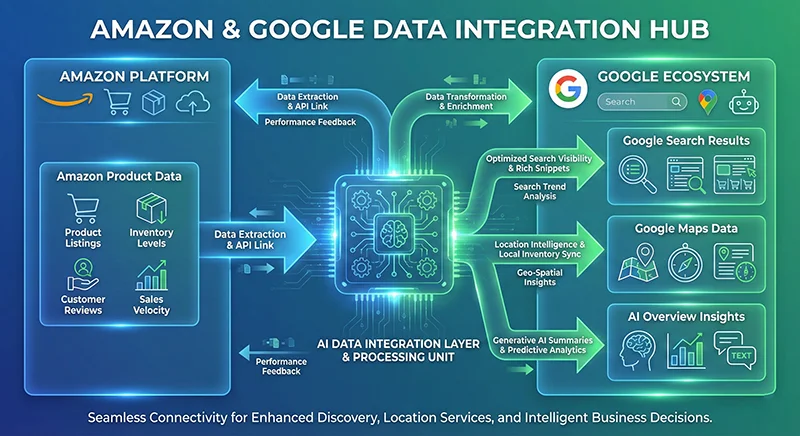
Pangolinfo provides not a single data collection tool, but a complete data collection system covering both Amazon on-site and Google off-site. On-site, Scrape API supports comprehensive Amazon data collection including product details, search results, rankings, reviews, and ad positions. Off-site, our AI Overview SERP API specifically targets the Google search ecosystem, capable of obtaining complete SERP data including AI Overview.
This multi-source unified data collection capability means you can use the same technical architecture and data pipeline to simultaneously obtain on-site and off-site data. Unified data formats and consistent interface calling methods greatly reduce technical integration complexity. You don’t need to interface with multiple different data suppliers or handle various data formats—everything completes within one system.
Core Capability Two: Complete AI Overview Parsing
Google’s AI Overview is currently the most valuable yet hardest to collect data type in the search ecosystem. It’s not simple HTML structure but dynamically generated AI content containing multi-layered information: main answers, citation sources, related questions, recommended products, etc. Ordinary web scraping tools struggle to completely obtain this information.
Pangolinfo’s AI Overview data collection solution is specifically optimized to completely parse all AI Overview components and return them in structured format. You can obtain: AI-generated main answer text, list of cited source websites, related follow-up questions, recommended products or services, and AI Overview’s position information within the entire SERP.
This data is crucial for understanding how Google AI comprehends and answers user questions. By analyzing AI Overview content for numerous keywords, you can discover: which types of questions trigger AI Overview, which sources AI tends to cite, your brand or product’s appearance frequency in AI recommendations, and how to optimize content to increase AI Overview exposure opportunities.
Core Capability Three: Google Maps Business Data
For sellers with offline business or focusing on local markets, Google Maps data is indispensable. Through our Map Data API, you can collect:
- Store Basic Information: Name, address, phone, business hours, website link
- User Review Data: Ratings, review count, review content, review time distribution
- Popular Times: Traffic predictions for different time periods
- Competitor Distribution: Density and distribution of similar stores in specific areas
- Search Trends: Search popularity changes for specific locations or categories
This data helps you make more precise market decisions. For example, if you discover related physical store search volume surging in a city, you can increase Amazon advertising for that region in advance or optimize logistics configuration to shorten delivery time. If you have your own physical stores, analyzing competitors’ Google Maps data helps you understand their service hours, customer reviews, and popular times to optimize your own operations.
Core Capability Four: Data Integration and Visualization
Collecting data is just the first step; more important is how to integrate and analyze on-site and off-site data. Pangolinfo’s AMZ Data Tracker provides a visual data integration platform where you can:
- Correlation Analysis: Associate Amazon keyword rankings with Google search trends to discover traffic source change patterns
- Trend Comparison: Simultaneously display on-site sales curves and off-site search popularity curves to identify causal relationships
- Competitor Monitoring: Track competitors’ comprehensive performance on Amazon and Google for complete competitive situation assessment
- Alert Mechanism: Automatically send alerts when off-site data shows abnormal fluctuations (like sudden search volume increase or negative review growth)
For enterprises with technical teams, we also support exporting data via API to your own BI systems or data warehouses for deeper customized analysis. Data ownership completely belongs to you, allowing long-term storage and free use without platform restrictions.
Core Capability Five: Flexible Pricing Model
Unlike traditional SEO tools’ fixed monthly fees, Pangolinfo adopts a pay-as-you-go model. You only pay for actual data volume used, with no minimum consumption requirement and no feature bundling. This pricing model particularly suits:
- Startup Teams: Can start small, collecting data for just dozens of key keywords monthly with controllable costs
- Seasonal Businesses: Increase data collection during peak season, reduce during off-season, costs fluctuate with business
- Project-based Needs: Temporarily increase data collection for specific projects (like new product launches, market research), stop after project ends without waste
- Large-scale Applications: For enterprises needing to collect thousands of keywords daily, we provide bulk discounts—larger scale, lower unit price
Real Case: Building Amazon+Google Omnichannel Monitoring System
Scenario Description: New Product Launch Omnichannel Data Tracking
Suppose you’re preparing to launch a new Bluetooth earphone on Amazon, product name “SoundPro X1.” Traditional approach only monitors Amazon on-site keyword rankings, sales, reviews, etc. But adopting an omnichannel data integration solution, you can build a more complete monitoring system.
Step One: Establish Monitoring Keyword Matrix
First, establish a keyword matrix covering both on-site and off-site:
- Brand Keywords: “SoundPro X1”, “SoundPro earbuds”
- Category Keywords: “wireless earbuds”, “bluetooth headphones”, “noise cancelling earbuds”
- Competitor Keywords: “AirPods Pro”, “Sony WF-1000XM5”, “Bose QuietComfort”
- Long-tail Keywords: “best wireless earbuds under 100”, “earbuds for running”, “earbuds with long battery life”
These keywords need simultaneous monitoring on both Amazon and Google for data comparison.
Step Two: Set Up Automated Data Collection
Using Pangolinfo’s API, set up daily automated collection tasks. Here’s a simplified code example:
import requests
import pandas as pd
from datetime import datetime

# API Configuration
API_KEY = "your_api_key"
BASE_URL = "https://api.pangolinfo.com"

# Keyword List
keywords = [
    "wireless earbuds",
    "bluetooth headphones",
    "SoundPro X1",
    "best wireless earbuds under 100"
]

# 1. Collect Amazon Search Results
def collect_amazon_data(keyword):
    params = {
        "api_key": API_KEY,
        "type": "search",
        "amazon_domain": "amazon.com",
        "keyword": keyword,
        "page": "1-3"
    }
    response = requests.get(f"{BASE_URL}/scrape", params=params)
    return response.json()

# 2. Collect Google SERP Data (including AI Overview)
def collect_google_data(keyword):
    params = {
        "api_key": API_KEY,
        "keyword": keyword,
        "location": "United States",
        "language": "en",
        "device": "desktop"
    }
    response = requests.get(f"{BASE_URL}/serp", params=params)
    return response.json()

# 3. Integrate Data
results = []
for keyword in keywords:
    # Amazon Data
    amazon_data = collect_amazon_data(keyword)
    amazon_rank = find_product_rank(amazon_data, "SoundPro X1")

    # Google Data
    google_data = collect_google_data(keyword)
    ai_overview = extract_ai_overview(google_data)
    search_volume = google_data.get('search_volume', 0)

    # Merge Results
    results.append({
        'date': datetime.now().strftime('%Y-%m-%d'),
        'keyword': keyword,
        'amazon_rank': amazon_rank,
        'google_search_volume': search_volume,
        'in_ai_overview': check_brand_in_ai_overview(ai_overview, "SoundPro"),
        'ai_overview_content': ai_overview.get('main_answer', '')
    })

# 4. Save to Database or CSV
df = pd.DataFrame(results)
df.to_csv(f'daily_tracking_{datetime.now().strftime("%Y%m%d")}.csv', index=False)
print(f"Data collection complete, {len(results)} records")
Step Three: Data Analysis and Insight Extraction
After collecting data for a period, you can perform multi-dimensional analysis:
Correlation Analysis: When Google search volume rises, is Amazon ranking also improving? If search volume increases but ranking doesn’t change, it indicates traffic isn’t effectively converting to Amazon, possibly requiring off-site traffic optimization.
AI Overview Impact Assessment: Compare keywords appearing in AI Overview versus those not appearing—what’s the difference in Amazon conversion rates? If AI Overview mentions your brand, does related keyword Amazon search volume increase?
Competitor Dynamic Monitoring: When competitors increase Google advertising (judged by SERP ad position count), is your Amazon traffic affected? Need to adjust response strategies promptly.
Trend Prediction: If a long-tail keyword’s Google search volume continues growing but Amazon competition isn’t yet intense, this may be an opportunity for early positioning.
Step Four: Establish Alert Mechanism
Based on data analysis results, set automated alert rules:
- When brand keyword Google search volume drops over 20%, send alert
- When competitors appear in your brand keyword AI Overview, notify immediately
- When a keyword’s Google search volume surges but Amazon ranking unchanged, prompt optimization opportunity
- When negative reviews increase for related stores on Google Maps, warn of brand risk
Actual Results
Sellers adopting this omnichannel monitoring system report they can:
- Discover market trend changes 2-3 weeks early, adjusting strategies before competitors
- Increase off-site traffic conversion rate by 30% through precise identification of high-intent traffic sources
- Reduce ineffective ad spending by 50% through off-site data validation of ad effectiveness
- Grow brand search volume by 80% through monitoring and optimizing off-site brand exposure
From Data Silos to Omnichannel View: Begin Your Data Integration Journey
In the data-driven e-commerce era, relying on single-platform data is like the blind men and the elephant—you can never see the market’s complete picture. Amazon on-site data tells you “what happened,” while Google data scraping helps you understand “why it happened” and “what will happen next.” Integrating both constructs a true omnichannel data view for wiser business decisions.
Off-site data’s value lies not only in supplementing on-site data blind spots but also in opening a completely new competitive dimension. While most sellers still “compete internally” within Amazon, sellers mastering omnichannel e-commerce data integration capabilities have already transcended this limitation, examining markets and strategizing from a higher perspective. They’re not competing with rivals on who operates Amazon more meticulously, but on who can discover opportunities earlier, respond to changes faster, and predict trends more accurately.
Technological progress makes this omnichannel data integration increasingly accessible. You don’t need to build massive technical teams or invest huge costs—through professional off-site data analysis tools and API services, even small and medium sellers can build enterprise-level data analysis capabilities. The key is taking the first step, leaving the comfort zone of single data sources, and embracing a more complete data perspective.
Take Action Now: Three Steps to Begin Omnichannel Data Analysis
Step One: Assess Current State
Review your current data analysis system and ask yourself several questions: Do you know what consumers searched on Google before purchasing? Do you understand competitors’ off-site marketing strategies? Can you predict market trends in advance? If answers are negative, you need to introduce off-site data.
Step Two: Small-scale Pilot
Don’t pursue comprehensiveness from the start—choose 1-2 core products or keywords to begin collecting off-site data. Spend one month observing on-site and off-site data correlations to validate data value. You can start with a free trial of Pangolinfo’s AI Overview SERP API to experience the convenience of Google search results extraction.
Step Three: Systematic Integration
After validating data value, gradually expand scope and establish systematic data collection and analysis processes. Integrate on-site and off-site data into a unified analysis platform with automated monitoring and alert mechanisms. At this stage, consider using visualization tools like AMZ Data Tracker to lower technical barriers.
Data integration isn’t the goal but the means. The ultimate objective is making better business decisions through a more complete data view and gaining competitive advantages. Start acting now—don’t let data blind spots become bottlenecks for your business growth.
Want to learn more about omnichannel e-commerce data integration implementation details? Visit Pangolinfo Documentation Center for complete API documentation and best practice guides, or register directly in the Console for a free trial to personally experience omnichannel data power.
Ready to build your omnichannel data analysis system? Visit AI Overview SERP API to learn more, or register directly in the Console for a free trial to begin your omnichannel data integration journey!