

1. Introduction: E-commerce Data Hegemony and Acquisition Challenges in the Digital Economy Era
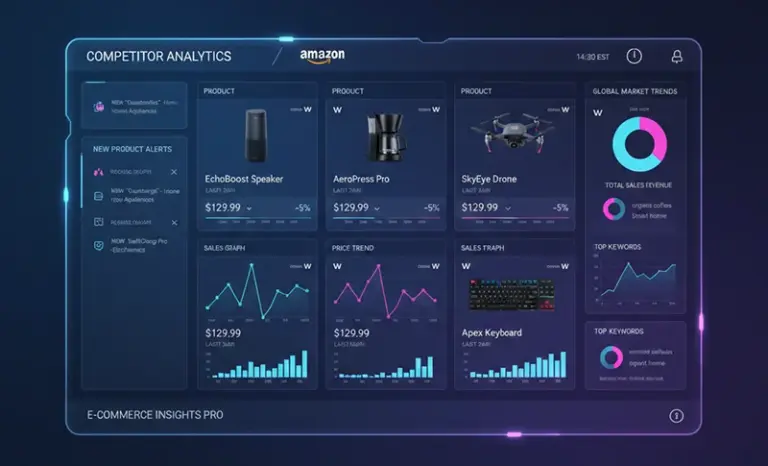
In the global digital economy landscape of 2026, e-commerce is not merely a venue for commodity exchange but a digitized mapping of consumer behavior, market trends, price elasticity, and supply chain dynamics. Amazon.com, as the undisputed hegemon in this landscape, generates petabytes of data daily—encompassing product pricing fluctuations, consumer review sentiment, inventory turnover velocity, and keyword search popularity—which has become the core asset driving global retail decision-making. For brand manufacturers, third-party sellers (3P Sellers), market research institutions, and quantitative hedge funds, the ability to acquire Amazon’s public data in real-time, accurately, and at scale directly determines their success in pricing strategies, new product development, inventory management, and investment decisions.
However, the high-value nature of data inevitably comes with high acquisition barriers. With the proliferation of artificial intelligence (AI) technology, the confrontation between web scraping and anti-bot technologies has evolved into an “arms race” that extends beyond the technical realm. Amazon has deployed the industry’s most complex, dynamic, and machine learning-based defense system, designed to protect its ecosystem from malicious traffic while inadvertently raising the cost of legitimate business intelligence acquisition. For enterprises seeking efficient Amazon Data Scrape API solutions, understanding the technical essence of this adversarial ecosystem is crucial.
This report aims to provide a detailed strategic guide for Chief Technology Officers (CTOs), data engineers, e-commerce operations directors, and legal compliance experts. We will deeply analyze Amazon’s latest anti-bot defense mechanisms in 2026, from TCP/IP protocol stack bottom-layer fingerprints to application-layer behavioral biometrics; we will explore the technical architecture for building highly available data scraping systems, comparing the Total Cost of Ownership (TCO) of “in-house” versus “outsourcing”; and in this context, objectively analyze how enterprise-level e-commerce data collection solutions like Pangolinfo (including Scrape API and AMZ Data Tracker) solve industry pain points through technological innovation. Finally, the report will rigorously explore the legal boundaries and compliance issues of data scraping, ensuring enterprises maximize data value while avoiding legal risks.
2. Defense System Deep Deconstruction: Evolution of Amazon’s Anti-Bot Mechanisms in 2026
To build a successful scraping strategy, one must first understand the defense logic from the opponent’s perspective. Amazon’s defense system is no longer a simple firewall based on static rules (such as User-Agent blacklists) but a multi-layered, multi-dimensional, real-time reputation scoring dynamic system. This system leverages AWS’s massive computing power and global network edge nodes to achieve millisecond-level blocking of anomalous traffic. This advanced Amazon Anti-Bot Technology system represents the industry’s highest level.
2.1 Network and Transport Layer Defense: Traffic Characteristics and Protocol Fingerprints
Before data packets reach the application server, Amazon’s edge network (based on AWS Shield and CloudFront technology stack) has already performed the first round of traffic cleansing.
2.1.1 IP Reputation System and Autonomous System (ASN) Analysis
IP addresses are the first business card of network identity. Amazon maintains a massive IP reputation database that not only records specific IP addresses but also deeply analyzes the Autonomous System (ASN) to which IPs belong. Comprehensive blocking of datacenter IPs has become the norm: traffic from well-known cloud service providers such as AWS EC2, Google Cloud Platform (GCP), Microsoft Azure, and DigitalOcean is almost indiscriminately marked as “suspicious” when accessing Amazon’s front-end pages (such as search result pages and product detail pages). This is because ordinary consumers do not browse shopping websites through cloud servers. In 2026, the success rate of using datacenter proxies directly for scraping has dropped to freezing point, often receiving HTTP 503 Service Unavailable responses or being forcibly redirected to CAPTCHA pages after just a few requests.
The abuse detection mechanism for residential IPs is also continuously upgrading. Although residential IPs (from ISPs like Comcast, Verizon, AT&T) are considered highly trustworthy, Amazon has introduced more granular detection mechanisms. If a residential IP exhibits non-human request patterns within a short period (such as high concurrent access, no Cookies context), it will be temporarily placed on a “graylist” and face stricter CAPTCHA challenges. This is why professional Amazon Scraping API services must be equipped with intelligent IP rotation mechanisms.
2.1.2 TLS Fingerprinting: The Battle of JA3 and JA4
The handshake process of the Transport Layer Security (TLS) protocol has been the core battlefield of anti-bot technology in recent years. When a client (whether a browser, Python script, or Go program) establishes an HTTPS connection with a server, it sends a series of unencrypted metadata in the Client Hello message, including supported TLS versions (such as TLS 1.2, TLS 1.3), cipher suites list and their arrangement order, supported elliptic curves and point formats, and TLS extensions and their parameters.
Security researchers have discovered that different TLS client libraries (such as OpenSSL, BoringSSL, NSS) and browsers (Chrome, Firefox, Safari) have unique characteristics when constructing Client Hello messages. By hashing these characteristics, unique fingerprints (such as JA3 or JA4 fingerprints) can be generated. Amazon’s detection logic compares whether the User-Agent in the HTTP request header matches the underlying TLS fingerprint.
Inconsistency Example: If a scraper script masquerades as Mozilla/5.0 (Windows NT 10.0; Win64; x64) AppleWebKit/537.36 (KHTML, like Gecko) Chrome/120.0.0.0 Safari/537.36 in the HTTP header but exhibits characteristics of the Python requests library (based on OpenSSL) during TLS handshake (such as a shorter cipher suite list and different extension order), the defense system will immediately identify this as fraudulent behavior and block the connection.
The current state in 2026: Detection mechanisms have evolved to not only identify fingerprints but also recognize TCP/IP protocol stack characteristics (Passive OS Fingerprinting). For example, Windows systems’ TCP window size and TTL (Time To Live) values differ significantly from Linux systems. If the HTTP header claims to be Windows Chrome but TCP layer characteristics show a Linux server, the request will be intercepted.
2.2 Application Layer Defense: Browser Environment and Behavioral Biometrics
When a request successfully establishes a connection and begins loading a page, the defense focus shifts to the application layer. Amazon detects the client’s true environment by injecting obfuscated JavaScript code (usually distributed via CDN).
2.2.1 Browser Fingerprinting
In addition to TLS fingerprints, the browser environment itself is full of identifiable characteristics. Canvas fingerprinting technology identifies devices by drawing a hidden Canvas graphic in the background and reading the rendered pixel data. Because different graphics cards, drivers, and operating systems have subtle differences in anti-aliasing processing of graphic rendering, the generated hash values can uniquely identify devices. Similarly, by rendering 3D graphics through WebGL or processing audio signals (AudioContext), hardware characteristics can be further extracted.
Headless detection is another key defense line. Automated testing tools (such as Selenium, Puppeteer, Playwright) leave obvious traces in default mode. For example, the navigator.webdriver property is true, or specific Chrome DevTools Protocol (CDP) hooks are activated. Amazon detects these characteristics and immediately judges them as bots once discovered. This is why high-quality Amazon Product Data Extraction solutions must employ stealth techniques.
2.2.2 Behavioral Biometrics
This is the ultimate defense line for distinguishing “scripts” from “humans.” Amazon collects all interaction data from users on the page. Mouse trajectory analysis shows that human mouse movement trajectories are curved, accompanied by changes in acceleration and slight jitters, while script-generated movements are usually straight lines or mathematically perfect curves with constant speed. Regarding click characteristics, when humans click the mouse, there is a random interval of tens to hundreds of milliseconds between mousedown and mouseup, while scripts usually complete instantly.
Browsing pattern analysis is equally important. When browsing products, human users scroll pages, view images, click reviews, and have varying dwell times. Crawlers tend to go straight for target data (such as price elements) with extremely short page dwell times. The system performs real-time streaming analysis of this behavioral data, calculating a “human likelihood score.” Those with low scores will face CAPTCHA challenges.
2.2.3 CAPTCHA and Turing Tests
When the above mechanisms suspect a request is a bot but cannot be certain, Amazon deploys CAPTCHAs. CAPTCHAs in 2026 are no longer simple distorted characters but combine cognitive ability challenges. Logic puzzles (such as “Funcaptcha”) require users to rotate images to the correct angle or find specific objects in complex scenes. Invisible verification runs cryptographic algorithm challenges (Proof-of-Work) in the background, forcing clients to consume significant CPU time calculating hash values, thereby increasing the operating cost of crawlers.
3. The Art of Attack and Defense: Technical Architecture and Best Practices for High-Fidelity Data Scraping
Faced with such tight defenses, traditional scraping techniques are no longer viable. Building a stable, efficient, and compliant Amazon scraping system requires comprehensive reconstruction from infrastructure, protocol simulation to strategic logic. This chapter will detail each level of this technology stack.
3.1 Infrastructure Layer: The Art and Science of Proxy IP Management
Proxies are the lifeblood of data scraping. Without high-quality proxy resources, any advanced code logic cannot be deployed.
3.1.1 Strategic Selection of Proxy Types
| Proxy Type | Characteristics | Use Cases | Amazon Scraping Applicability |
|---|---|---|---|
| Datacenter Proxy | Fast, low cost, fixed IP | Internal service testing, low-defense websites | Extremely Low (easily blocked) |
| Residential Proxy | From real home broadband, high reputation | Evade strong anti-scraping, simulate real users | Extremely High (core resource) |
| Mobile Proxy | From cellular networks (4G/5G), shared IP | Account registration, highly sensitive operations | High (but expensive) |
| ISP Proxy (Static Residential) | Datacenter hosted but registered as ISP IP | Need to maintain login state (Sticky Session) | Medium/High |
For Amazon scraping, rotating residential proxies are the industry standard configuration. Best practice is to switch to a new IP address for each HTTP request, making Amazon only see scattered traffic from around the world that is unrelated to each other, thereby evading rate limiting based on IP frequency.
3.1.2 The Importance of Geo-Targeting
Amazon’s page content is highly dependent on the user’s geographic location. For example, the same ASIN may display completely different inventory status and shipping costs to users in New York versus Texas. More importantly, certain products may only be sold in specific regions. Technical implementation requires the scraping system to have the ability to pass geographic location parameters. This is not just about entering a zip code on Amazon’s page but also selecting proxy IPs from corresponding regions at the network layer to prevent triggering risk control due to IP physical location not matching the target zip code.
3.2 Protocol Layer: TLS Fingerprint Forgery and Full-Stack Consistency
To bypass TLS fingerprint detection, developers must abandon Python’s standard requests library and instead use tools that can control TLS handshake details from the bottom layer. Curl-Impersonate / curl_cffi is one of the most advanced solutions currently available. It is a modified version of curl with preset TLS fingerprint characteristics of browsers like Chrome, Firefox, and Safari. Through the Python binding library curl_cffi, developers can easily initiate HTTPS requests disguised as real browsers, passing JA3/JA4 detection. In other language ecosystems, libraries like Go CycleTLS and Node.js Got-Scraping allow developers to customize cipher suite lists and extension orders to simulate specific fingerprints.
Full-Stack Consistency Principle: Forgery must be comprehensive. The User-Agent, Accept-Language, and Sec-Ch-Ua (Client Hints) in HTTP headers must be completely consistent with the browser version and operating system represented by the TLS fingerprint. Additionally, TCP layer parameters (such as TTL, Window Size) should ideally be adjusted through operating system-level configuration (such as Linux’s sysctl) to match the target disguised OS.
3.3 Rendering Layer: Headless Browsers and Stealth Techniques
For data that must execute JavaScript to obtain (such as dynamically loaded reviews and variant information), headless browsers are essential. Playwright and Puppeteer are current mainstream choices; compared to the outdated Selenium, they have better support for modern web standards and finer control granularity.
Stealth techniques are crucial. Removing automation features requires using puppeteer-extra-plugin-stealth or Playwright’s custom scripts to override the navigator.webdriver property, forge navigator.plugins and navigator.languages to make them look like ordinary browsers. Through CDP (Chrome DevTools Protocol) manipulation, browser bottom-layer behavior can be directly modified, such as injecting JS code before script execution and intercepting specific detection API calls.
3.4 Strategy Layer: Simulating Human Behavior and Request Scheduling
Randomization is a key strategy. Introduce randomness in all controllable dimensions: request intervals should not be a fixed 2 seconds but random values following a normal distribution; mouse movement trajectories should include Bézier curve characteristics; User-Agent should rotate within a reasonable browser version pool. Referer forgery is equally important; do not directly access product detail pages. Set the HTTP Referer header to Google search result pages, Amazon category pages, or site search pages to simulate natural traffic source paths.
Regarding concurrency control, avoid explosive high concurrent access to the same ASIN or the same store. A global task scheduling queue should be established to smooth the request rate for specific targets.
4. Enterprise-Level Solution Integration: Pangolinfo’s Technical Advantages and Applications
While building a scraping system “in-house” is theoretically feasible, in actual engineering, maintaining an architecture that can long-term combat Amazon’s anti-scraping system requires enormous investment. This includes continuously purchasing expensive proxy pools, hiring senior anti-scraping engineers for offensive and defensive combat, and responding to frequent HTML structure changes. For enterprises pursuing high SLA (Service Level Agreement) and focusing on data analysis rather than data scraping itself, adopting professional commercial Scraping APIs is often the choice with better TCO (Total Cost of Ownership).
In this chapter, we will deeply analyze Pangolinfo’s technical architecture to demonstrate how modern scraping services solve the above pain points. Pangolinfo’s Scrape API and AMZ Data Tracker represent two integration paradigms that meet different business needs.
4.1 Pangolinfo Scrape API: Defining the “Zero Blocking” Scraping Standard
The core value proposition of Pangolinfo Scrape API lies in encapsulating complex anti-scraping combat within a black box, providing users with simple, standard HTTP interfaces.
4.1.1 Implementation Mechanism of “Zero Blocking” Technology
Pangolinfo’s claimed “zero blocking” is not marketing rhetoric but based on a complex multi-layer proxy and CAPTCHA handling system. The intelligent proxy routing network is its core: the system backend integrates millions of residential IP nodes globally. When users initiate requests, the intelligent routing algorithm automatically selects an IP with high health and that has not recently accessed the target domain based on the target URL’s characteristics (such as country, site). If the request is blocked by Amazon (such as returning 429 or 503), the system automatically switches proxies and retries within milliseconds until successful. For users, this process is transparent.
Automatic CAPTCHA solving (Auto CAPTCHA Handling) is another major advantage. For Amazon’s CAPTCHA wall, Pangolinfo has built-in automatic parsing engines based on computer vision (CV) and machine learning. For simple character CAPTCHAs, OCR models can instantly recognize them; for complex puzzles or logic questions, the system may call pre-trained reinforcement learning models for interaction. This ensures data flow continuity without manual intervention.
The real-time fingerprint library update mechanism ensures the system always stays ahead. Pangolinfo’s engineering team continuously monitors Amazon’s fingerprint detection logic and updates its proxy nodes’ TLS fingerprints and browser fingerprint feature libraries in real-time, ensuring they always remain within “whitelist” feature ranges.
4.1.2 Core Features and Enterprise-Level Scenarios
High-Concurrency Asynchronous Batch Processing: For large sellers or data companies that need to monitor millions of SKUs across the entire site, synchronous requests (initiate request -> wait for response) are too inefficient and prone to connection timeouts due to network fluctuations. Pangolinfo provides asynchronous interfaces where users can submit task lists containing millions of URLs at once to the queue. The system launches large-scale concurrent workers in the background for scraping and, upon completion, actively pushes data to users’ servers via Webhook (Custom Callbacks). This mode greatly improves throughput and reduces client resource consumption.
Structured Data Smart Parsing: Amazon’s front-end page structure (DOM) changes frequently, and different categories (such as books, electronics, clothing) have vastly different page layouts. Maintaining a universal HTML parsing script (Parser) is extremely time-consuming. Pangolinfo API not only supports returning raw HTML but also supports returning cleaned JSON data. Its built-in parsers cover Amazon’s core pages such as product detail pages, list pages, review pages, and offer pages, automatically extracting key fields like Title, Price, Rating, Review Count, Variations, BuyBox Seller with accuracy rates exceeding 98%.
Global Zip Code Targeting: Supports specifying zipcode in request parameters. The system automatically uses IPs from corresponding regions and simulates setting delivery address cookies to obtain region-specific inventory status, delivery timeliness, and regional pricing. This is crucial for refined operations (such as FBA warehouse replenishment strategies).
4.1.3 Code Integration Example (Python)
The following code demonstrates how to use Pangolinfo Scrape API’s asynchronous mode for large-scale data scraping, including error handling and retry logic, reflecting enterprise-level integration best practices.
import requests
import time
import json

# Configuration constants
API_KEY = "YOUR_PANGOLIN_API_TOKEN"
BASE_URL = "https://scrapeapi.pangolinfo.com/api/v1"
CALLBACK_URL = "https://your-server.com/webhook/amazon-data"

def submit_async_job(asin_list):
    """
    Submit asynchronous batch scraping task
    """
    endpoint = f"{BASE_URL}/scrape-async"
    headers = {
        "Authorization": f"Bearer {API_KEY}",
        "Content-Type": "application/json"
    }

    # Build Payload
    tasks = []
    for asin in asin_list:
        tasks.append({
            "url": f"https://www.amazon.com/dp/{asin}",
            "formats": ["json"],  # Request parsed JSON data
            "parserName": "amzProductDetail", # Specify parser
            "bizContext": {
                "zipcode": "10001" # Lock to New York region
            }
        })

    payload = {
        "tasks": tasks,
        "callbackUrl": CALLBACK_URL # Push to this address after scraping completes
    }

    try:
        response = requests.post(endpoint, json=payload, headers=headers)
        response.raise_for_status()
        return response.json().get("jobId")
    except requests.exceptions.RequestException as e:
        print(f"Error submitting job: {e}")
        return None

def check_job_status(job_id):
    """
    Poll task status (if not using Webhook)
    """
    endpoint = f"{BASE_URL}/jobs/{job_id}"
    headers = {"Authorization": f"Bearer {API_KEY}"}

    response = requests.get(endpoint, headers=headers)
    return response.json()

# Example call
asins_to_scrape = ["B08N5WRWNW", "B09G9FPHY6", "B0B7CPSN8D"]  # Assume thousands
job_id = submit_async_job(asins_to_scrape)

if job_id:
    print(f"Job submitted successfully. ID: {job_id}")
    print("Waiting for callback...")
    # In actual production environment, no need to poll here, wait for Webhook trigger
4.2 AMZ Data Tracker: Visualizing Operational Decision Empowerment
For non-technical product selection experts, brand operations personnel, or small and medium sellers, writing code to call APIs has too high a barrier. Pangolinfo encapsulates its powerful underlying scraping capabilities into a visualization tool—AMZ Data Tracker (and its accompanying Chrome extension), achieving “what you see is what you get” data acquisition.
4.2.1 The Power of No-Code Visualization
Interactive scraping functionality makes data acquisition simple. After installing the plugin, users only need to click on elements they want to scrape on Amazon pages (such as price, title, ranking), and the tool automatically identifies page structure and generates scraping rules. This approach greatly lowers the barrier to data acquisition, enabling operations personnel to independently build data monitoring dashboards without waiting for IT department scheduling and development.
Real-time data enhancement functionality provides unique value. When browsing Amazon pages, AMZ Data Tracker overlays additional data layers on the page. For example, directly displaying each ASIN’s real sales estimates, BSR historical ranking changes, and keyword indexing status on search result pages. This enables operations personnel to gain backend perspective insights while browsing the frontend.
4.2.2 Core Application Scenarios
New Product Monitoring: Markets change rapidly—when do competitors launch new products? What pricing strategies do they adopt? Users can set monitoring for specific categories or brands. The system automatically scans “New Releases” lists periodically, and once new ASINs are discovered, immediately scrapes their titles, images, prices, and initial reviews, generating reports. This helps sellers react quickly before competitors gain momentum, formulating defensive or follow-up strategies.
Keyword Ranking Monitoring and SEO Optimization: Product organic traffic depends on keyword rankings. AMZ Data Tracker can regularly track specified ASINs’ organic search ranking positions for core keywords. If significant ranking drops are detected, operations personnel can promptly check listing weight or adjust PPC advertising.
Hijacker Alert: Third-party sellers maliciously hijacking listings with low prices and stealing BuyBox is a nightmare for brand owners. The system monitors listing BuyBox owners at high frequency. Once detected as changing to an unfamiliar seller, immediately sends email or SMS alerts, helping brand owners quickly file complaints or adjust prices.
5. Deep Value Mining of Data: From Scraping to Business Intelligence
Scraping data is only a means, not an end. Transforming raw data into executable business strategies is the core competitiveness of data-driven enterprises. Based on high-fidelity data provided by tools like Pangolinfo, enterprises can build deep models in the following areas.
5.1 Dynamic Pricing and Game Theory Strategies
E-commerce pricing is a zero-sum game. By scraping competitor prices at high frequency (using Scrape API’s real-time synchronous mode), combined with one’s own cost structure, inventory levels, and historical sales data, enterprises can build algorithmic pricing models. Following strategies require that when major competitors lower prices and their inventory is sufficient, algorithms automatically adjust prices to maintain specific price differences (such as always being $0.05 lower than competitors), ensuring BuyBox share. Profit maximization strategies involve automatically raising prices when detecting competitor stockouts (Inventory Scarcity) or extended delivery times, significantly boosting profit margins without sacrificing sales volume. Data inputs include: Competitor Price, Coupon Status, Shipping Fee, Delivery Date, BuyBox Winner.
5.2 NLP-Based Consumer Sentiment and Demand Analysis
Amazon’s review section and Q&A section are gold mines of authentic user voices. For product improvement, using natural language processing (NLP) technology (such as BERT models) to perform clustering analysis on massive negative reviews (1-3 stars), identifying high-frequency negative keywords (such as “battery life”, “fragile”, “leaking”), directly guides next-generation product engineering improvements and solves user pain points.
Marketing selling point extraction is equally important. Analyzing use cases and emotional triggers most frequently mentioned by users in positive reviews, transforming them into listing bullet points or advertising copy to improve conversion rates.
5.3 Sales Forecasting and Inventory Optimization
BSR estimation models are key tools. Although Amazon does not directly disclose sales, there is a strong correlation between BSR (Best Sellers Rank) and sales. By long-term scraping BSR fluctuation data combined with category total capacity models, competitors’ daily and monthly sales can be reverse-engineered. Pangolinfo’s AMZ Data Tracker has built-in such algorithms, directly providing estimates.
For inventory planning, by monitoring competitors’ inventory levels (through “Add to Cart” maximum quantity testing or estimating based on BSR and review growth rates), predicting when competitors will stock out. During competitor stockout windows, increase advertising to capture market share at extremely low costs.
6. Legal Boundaries and Compliance Guidelines: Data Ethics in 2026
While pursuing technical and commercial interests, legal bottom lines must be strictly observed. The legal environment for data scraping in 2026, though clarified through several landmark cases, still contains traps.
6.1 Core Legal Precedents and Principles
HiQ Labs v. LinkedIn (2019/2022): This landmark case established a fundamental principle: scraping publicly available and non-password-protected data does not, in principle, violate the U.S. Computer Fraud and Abuse Act (CFAA). Courts held that for public data without password walls, access authorization exists by default and cannot be revoked through Cease and Desist letters.
Meta v. Bright Data (2024): This case further clarified boundaries. Courts ruled that while scraping public data does not violate CFAA, if scraping behavior violates Terms of Service (ToS) agreed upon between users and platforms (especially when users are logged into accounts while scraping), it may constitute breach of contract. Key insight: Enterprises conducting large-scale automated scraping must absolutely prohibit logging into Amazon buyer or seller accounts. Must proceed in non-logged-in (Guest) state to avoid litigation or account ban risks due to ToS violations.
6.2 Personally Identifiable Information (PII) and Privacy Compliance
Globally, privacy regulations such as GDPR (EU) and CCPA/CPRA (California) provide extremely strict protection for personal data (PII). Red line is clear: strictly prohibit scraping, storing, or processing data containing buyers’ real names, home addresses, phone numbers, avatars, or other information that can identify specific individuals.
Pangolinfo’s compliance design is worth learning from. Pangolinfo Scrape API has built-in PII filtering mechanisms on the server side. Before returning review or Q&A data, the system automatically runs regular expressions and Named Entity Recognition (NER) models to cleanse sensitive personal information, retaining only unstructured text content for analysis. This design helps enterprises avoid privacy compliance risks at the source.
6.3 Intellectual Property (IP) and Fair Use
Product images, detailed text descriptions, and video content on Amazon are usually copyright-protected. Fair Use principles state: if extracting factual data (such as prices, parameters, rankings, review statistics) for market analysis, price comparison, or aggregation, it is usually considered fair use. However, if directly copying images and copy to build one’s own e-commerce website (Copycat) or using them to train generative AI models without authorization, it may constitute infringement.
7. Conclusion and Future Outlook
Amazon data scraping in 2026 is no longer simple script writing but a complex strategic engineering integrating network security, distributed system engineering, artificial intelligence algorithms, and legal compliance. For enterprise decision-makers, there is a clear choice between “build” and “buy.”
Build solutions suit large tech companies with strong engineering teams, requiring extremely customized data logic (such as complex interactive scraping) and able to bear high maintenance costs (DevOps, IP pools, anti-scraping combat). Buy solutions are the higher ROI choice for most e-commerce sellers, brand owners, SaaS service providers, and investment institutions—integrating mature commercial APIs. Pangolinfo’s Scrape API[View Document], with its “zero blocking” technology and high-concurrency asynchronous architecture, solves underlying stability and scalability challenges; while AMZ Data Tracker provides non-technical teams with out-of-the-box data insights.
This combined model enables enterprises to concentrate valuable resources on core business analysis, model building, and decision-making rather than consuming them in endless anti-scraping cat-and-mouse games. Looking ahead, with the rise of technologies like Google’s proposed Web Environment Integrity (WEI) API and Amazon Bedrock Agent AI agents, internet data access protocols may undergo fundamental transformations. An ecosystem based on cryptographic signatures and authorized access “whitelist bots” may gradually take shape. But before that era fully arrives, mastering high-fidelity, anti-detection Amazon Data Scrape API technology remains the key to enterprises gaining intelligence advantages in fierce e-commerce competition.
Appendix: Technical Parameter Comparison of Mainstream Scraping Solutions
To more intuitively demonstrate differences between technical routes, the following table compares key indicators of DIY crawlers versus Pangolinfo solutions.
| Dimension | DIY Crawler (Open Source) | Pangolinfo Scrape API (Enterprise) |
|---|---|---|
| Anti-Scraping Combat Capability | Low/Medium: Requires continuous manual code updates to counter TLS fingerprints, Canvas detection, and JS obfuscation. System may be paralyzed for days once Amazon upgrades WAF. | Extremely High: Cloud-based real-time updates of fingerprint libraries and CAPTCHA parsing models. Combat logic transparent to users, ensuring 99.9% connectivity. |
| Infrastructure Maintenance | Heavy: Must self-procure and manage proxy pools (IP Rotation), maintain server clusters, handle retry logic and exception monitoring. | Zero Maintenance: Serverless experience. Users only need to call API without worrying about underlying IP and server status. |
| Concurrency Scalability | Limited: Constrained by local bandwidth, hardware resources, and proxy quotas. Scaling requires architecture redeployment. | Unlimited Elasticity: Based on cloud-native architecture, supports seamless scaling from 1k to 100M+ requests per day. Supports asynchronous batch processing. |
| Data Parsing | Time-consuming: Must write and maintain XPath/CSS selectors for each page type. Page tweaks cause parsing failures. | Smart Parsing: Built-in parsers for Amazon pages, directly outputting structured JSON data, maintained and updated by vendor. |
| Compliance Risk | High: Easily violates laws or causes IP bans due to improper operations (such as excessive rates, unredacted PII). | Low: Built-in PII filtering, follows best scraping frequency practices, provides compliance assurance. |
| Cost Structure | High Fixed Costs: Must pay server and personnel salaries regardless of scraping volume. | Pay-as-you-go: Costs linearly related to business volume, no hidden sunk costs. |
Through this report’s in-depth analysis, we recommend enterprises prudently select the most suitable data scraping strategy based on their business scale, technical DNA, and data dependency, maximizing Amazon data’s unlimited commercial value while ensuring compliance.