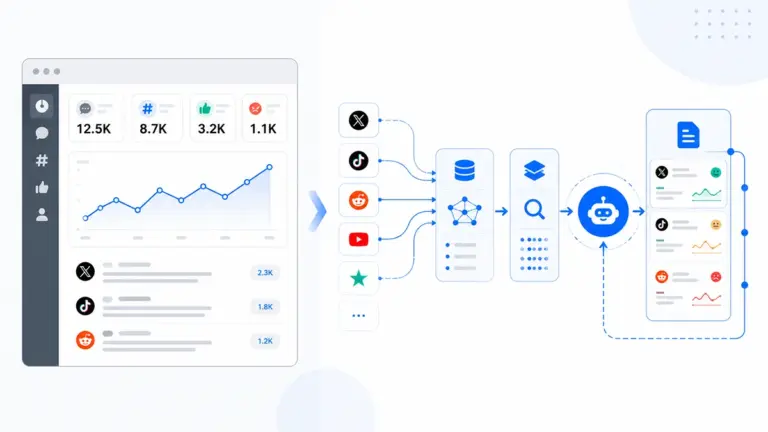


Voice of customer (VOC) meaning, in one sentence: it’s the practice of listening to what customers say on social, reviews, and support channels—and turning that raw voice into share of voice, sentiment, and actions a brand can actually take.
Voice of customer (VOC) meaning, in one line: VOC is short for “Voice of Customer”—a method of listening to what users say unprompted, then acting on it. Below we unpack the term and show how it differs from market research and NPS.
Voice of Customer (VOC) Meaning: What the Term Actually Refers To
VOC stands for Voice of Customer—the customer’s voice, because the data is what users say: a TikTok rant, an Amazon review, a Reddit thread, a Trustpilot complaint. None of it is something you designed.
The key to VOC is this: it’s listening, not asking. You capture the expressions users leave in public channels and turn them into signals. So VOC is two layers: the posts and reviews (data), and the method that turns them into share of voice, sentiment, and action.
VOC Is Not the Same as “Market Research”
The term most often mixed up with VOC is market research. The difference is direction: market research is you asking a designed question on a quarterly or annual cadence; VOC is users talking and you merely listening—always-on, reaching the “silent majority” your survey never samples.
This doesn’t make research useless. A survey yields an attitude score; VOC finds the reason and the fix. The robust setup runs both—VOC explaining why the score moved. For the full definition, five-step method, and cluster map, see our pillar guide “What Is Voice of Customer Analysis”.
VOC vs Research vs NPS: One Table to See the Difference
Putting the three most-confused concepts side by side makes the line clear:
| Dimension | VOC analysis | Market research / survey | NPS |
|---|---|---|---|
| Direction | Users say, you listen | You ask, users answer | You ask one fixed referral question |
| Cadence | Always-on, real time | Periodic (quarterly / yearly) | Periodic |
| Leading bias | None—natural language | Wording shapes the answer | One dimension only |
| Granularity | Down to a single post / user | Aggregated sample | A single 0–10 score |
| Signal speed | Hours | Weeks | Weeks |
| Best at | Finding cause, suggesting fix | Quantifying attitude | Tracking loyalty trend |
Remember: NPS and surveys ask a fixed question at a fixed time; VOC listens to anything users say, any time. They’re complements, not replacements—VOC explains “why”; research and NPS quantify “how much.”
Why This Distinction Matters More in 2026
Telling VOC apart from research got urgent in 2026: the payoff of listening jumped. AI Agents now consume VOC and auto-report; generative search (ChatGPT, Perplexity, Google AI Overview) pulls answers from public discussion; social is now the shelf, so swings hit conversion in days. A brand on quarterly surveys alone chases hour-level movement with a monthly snapshot. The full method is in the VOC pillar guide.
How a Small Team Starts “Listening” to VOC—Without a Crawler
You don’t need a data team to start. Three steps get a brand listening this quarter:
Pick one real question. Start from a decision you actually have to make—”why are our negative reviews happening,” “which competitor is taking share.” VOC answers specific questions, not a firehose.
Cover the channels users actually use. If your buyers are on TikTok and Reddit, Trustpilot alone makes you blind. Map where the category talks first, then pull those platforms.
Don’t run it if you won’t close the loop. The common failure is a report nobody acts on. Bind output to an owner: negative spikes alert support in Slack; recurring drivers get one line to product each month. Prefer not to build the infrastructure? VOC Insight MCP wraps collection and routing behind one interface—26 tools, 7 default plus 2 optional platforms, billed per 600 credits. You ask; the data arrives.
Compliance Boundary: Public Data Outside Mainland China Only
One hard red line: VOC Insight MCP serves global brands analyzing compliant public data outside Mainland China only. We don’t touch any China-based social platform, nor collect from Xiaohongshu, Weibo, LinkedIn, or any platform outside our scope. All data comes from publicly accessible posts, ratings, and reviews, per each platform’s public-data and developer rules. For the boundary, see the VOC Insight MCP overview → in our docs.
VOC Insight MCP: Let Your AI Agent Understand Customers Directly
Our starting point at Pangolinfo: brands don’t lack data, they lack data an agent can use. VOC Insight MCP packages the method into a standard MCP service—7 default plus 2 optional platforms, 26 tools, billed per 600 credits. In Claude Code you type “compare our share of voice vs the competitor last month and flag negative risk,” and the agent calls tools, pulls posts, writes the report—no crawler. See the VOC Insight MCP product page for the difference vs traditional social monitoring. (MCP, the Model Context Protocol, is an open standard—see modelcontextprotocol.io.)
You Asked What VOC Means—More Questions
Is VOC the abbreviation for Voice of Customer?
Yes. VOC stands for Voice of Customer, often translated as “consumer voice.” But today it’s used more as a whole method—capturing users’ native expressions in public channels and turning them into insight and action—not just a noun.
How is VOC different from market research (surveys)?
Direction differs. Market research is you asking a designed question, with a sample and cadence you control. VOC is users talking and you listening—always-on, reaching the silent majority your survey never samples. They complement each other: research quantifies “how much,” VOC explains “why.”
Is VOC the same as NPS?
No. NPS is one fixed survey question (“how likely are you to recommend us,” 0–10) that yields a single loyalty score. VOC listens across channels to anything users say and can locate the specific cause behind a score swing. VOC explains why NPS dropped.
Does sentiment analysis equal VOC?
No. Sentiment analysis is just one step inside VOC—tagging posts positive or negative. A dashboard showing “62% positive” without saying which feature is dragging is only half done. VOC also drills to drivers and routes conclusions to a team that can act.
Small team, tight budget—how do we do VOC?
An agent-native “set once, run automatically” setup fits best: cheaply monitor negative spikes, track competitors, feed sourcing. Per-credit billing beats a subscription dashboard for small teams. Start with one or two real questions, close the loop, then expand—no need to cover every platform on day one.
分析:从社媒声量到品牌洞察-768x432.webp "What Is Voice of Customer (VOC) Analysis: Definition, Method, and Why 2026 Changed the Game 2")