

Here’s a counterintuitive truth most Amazon sellers never confront: the reason your sales estimates are wrong isn’t your estimation formula—it’s the data you’re feeding it. A sophisticated BSR-to-sales conversion model is entirely useless if the BSR values you’re plugging in are 12 hours stale, or if you’re ignoring price fluctuations that happened during that window.
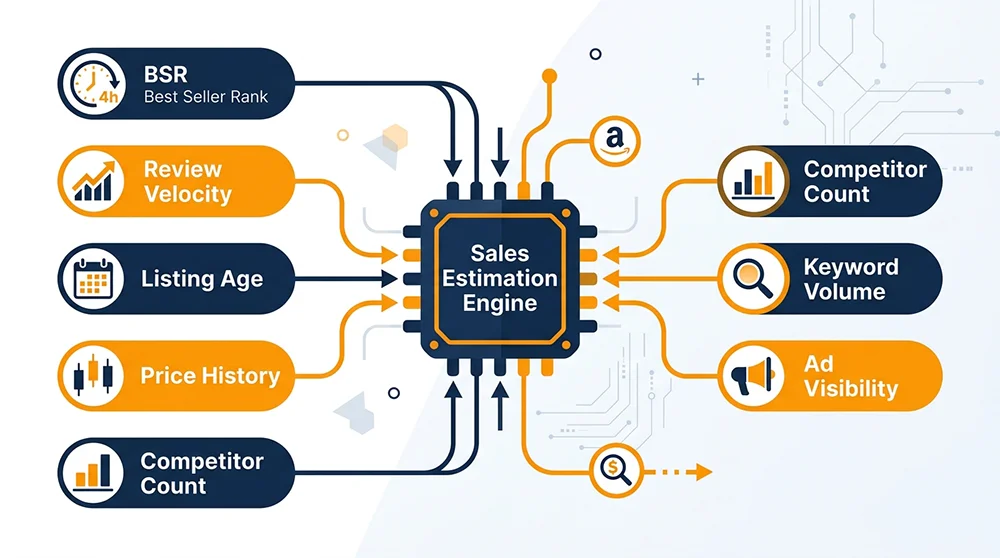
After understanding what Amazon sales estimate data is and mastering how to accurately estimate Amazon sales, you must confront the most operational challenge: **Which 7 data inputs are non-negotiable, and exactly how do you obtain each of them?**
This guide is a complete reference for building your Amazon sales estimation data acquisition stack. Whether you’re a solo seller or managing a data team, you’ll leave with a concrete sourcing plan for every data dimension you need.
Why “Data Quality” Is the Real Bottleneck of Sales Estimation
Amazon does not publish actual sales figures for any product. Every estimation tool on the market—from Jungle Scout to Chrome extensions—is reverse-engineering sales from indirect signals. This creates an unavoidable “Garbage In, Garbage Out” problem.
Understanding the core value of Amazon sales data means recognizing that high-value decisions (inventory, sourcing, market entry) require high-quality inputs. If you’re building those decisions on once-a-day BSR screenshots, you’re gambling, not calculating.
The 7 Non-Negotiable Data Inputs for Amazon Sales Estimation
Input 1: BSR (Best Sellers Rank)
This is the primary engine of every estimation model. BSR and sales volume follow a power-law distribution. Three critical rules: ① Always distinguish main-category BSR from sub-category BSR; ② Sample at a minimum of every 4-6 hours (daily sampling introduces fatal distortion); ③ Collect historical trends, never just point-in-time snapshots.
Free: Visible on the Amazon product detail page, but manual and single-point only.
Paid: Keepa (best historical chart), Pangolinfo Scrape API (high-frequency concurrent extraction across an entire category).
Input 2: Review Count & Velocity
Review velocity is the second signal engine, independent of BSR, and the most reliable cross-validation tool. In most categories, the review-to-sales conversion rate runs between 2% and 5%. If a competitor’s BSR is flat but their reviews are growing rapidly, their actual sales may be accelerating. A BSR-only model would miss this entirely.
Free: Manually observe the review count on Amazon’s frontend, but historical velocity requires external tools.
Paid: Pangolinfo Reviews Scraper API (automated daily tracking of review increments per ASIN), Jungle Scout.
Input 3: Listing Age
The BSR-to-sales conversion coefficient for new products (launched < 90 days ago) is fundamentally different from established products. A two-year-old listing with a BSR of 5,000 has stable organic traffic. A brand-new listing at the same BSR is almost certainly advertising-subsidized and cannot be estimated with the same formula.
How to get it: The “Date First Available” field on Amazon product pages. Use a Scrape API to batch-extract this field across hundreds of ASINs simultaneously.
Input 4: Price History & Promotional Events
Price is the most powerful distorter of BSR signals. A BSR recorded during a Lightning Deal sale will produce a 3-5x inflated sales estimate if you don’t apply a discount correction. You must align “price at time T” with “BSR at time T” on the same timeline.
Free: CamelCamelCamel for single-product price history.
Paid: Keepa (price & BSR displayed on the same graph), Pangolinfo Scrape API (captures real-time price, coupon status, and deal badge simultaneously).
Input 5: Category Competitor Count
The same BSR represents dramatically different sales volumes depending on how many competitors exist in the niche. A product ranked #100 in a 2,000-ASIN sub-niche might outsell a product ranked #100 in a 50,000-ASIN category by 10x or more. Your estimation formula must include a category depth coefficient.
How to get it: Search your target keyword on Amazon and check the total “results” count. Average across multiple sub-keywords for a more reliable baseline.
Input 6: Keyword Search Volume
Search volume data provides demand-side validation for your supply-side BSR estimates. If a category’s total keyword search volume is 3,000 searches/month but your BSR model suggests 20,000 monthly units sold, those two numbers are in fatal conflict—and your BSR model is probably wrong.
Paid: Helium 10 Cerebro/Magnet, Jungle Scout Keyword Scout, SellerSprite. This data cannot be obtained from Amazon directly; third-party tools are mandatory.
Input 7: Sponsored Products Ad Visibility
If a competitor maintains a strong BSR but consistently appears in the top ad position for every major keyword, their sales are dependent on paid traffic. The moment they cut ad spend, their BSR will collapse. Tracking a competitor’s advertising visibility helps you assess the “sustainability health” of their estimated sales volume.
How to get it: Use a SERP API to query keyword-level search results and flag whether a target ASIN appears in the sponsored positions.
Building Your Data Acquisition Mix: Free vs Paid Comparison
No single tool covers all 7 dimensions. Efficient sellers build a hybrid “free + paid” data sourcing matrix calibrated to their scale and budget.
| Data Input | Free Source | Paid Tool | Accuracy |
|---|---|---|---|
| BSR History | Keepa (limited free) | Pangolinfo Scrape API | ⭐⭐⭐⭐⭐ |
| Review Velocity | Manual tracking | Pangolinfo Reviews API | ⭐⭐⭐⭐ |
| Listing Age | Amazon product page | Batch Scrape API | ⭐⭐⭐⭐⭐ |
| Price History | CamelCamelCamel | Keepa / Scrape API | ⭐⭐⭐⭐ |
| Competitor Count | Amazon frontend | SERP API | ⭐⭐⭐ |
| Keyword Volume | Google Trends (proxy) | Helium 10 / SellerSprite | ⭐⭐⭐⭐ |
| Ad Visibility | Manual search checks | SERP API / AMZ Data Tracker | ⭐⭐⭐⭐ |
The Three Principles of High-Quality Data Collection
When building your data acquisition pipeline, three parameters determine the ceiling of your estimation accuracy:
- Frequency: BSR requires a minimum of every 4 hours; daily sampling is insufficient. Review counts can be collected daily. Low frequency is the single largest cause of estimation distortion.
- Depth: You cannot work from snapshots. You need 30-90 days of historical data accumulation. The longer the time series, the higher the confidence in your conversion coefficients.
- Coverage: Don’t monitor just 3-5 competitors. Put the entire Top 100 ASINs in your tracking pool. Only then can you establish an accurate baseline for category-wide sales distribution.
For a single solution that addresses all three requirements, integrating the Pangolinfo General Scrape API is currently the most cost-effective approach. It supports high-frequency concurrent extraction across Amazon’s entire catalog, eliminates the need for proxy pool management, and outputs clean, structured JSON directly into your estimation models or BI dashboards.
Conclusion and Action Plan
The accuracy of your Amazon sales estimates is a direct function of your data sourcing strategy. The 7 key inputs—BSR, review velocity, listing age, price history, competitor count, keyword search volume, and ad visibility—form a complete estimation input framework. Missing any one of them creates a structural blind spot in your model.
Use this guide as a checklist against your current data stack. Identify your weakest dimension and address it first. To learn how to integrate all 7 data inputs into a unified, end-to-end estimation workflow, read our definitive guide: Amazon Sales Estimate Data: Complete 2026 Playbook.