
Abstract
The fourth-quarter promotional window—anchored by Black Friday (November 27) and Cyber Monday (November 30)—represents the highest concentration of consumer transaction velocity in global e-commerce. However, empirical marketplace data indicates a structural divergence between gross merchandise volume (GMV) expansion and net contribution margin retention. The operating environment on Amazon has undergone profound structural shifts: the permanent compression of Fulfillment by Amazon (FBA) baseline capacity allocations (reduced by up to 75% across standard and oversized tiers), a multi-layered fee architecture combining a $0.08 baseline fulfillment increase, a 3.5% fuel and logistics surcharge, and a $0.32 per-unit holiday peak fulfillment surcharge, alongside a fundamental overhaul of promotional fee mechanics ($5 upfront plus 2.5% variable sales fee on coupons; $100 upfront plus 1.5% variable sales fee on peak event deals). Concurrently, product discovery has transitioned from lexical keyword matching (A9/A10) to semantic intent reasoning powered by the COSMO knowledge graph and the integration of Rufus into Alexa for Shopping within the primary search bar.
This paper establishes a comprehensive, quantitative operational framework for Amazon sellers navigating the Black Friday and Cyber Monday (BFCM) cycle. Structured across four core operational phases, the study examines: (1) pre-promotion preparation, supply chain backward scheduling, and econometric margin boundary modeling; (2) diagnostic state analysis and performance expectations across distinct product lifecycle cohorts—new launches, best-sellers, and stagnant (“half-dead”) listings; (3) a synchronized, multi-lever execution playbook integrating promotional mechanics, Pay-Per-Click (PPC) auction bidding, and real-time competitive intelligence via programmatic infrastructures such as the Pangolinfo Amazon Scraper API and Amazon Data MCP; and (4) post-promotion stabilization engineering to mitigate order-volume cliffs, recalibrate price elasticity, and preserve organic ranking velocity through December and Q1.
01 How to Prepare and Execute Efficiently Before the BFCM Promotion
Executing a high-volume, margin-positive BFCM campaign requires treating the promotional window not as a four-day retail event, but as an eight-to-twelve-week operations and financial engineering project. Because Amazon enforces non-negotiable operational gates for inbound logistics and promotional scheduling, failures in upstream preparation cannot be remediated through downstream advertising expenditure.
1.1 Backward Operational Scheduling and Supply Chain Gateways
Amazon’s fulfillment network transitions from an inbound-receiving orientation in September and October to an outbound-fulfillment orientation in November and December. Consequently, sellers face strict cutoffs that dictate production and freight timelines:
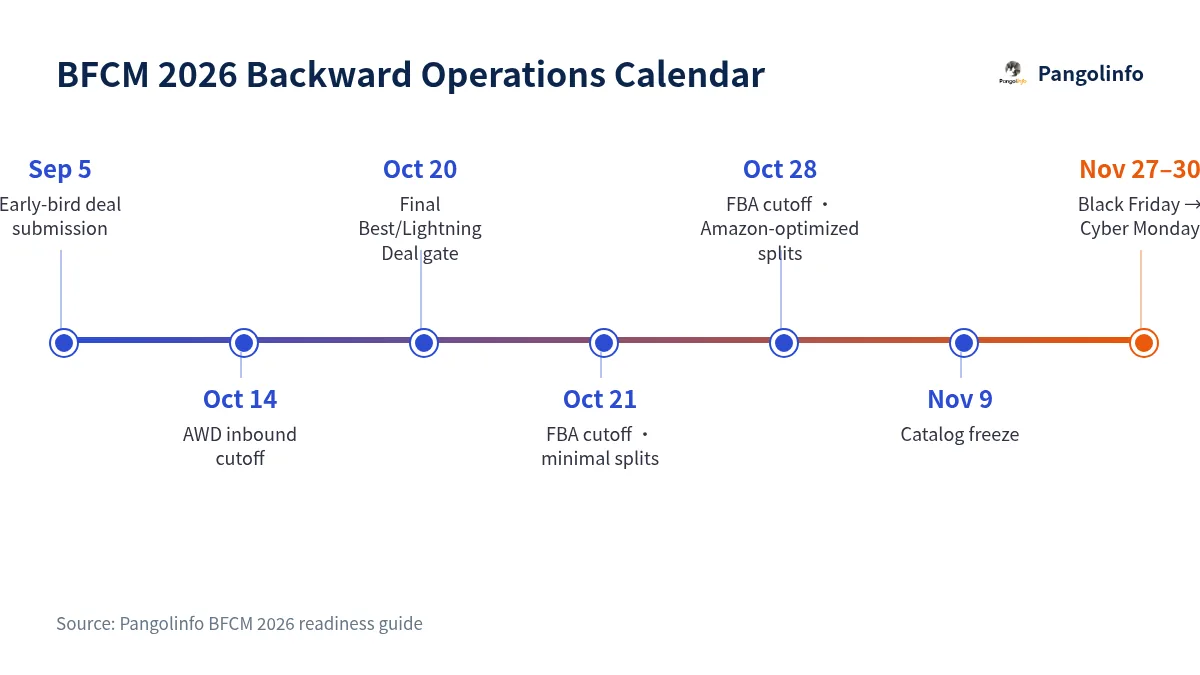
- September 5: Early-bird submission deadline for Black Friday and Cyber Monday Lightning Deals and Best Deals.
- October 14: Inbound arrival cutoff for Amazon Warehousing and Distribution (AWD) shipments.
- October 20: Final submission gate for BFCM Best Deals and Lightning Deals in Seller Central.
- October 21: FBA inbound cutoff for shipments utilizing “minimal shipment splits” (consolidating inventory into single fulfillment centers, which incurs inbound placement fees ranging from 0.5% to 1.5% of revenue).
- October 28: FBA inbound cutoff for “Amazon-optimized shipment splits” (requiring at least five identical cartons per SKU distributed across multiple fulfillment facilities).
- November 9: Recommended self-imposed catalog freeze date. Modifying product titles, merging or splitting parent-child variations, or altering core backend search terms after this date risks triggering algorithmic re-indexing or automated listing suppression during peak traffic.
To navigate the permanent 60% to 75% FBA storage capacity reductions introduced in May 2025, sellers must decouple bulk holiday storage from immediate FBA fulfillment allocation. While maintaining an Inventory Performance Index (IPI) score above 400 avoids severe statutory restrictions, empirical data demonstrates that an IPI exceeding 500 is necessary to buffer against network-wide Q4 cubic-footage compressions. Sellers operating near capacity ceilings should deploy a two-wave inventory architecture: routing 60 days of cover into AWD—where bulk storage costs $2.40 per cubic foot during peak without incurring FBA peak fulfillment surcharges, and where auto-replenished inventory (70%+ auto-replenishment ratio over 90 days) is exempt from FBA capacity limits and low-inventory-level fees—while maintaining a lean 30-day high-velocity buffer inside FBA. If direct FBA capacity remains constrained, sellers must submit reservation fee bids via the Capacity Manager in August or September, offsetting the per-cubic-foot reservation liability with the $0.15 performance credit earned per dollar of sales generated from the expanded allocation.
1.2 Unit Economics and Margin Boundary Modeling
Protecting profit margins during high-velocity scaling demands rigorous contribution margin accounting prior to deal commitment. Relying on historical cost baselines results in systematic margin erosion due to compounding fee adjustments. Specifically, unit economics models must incorporate:
- Baseline FBA Inflation: An average $0.08 per-unit increase instituted in the January 15 fee update.
- Fuel and Logistics Surcharge: A permanent 3.5% surcharge applied on top of base fulfillment rates since April 17.
- Holiday Peak Fulfillment Fee: Active from October 15 through January 14, adding an average of $0.32 per unit shipped.
- Q4 Peak Monthly Storage Rates: Active October 1 through December 31, elevating standard-size storage from $0.78 to $2.40 per cubic foot (a 207.7% increase) and oversize storage from $0.56 to $1.40 per cubic foot. If a seller’s Storage Utilization Ratio exceeds 22 weeks of supply over a trailing 13-week window, storage utilization surcharges add $0.44 to $1.88 per cubic foot on top of the $2.40 peak rate, reaching up to $4.28 per cubic foot monthly.
- Escrow Return Reserve: Because e-commerce return rates climb 2% to 3% annually—averaging 5% to 8% in Home & Kitchen and 10% to 15% in Consumer Electronics—and because Amazon extends the holiday return window into late January, financial models must quarantine 6% to 12% of gross Q4 revenue as a return liability reserve.
We define the Pre-Advertising Contribution Margin Rate (CMRpre-ad)—which functions directly as the Break-Even Advertising Cost of Sales (ACoSBE)—using the following equation:

Where Ppromo is the net promotional selling price, COGS is landed cost of goods sold, Fref is the category referral fee (typically 15%, or 8% for Consumer Electronics), FFBA_peak × 1.035 represents the peak fulfillment fee compounded by the 3.5% logistics surcharge, Fstorage is allocated unit storage cost, Fpromo_var is the variable promotional fee, and Rescrow is the per-unit return cost allowance.
Promotional Fee Crossover Analysis
Effective June 2, 2025, Amazon replaced its legacy $0.60 per-unit coupon redemption fee and flat $150/$300 deal fees with a performance-based fee architecture. Understanding the mathematical crossover between promotional vehicles is vital for margin preservation:
| Promotional Tool | Non-Peak Fee Structure | Peak Event Fee Structure (BFCM / Prime Day) | Optimal Price & Volume Threshold | Reference Price (“Was Price”) Requirement |
|---|---|---|---|---|
| Amazon Coupons | $5 flat upfront + 2.5% of coupon-attributed sales | $5 flat upfront + 2.5% of coupon-attributed sales | Optimal for ASINs priced under $22–$24 or generating less than $4,333 in promotional revenue | Discount must be 5%–50%; at least 5% below Was Price |
| Lightning Deals (4–12 hrs) | $70/day upfront + 1.0% of deal sales ($2,000 cap) | $100 flat upfront + 1.5% of deal sales ($5,000 cap) | Optimal for high-velocity hero ASINs generating over $6,333 in peak deal revenue | Strict 30-to-90-day lowest price validation; requires 4.0+ star rating |
| Best Deals (Multi-day) | $70/day upfront + 1.0% of deal sales ($2,000 cap) | $100 flat upfront + 1.5% of deal sales ($5,000 cap) | Optimal for mid-to-high-priced catalog anchors across multi-day event windows | Strict reference price validation; requires 4.0+ star rating |
| Prime Exclusive Discounts | $0 (Free outside major events) | $100 flat fee per campaign | Ideal for catalog-wide Prime strikethrough badges with zero variable sales tax | Flexible reference-price validation compared to standard Deals |
| Brand Tailored Promotions | $0 (No upfront or variable fee) | $0 (No upfront or variable fee) | High-margin defense targeting cart abandoners, repeat buyers, and brand followers | No public Was Price reset; protects baseline price integrity |
Consider the mathematical crossover between a Coupon ($5 + 2.5% of revenue R) and a Peak Event Deal ($100 + 1.5% of revenue R):

During peak events, if an ASIN is projected to generate more than $9,500 in promotional revenue (or $4,333 during non-peak days where the deal fee is $70 + 1%), a Deal incurs lower percentage-based erosion than a Coupon. Furthermore, sellers must strictly audit promotional stacking: allowing a 15% Lightning Deal to run concurrently with a 10% unpaused Coupon creates a combined 25% discount while triggering dual fee structures ($100 + 1.5% plus $5 + 2.5%), annihilating contribution margin.
1.3 Retail Readiness and Algorithmic Optimization for COSMO and Alexa for Shopping
On May 13, 2026, Amazon retired the standalone Rufus chat drawer in the U.S. marketplace and integrated its generative AI directly into the primary search bar as Alexa for Shopping (while retaining the Rufus nomenclature in UK and EU marketplaces). Serving over 300 million shoppers and driving a 60% higher purchase completion rate among active users, Alexa for Shopping operates atop Amazon’s COSMO (Commonsense Knowledge Generation and Serving System) knowledge graph.
Empirical research by the Mars Agency reveals that only 22% of traditional Page-1 organic listings appear in AI assistant recommendations for identical queries, while 36% of AI-recommended products do not rank on Page 1 of classic A9/A10 search results. Moreover, statistical audits of over 1,300 AI recommendations indicate that zero recommended products carried a rating below 4.0 stars, and 92% were Prime-eligible with complete structured attributes. To prepare listings before the November 9 catalog freeze, sellers must execute four structural upgrades:
- Structured Backend Attribute Completion: Large Language Models (LLMs) filter catalog candidates via structured taxonomy fields before parsing unstructured prose. Sellers must populate 100% of optional and required attributes in Seller Central (material, dimensions, intended use, target audience, compatibility, care instructions). Because the COSMO knowledge graph requires 7 to 14 days to index and map relational intent across updated backend attributes, completion by early November is mandatory.
- 75-Character Title Compliance and Noun-Phrase Architecture: Following Amazon’s enforcement of the 75-character title limit (where non-compliant titles are automatically rewritten by Amazon’s internal AI, giving brand owners a 14-day review window), titles must lead with clear semantic noun phrases rather than repetitive keyword strings. A structure of
[Core Product Type] + [Primary Functional Spec] + [Primary Use Case/Audience]within the first 75–80 characters prevents mobile truncation and satisfies AI retrieval vectors. - Conversational Q&A Bullet Point Engineering: Replace legacy all-caps keyword headers with intent-first conversational answers designed to minimize LLM hallucination risk. Each of the five bullets should resolve a distinct buyer question using the formula: Outcome (Shopper Benefit) → Verifiable Feature (Technical Proof) → Contextual Use Case (Scenario/Persona).
- Multimodal Visual SEO and A+ Comparison Charts: Alexa for Shopping utilizes Computer Vision (CV) and Optical Character Recognition (OCR) to verify product claims via secondary images. While the main image must remain strictly compliant (pure white background, zero promotional badges or watermarks to pass Amazon’s automated pre-deal compliance checks), secondary infographics must feature high-contrast text overlays containing core noun phrases. Additionally, embedding structured comparison charts in A+ Content allows the AI assistant to answer cross-catalog comparative queries (“Which model is best for a small apartment?”) while retaining the shopper within the brand’s ecosystem.
1.4 Establishing the Real-Time Competitive Intelligence Infrastructure
Pangolinfo Amazon Scraper APIPangolinfo Amazon Scraper APIAmazon Data MCPAmazon Data MCP (Model Context Protocol):
- Automated Pipeline Baseline (Pangolinfo Amazon Scraper API): For enterprise catalogs and automated ERP/BI workflows, the REST API ingests live frontend Amazon data across specific U.S. and international ZIP codes with a 99%+ page-structure restoration accuracy and a 90%+ Sponsored Products ad-placement capture rate. In the 30 days preceding Black Friday, sellers configure scheduled batch jobs to log daily competitor list prices, “Was Prices,” coupon clip badges, and organic-versus-sponsored SERP positions across top keywords, creating an immutable historical baseline to evaluate whether rival BFCM discounts are genuine or artificially inflated.
- Agentic Workflow Auditing (Pangolinfo Amazon Data MCP): For agile brand managers and operational analysts utilizing AI clients (such as Claude, Cursor, or custom agent workflows), connecting the zero-dependency Amazon Data MCP exposes 19 live data tools directly to the AI agent. Analysts can execute a “Single-ASIN 360° Audit” or “Customer Review Sentiment Mining” in a single natural-language prompt—extracting recurring defect complaints from the last 100 competitor reviews and immediately engineering pre-BFCM A+ Content modules to neutralize those exact buyer objections.
02 Current Status and Expectations for New Products / Best-Sellers / “Half-Dead” (Stagnant) Listings
A fatal strategic error during BFCM is applying a uniform volume-scaling mandate across an entire product catalog. Advertising benchmarks across hundreds of millions of dollars in ad spend reveal a platform-wide median ACoS of 30.1% to 35.0%, a median cost-per-click (CPC) of $1.10 to $1.26 (rising to $1.35–$1.45 in Q4 baselines and $2.00–$6.00+ during peak BFCM hours), an average click-through rate (CTR) of 0.56%, and an average conversion rate (CVR) of 10.2% to 11.1%. Furthermore, platform-wide Cost Per Mille (CPM) has surged 39.18% year-over-year (from $5.81 to $8.08) as Amazon’s quarterly advertising revenue expanded 26% YoY to $19.8 billion.
In this hyper-inflated auction environment, capital allocation must be strictly segmented by ASIN lifecycle status.
2.1 Cohort Diagnostic Matrix and Benchmark Expectations
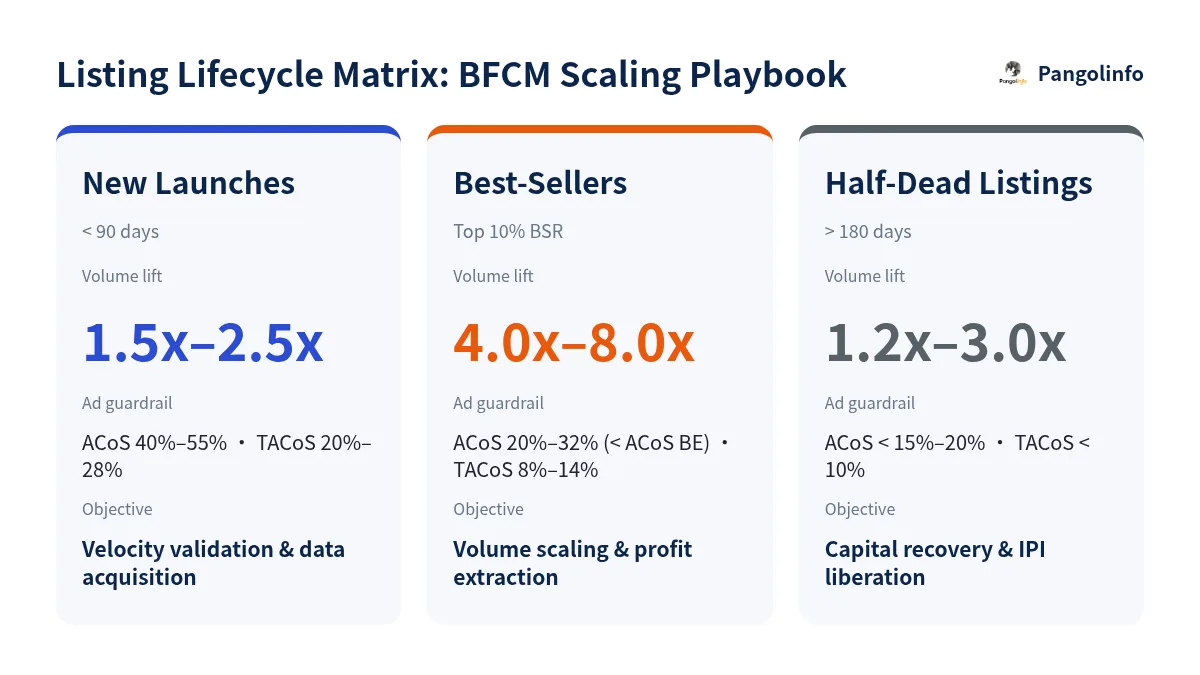
The table below establishes the operational diagnostics, realistic BFCM performance expectations, and financial guardrails across the three primary catalog cohorts:
| Diagnostic Dimension | Cohort A: New Product Launches (< 90 Days) | Cohort B: Best-Sellers / Hero ASINs (Top 10% BSR) | Cohort C: “Half-Dead” / Stagnant Listings (> 180 Days) |
|---|---|---|---|
| Current Structural Status | Low review count (< 15–30), unstable CVR, unestablished “Was Price,” operating in honeymoon or early indexing phase. | High review moat (4.3+ stars, 500+ reviews), high organic rank on head terms, strong historical CVR (12%–18%+), verified deal eligibility. | Declining session volume, suppressed Buy Box or compressed margin, aged inventory approaching 181–270+ day surcharge tiers, rating drift (3.6–3.9 stars). |
| Primary BFCM Objective | Velocity Validation & Data Acquisition: Establish semantic indexing, cross the 30-review threshold, and capture long-tail organic rank. | Volume Scaling & Profit Extraction: Maximize net dollar contribution, defend Top-of-Search (ToS) Share of Voice (SOV), and lift 4x–8x baseline unit velocity. | Capital Recovery & IPI Liberation: Liquidate aged cubic footage prior to Q4/Q1 surcharges, recover sunk COGS, or validate selective micro-niche revival. |
| Expected Volume Multiplier | 1.5x to 2.5x over October baseline (constrained by trust signals and review volume). | 4.0x to 8.0x on peak event days (Black Friday & Cyber Monday); 2.0x to 3.0x across Cyber Week. | 1.2x to 3.0x (highly elastic; strictly dependent on aggressive price discounting or bundle attachment). |
| Target ACoS / TACoS Band | Target ACoS: 40%–55% (Break-even or controlled investment) |
Target TACoS: 20%–28% | Target ACoS: 20%–32% (Strictly below ACoSBE)
Target TACoS: 8%–14% | Target ACoS: < 15%–20% (Strict ROAS ceiling; zero tolerance for unattributed ad bleed)
Target TACoS: < 10% |
| Primary Operational Risk | Overbidding on broad head terms against entrenched rivals, resulting in high CPC clicks ($3.00+) that bounce due to low review count. | Mid-event FBA stockout (destroying BSR momentum going into December) or margin destruction via overlapping deal/coupon discounts. | Throwing good ad dollars after bad inventory; incurring $0.50–$5.45+/cu ft aged surcharges alongside $2.40/cu ft peak storage fees. |
2.2 Granular Analysis of Cohort Dynamics
2.2.1 New Products: The Cold-Start Paradox in a High-CPC Auction
New products entering their first BFCM face an asymmetric auction disadvantage. Empirical data from Olifant Digital and SellerStack demonstrates that top-tier advertisers spending over $10,000/month achieve a 14.5% to 15.9% conversion rate and a 23.0% to 28.6% median ACoS, whereas smaller or newly launched cohorts convert at just 8.3% to 10.2% while paying higher effective CPCs due to lower historical click-through and conversion weights in Amazon’s ad auction. Furthermore, because new ASINs often lack an established 30-day “Was Price” history, they are frequently disqualified from official Lightning Deals and Best Deals. Expecting a newly launched ASIN to profitably win generic category head terms during Black Friday is mathematically unsound. Instead, expectations must center on exploiting giftable or situational micro-niches, leveraging the FBA New Selection program’s 180-day exemption from low-inventory-level fees, and using the traffic wave to accelerate velocity into a sustainable Q1 ranking baseline.
2.2.2 Best-Sellers: The Incrementality Trap and Margin Compression
Hero ASINs carry the revenue targets of the entire enterprise during Q4, routinely lifting 4x to 8x on Black Friday and Cyber Monday. However, best-sellers face the Incrementality Trap. As modeled in recent e-commerce econometric studies, if a $40 hero product with a $12 COGS and $10.80 combined referral/FBA fee (baseline contribution of $17.20/unit) runs a 20% Lightning Deal to $32, its unit contribution drops to $9.20 before promotional fees. If the deal sells 500 units ($16,000 revenue, incurring $340 in peak deal fees of $100 + 1.5%), net contribution is $4,260. However, if 50% of those 500 buyers (250 units) would have purchased the item at the full $40 price anyway ($4,300 baseline contribution), the promotion yields a net incremental loss of -$40 before accounting for elevated PPC spend. Therefore, the expectation for best-sellers is not blind discounting, but disciplined Break-Even Incremental Share Management: ensuring that deal depth is calibrated solely to the minimum threshold required to unlock the red “Deal” badge and sustain Top-of-Search conversion superiority (which converts at 13.1%—more than double the 5.5% conversion rate of product-page placements).
2.2.3 “Half-Dead” (Stagnant) Listings: Diagnostic Triage (Revive vs. Liquidate)
Stagnant listings—characterized by daily unit velocity under 2–5 units, decaying organic keyword rankings, and mounting days of supply—represent a severe financial liability during Q4. With standard-size peak storage jumping to $2.40 per cubic foot and the aged inventory surcharge adding $0.50/cu ft (181–210 days), $1.00/cu ft (211–240 days), $1.50/cu ft (241–270 days), and a punitive $5.45/cu ft at 271 days, passive retention destroys enterprise cash flow. Sellers must execute a binary diagnostic triage prior to BFCM:
- Path 1: Structural Obsolescence (Liquidate): If the ASIN suffers from a sub-3.8-star rating driven by physical design flaws, or if category COGS inflation has permanently compressed net margins below 8%, the expectation is 100% inventory clearance during the Q4 traffic surge to liberate IPI capacity and recoup working capital.
- Path 2: Merchandising/Traffic Stagnation (Revive): If the physical product maintains a 4.1+ star rating and healthy unit economics ($35%+ pre-ad margin), stagnation is typically an artifact of listing decay (e.g., AI-truncated titles, missing COSMO backend attributes, uncompetitive main image CTR, or lost Buy Box eligibility). These listings can expect a 2x–3x renaissance during BFCM if paired with a structural listing overhaul and low-CPC parasite or bundle strategies.
03 A Combined Playbook for Listings at Different Stages to Scale Volume Steadily
To scale volume steadily while fortifying the profit margin boundary, sellers must replace isolated tactical adjustments with a synchronized “Combined Playbook” (组合拳) integrating promotional engineering, bid-ceiling PPC architecture, AI search optimization, and real-time competitive counter-maneuvers.
3.1 The Combined Playbook for New Product Launches: Precision Infiltration
New listings must bypass the hyper-inflated head-term auction ($3.00–$6.00+ CPCs) and capture high-intent demand through semantic precision and asymmetric promotional mechanics:
-
Promotional Architecture (Price Integrity + High-Visibility Badging):
* Avoid Reference Price Contamination: Do not drop the standard “Your Price” field on a new launch, as doing so permanently resets the 30-day lowest price baseline required for future Q1 and Prime Day deals.
* Deploy Prime Exclusive Discounts (PEDs) or Targeted Coupons: For items priced under $24, activate a 10%–15% Coupon ($5 + 2.5% fee) to secure the high-visibility green badge in search results. For items priced over $30, utilize a Prime Exclusive Discount ($100 flat fee) or combine a modest 5% coupon with a Brand Tailored Promotion offering 15% off to “High-Spend Customers” or “Brand Followers,” generating conversion lift without resetting the public Was Price. -
Advertising Matrix (Long-Tail Exact + Product Attribute Targeting + Sponsored Prompts):
* Exact-Match Long-Tail Isolation: Allocate 70% of the launch PPC budget to Exact and Phrase match campaigns targeting 4-to-6-word intent queries (e.g., “insulated stainless water bottle for gym bag” rather than “water bottle”).
* Asymmetric ASIN Conquesting (Sponsored Products & Display): Target competitor product detail pages that exhibit higher prices, inferior ratings (< 4.0 stars), or slow delivery promises.
* Sponsored Prompts Activation: Having exited beta on March 25, 2026, as a billable CPC placement across Sponsored Products and Sponsored Brands, Sponsored Prompts inject your product directly into Alexa for Shopping conversational answers. Because new products with thoroughly populated COSMO backend attributes and Q&A-structured bullets score high on semantic relevance, Sponsored Prompts enable new launches to bypass Page-1 organic barriers and capture high-converting AI assistant traffic (which converts up to 60% more frequently than standard search). -
Real-Time Execution via Amazon Data MCP:
* Use an AI agent connected to the Pangolinfo Amazon Data MCP to run a “Blue-Ocean Keyword Scan” and “AI Traffic Entry Analysis”. By querying live Alexa for Shopping responses across 30 buyer persona prompts (e.g., “best budget gift for trail runners under $40”), sellers identify which specific functional attributes the AI prioritizes and update listing bullet points prior to the catalog freeze to capture uncontested AI shelf space.
3.2 The Combined Playbook for Best-Sellers: Fortress Defense and Calculated Scaling
For hero ASINs, the operational mandate is maximizing total net profit dollars across the 12-day BFCM window while preventing stockouts and bid-inflation bleed.
- Mathematical Bid-Ceiling Governance (The Max CPC Protocol):
Before auction inflation peaks in mid-November, calculate and lock the Maximum Profitable CPC (CPCmax) for every hero campaign using expected promotional metrics:

Worked Example: Suppose a hero ASIN normally sells at an AOV of $40 with a 12% CVR and a 30% target ACoS, yielding a baseline CPCmax of $40 × 0.12 × 0.30 = $1.44. During Black Friday, a 15% Lightning Deal reduces AOV to $34, but the red Deal badge elevates CVR to 18%. The recalibrated peak ceiling is $34 × 0.18 × 0.30 = $1.84. If live intraday auction bids for a generic keyword surge to $2.90 on Black Friday morning, do not chase the bid above $1.84. Let competitors absorb unprofitable clicks until their daily budgets exhaust by early afternoon, allowing your campaign to capture high-intent afternoon and evening conversions at sustainable CPCs.
-
Placement Multipliers and Schedule-Based Budget Rules:
* Because empirical data across managed accounts shows Top-of-Search placements convert at 2.02x the rate of product pages while costing only 1.29x more per click (yielding lower ACoS in 82% of accounts), isolate proven hero keywords (5–10 exact terms per campaign) and apply a 50%–150% Top-of-Search placement multiplier while keeping base bids conservative.
* Configure Schedule-Based Budget Rules in Amazon Ads along with performance conditions (e.g., automatically increase daily budget by 100%–200% on November 27–30 if ROAS exceeds 3.5x). Going dark at 2:00 PM on Black Friday due to budget exhaustion forfeits the highest-converting evening mobile shopping hours.
* Brand Defense Perimeter: Allocate 15%–20% of ad spend to Sponsored Brands (Video and Store Spotlight) and exact-match Sponsored Products targeting your own brand name and hero ASINs, neutralizing rival conquesting at a highly efficient 10%–20% ACoS. -
Hourly Geolocation Ad-Hijacking & Stock Defense via Pangolinfo Scraper API:
National ranking averages mask severe regional disparities across Amazon fulfillment zones. As documented in a Pangolinfo operational case study of a $1.8B GMV mother-and-baby enterprise seller, competitors frequently execute localized bid spikes on core keywords in high-density ZIP codes (e.g., New York 10001, Los Angeles 90001, Chicago 60601), hijacking Top-of-Search placements and causing sudden, unexplained traffic drops.
* By integrating the Pangolinfo Amazon Scraper API with ZIP-code parameter targeting into an automated hourly monitoring pipeline, sellers track real-time Sponsored Products placements (capturing 90%+ of ad slots) and competitor stock statuses across regional hubs.
* Tactical Execution: In the documented enterprise deployment, hourly API monitoring improved ad-hijack detection speed by 10x, reduced average CPC by over 38%, and lowered wasted daily ad spend by 60%. Conversely, when the API detects that a primary competitor’s hero ASIN has entered “Low Stock” or lost the Buy Box in specific regional ZIP codes during Black Friday afternoon, the seller can dynamically elevate prices by 5%–8% or redirect Sponsored Display retargeting onto that competitor’s ASIN to capture stranded demand at expanded margins.
3.3 The Combined Playbook for “Half-Dead” (Stagnant) Listings: Surgical Revival vs. Controlled Liquidation
Stagnant listings require a bifurcated execution strategy that strictly isolates capital exposure:
-
The Parasite Bundle & Virtual Bundle Strategy (Revival Cohort):
* Rather than paying $2.50+ CPCs to drive cold traffic to a stagnant listing, attach the stagnant ASIN to a high-traffic Best-Seller using Virtual Bundles (available to Brand Registered FBA sellers) or Multi-Buy Tiered Promotions (“Buy Hero ASIN X, get 25% off Stagnant ASIN Y”).
* Embed the stagnant ASIN prominently in the first column of the Hero ASIN’s A+ Content Comparison Chart with a clear complementary use case (e.g., pairing a stagnant replacement filter or travel case with a best-selling appliance). This siphons free, high-intent peak session traffic from the hero listing without risking a single dollar of standalone PPC spend. -
Low-Bid Catch-All & Dayparting Architecture:
* Place revive-worthy stagnant ASINs into an Automatic or Broad-match “Catch-All” Sponsored Products campaign with a hard bid ceiling of $0.25–$0.45 and a “Dynamic Bids – Down Only” setting.
* Implement Dayparting (Ad Scheduling): pause or reduce bids by 80% during peak morning competition when aggressive rivals burn through budgets, and activate campaigns between 6:00 PM and 11:00 PM PST when auction density thins and bargain-hunting shoppers convert on secondary pages. -
Aggressive Margin-Floor Liquidation (Liquidation Cohort):
* For inventory approaching the 181-day or 271-day aged surcharge cliff ($0.50 to $5.45/cu ft/month), calculate the Liquidation Floor Price (Pliq), where net proceeds equal the cost of an FBA Removal/Disposal Order plus 60 days of projected peak storage and aged surcharges.
* Deploy an Amazon Outlet Deal or a 30%–40% Coupon combined with Brand Tailored Promotions targeting “Cart Abandoners” and “Repeat Customers”. Convert dead cubic footage into liquid cash before December 31, immediately improving the account’s Storage Utilization Ratio below the 22-week surcharge threshold and boosting the Q1 IPI score.
3.4 Cross-Stage Tactical Execution Matrix
| Operational Lever | New Product Launches (0–90 Days) | Best-Sellers / Hero ASINs | “Half-Dead” / Stagnant Listings |
|---|---|---|---|
| Primary Promotional Vehicle | Prime Exclusive Discount ($100) or Coupon (< $24 price point) + Brand Tailored Promo | Lightning Deal / Best Deal ($100 + 1.5% capped at $5,000) | Virtual Bundles, Multi-Buy Attach Promos, Amazon Outlet, or Deep Coupon (25%–40%) |
| PPC Bidding Strategy | Fixed Bids or Down Only on 4–6 word Exact Long-Tail & Sponsored Prompts | Calculated CPCmax ceiling; +50% to +150% Top-of-Search placement multiplier | Strict low-bid Catch-All ($0.25–$0.45); evening dayparting; zero head-term bidding |
| Inventory & Safety Buffer | 45 days of cover in FBA; leverage 180-day FBA New Selection fee exemptions | 15%–20% FBA buffer + 60-day AWD auto-replenishment + FBM backup SKU active | Zero inbound restock; strict sell-through tracking to clear before 181/271-day aged gates |
| Pangolinfo Data Deployment | Amazon Data MCP: Query AI shopping prompts & mine competitor negative reviews | Amazon Scraper API: Hourly ZIP-code SP ad tracking, Buy Box defense & rival stock monitoring | Amazon Data MCP: Audit category price-band distributions to set exact liquidation price floors |
04 Post-Promotion Stabilization: Techniques to Avoid a Cliff-Like Drop in Orders
The 72 hours immediately following Cyber Monday (December 1–3) represent the most volatile transition in the Q4 calendar. A 2026 econometric study published in the International Journal of Production Economics (analyzing 2,451 Amazon products across 316,939 daily observations) demonstrated that while Lightning Deal participation significantly elevates Best Seller Rank (BSR), the ranking halo exhibits its strongest measurable persistence during the first 14 days post-promotion before decaying rapidly if subsequent conversion velocity collapses.
Sellers who abruptly revert prices to full MSRP and slash PPC budgets by 50%+ on December 1 induce a “conversion shock”: the sudden divergence between elevated traffic expectations and an uncompetitive full-price offer causes CVR to plummet, signaling to the A10 and COSMO algorithms that the listing is no longer relevant, which triggers a cliff-like drop in organic rank and order volume right before the lucrative December holiday gifting wave.
4.1 The “Step-Down” Price Elasticity and Promotional Tapering Protocol
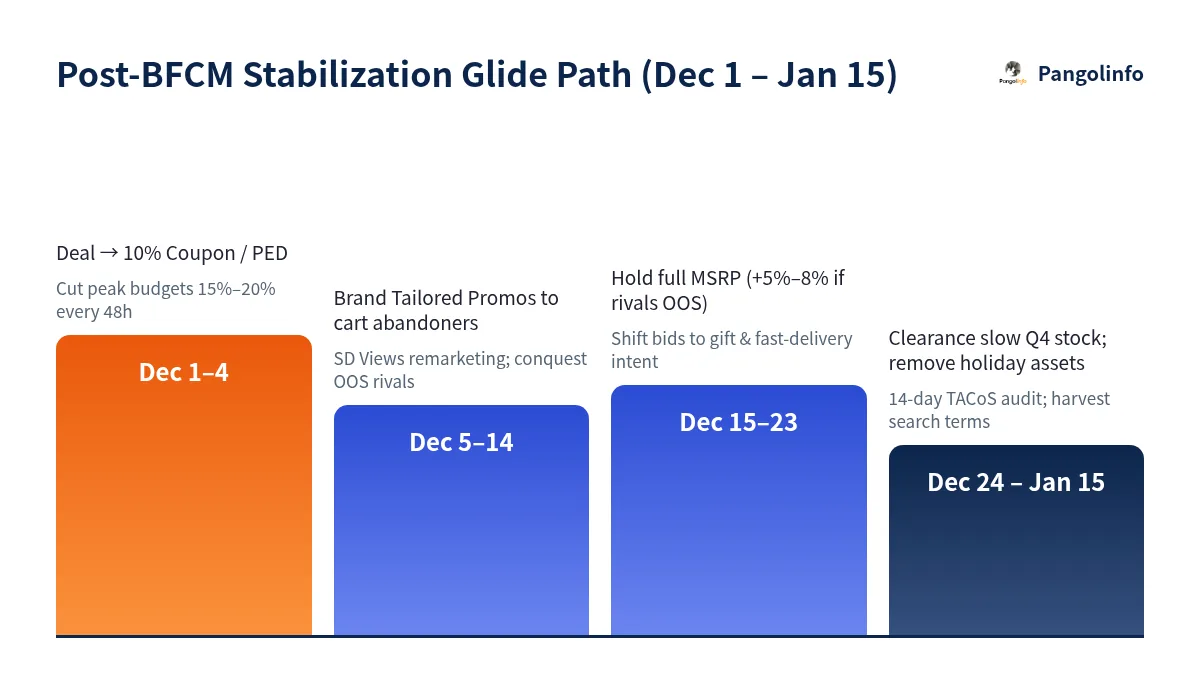
To preserve the 14-day post-deal BSR halo while restoring unit profitability, sellers must execute a three-stage price and promotional step-down across December 1–14:
-
Phase 1: The Cyber Week Tail (December 1–4 — Cushioning the Price Jump):
* Instead of jumping immediately from a 20% BFCM Deal price ($32.00) back to full retail ($40.00) at 12:01 AM on December 1, deploy an intermediate step-down price or post-event coupon (e.g., restoring list price to $39.99 while immediately activating a 10% Coupon or Prime Exclusive Discount to net $35.99).
* This softens the price elasticity shock for late Cyber Week browsers, maintains a visible discount badge in search results, and bridges the conversion rate gap while competitors who reverted straight to full MSRP suffer acute CVR collapse. -
Phase 2: Brand Tailored Promotions for Cart Abandoners (December 2–15):
* Millions of shoppers add items to their carts or view detail pages during Black Friday and Cyber Monday without completing checkout.
* Immediately launch a zero-fee Brand Tailored Promotion offering a 10%–15% exclusive discount to “Cart Abandoners” and “High-Spend / Potential New Customers” who interacted with the brand during the prior 30 days. Because BTPs are only visible to qualified audience segments, you convert high-intent BFCM stragglers without discounting the product for organic full-price holiday gift buyers. -
Phase 3: Full Margin Restoration & Last-Minute Gifting Surge (December 5–22):
* Once competitors begin experiencing post-BFCM FBA stockouts in early December, remove public coupons and restore full MSRP ($40.00). Shoppers purchasing between December 10 and Amazon’s final pre-Christmas Prime delivery cutoff (typically December 22–23) prioritize guaranteed delivery speed and Prime badge certainty over minor price discounts.
4.2 PPC Budget Tapering, Attribution Lag Management, and Retargeting
Advertising operations after Cyber Monday must account for consumer browsing lag and Amazon’s multi-day attribution windows:
- Gradual Budget Step-Down (20% Every 48 Hours): Never cut campaign budgets overnight on December 1. Step daily budgets and placement multipliers down by 15%–20% every 48 hours over a 6-to-8-day glide path, allowing bids to normalize smoothly alongside declining market CPCs.
- Respect the 7-to-14-Day Attribution Window: Amazon Sponsored Products utilizes a 7-day attribution window, while Sponsored Brands utilizes a 14-day window. Evaluating Cyber Monday search term reports on December 2 makes high-velocity keywords look artificially unprofitable because clicks are recorded immediately while delayed checkouts are still settling. Enforce a strict 7-day moratorium on pruning high-traffic keywords post-Cyber Monday; only negate terms that generated 15+ clicks with zero orders prior to the event.
- Sponsored Display & DSP Retargeting Harvest: Shift 10%–15% of post-event ad budgets into Sponsored Display Views Remarketing (targeting a 7-to-14-day lookback window of shoppers who viewed your detail page during BFCM but did not purchase, excluding recent buyers). Frame ad creative and Brand Store banners around “Holiday Gift Readiness” and “Fast Prime Delivery before Christmas”.
4.3 Post-Event Competitive Harvesting and AI Search Re-Indexing
The post-BFCM period creates massive structural asymmetries across the marketplace as poorly prepared competitors run out of FBA stock or suffer review degradation from rushed fulfillment.
- Exploiting Competitor Stockout Windows via Pangolinfo Scraper API:
During the first two weeks of December, configure the Pangolinfo Amazon Scraper API to monitor the inventory availability, delivery promise dates, and Buy Box ownership of the top 20 competing ASINs in your niche. When the API flags that a primary rival’s FBA stock is depleted (or its delivery promise slips past Christmas, e.g., “Arrives after Dec 25”), immediately launch an aggressive Sponsored Products Product Targeting (PAT) and Sponsored Display campaign targeting that exact competitor ASIN, while raising your own retail price by 5%–10%. You capture their stranded organic traffic at a fraction of peak CPC while expanding your net profit margin. -
Post-Event Review Defense and Alexa for Shopping Re-Optimization:
High BFCM order volume inevitably triggers a wave of customer reviews and buyer messages in mid-December. Because Alexa for Shopping (Rufus) treats recent customer reviews and Q&A as “ground truth” when formulating product recommendations, a cluster of unaddressed 1-star or 2-star reviews in December can cause the AI assistant to actively warn shoppers against buying your product.
* Use the Pangolinfo Amazon Data MCP (or the dedicated Amazon Review API) to pull and categorize all new post-BFCM reviews weekly.
* If customers report a recurring operational misunderstanding (e.g., “Battery didn’t turn on out of the box—didn’t realize there was a plastic pull-tab”), immediately update Bullet Point 5, add a clear instructional diagram to your secondary images, and post an authoritative answer in the Listing Q&A section. This inoculates the COSMO knowledge graph against negative sentiment drift and prevents January return spikes. -
January Cash Flow & Inventory Reconciliation:
Between December 20 and January 15, transition operational focus to balance sheet protection. On January 15, FBA fulfillment rates revert from peak surcharges (saving ~$0.32/unit) and monthly storage drops from $2.40 back to $0.78/cu ft. Audit all remaining Q4 inventory against the 181-day aged surcharge calendar, utilize the pre-allocated 6%–12% Escrow Return Reserve to absorb January holiday returns without disrupting Q1 supplier deposits, and feed your verified BFCM keyword conversion and price-elasticity datasets directly into your Q1 and Prime Day forecasting models.
4.4 Post-Promotion Stabilization Timeline (Dec 1 – Jan 15)
| Time Horizon | Pricing & Promotion Action | Advertising & Bidding Action | Inventory & Data Intelligence Action |
|---|---|---|---|
| Days 1–4 Post-BFCM (Dec 1–4) | Step down from 20%–30% Deal to 10% Coupon or PED; avoid immediate full MSRP shock. | Reduce peak budgets by 15%–20% every 48 hrs; freeze keyword negations to allow 7-day attribution settlement. | Track rival post-event price recovery speed and early stockouts via Pangolinfo Scraper API. |
| Days 5–14 Post-BFCM (Dec 5–14) | Launch zero-fee Brand Tailored Promos (10%–15%) to BFCM Cart Abandoners; restore public MSRP on hero SKUs. | Activate Sponsored Display Views Remarketing (14-day window); conquest stocked-out rival ASINs. | Audit 14-day post-deal BSR retention; ship final emergency FBA/FBM replenishment for Christmas cutoff. |
| Days 15–23 Post-BFCM (Dec 15–23) | Hold full MSRP (+5%–8% premium if rivals are OOS); emphasize Prime Christmas delivery certainty. | Shift bids to gift-intent & last-minute delivery queries; taper non-essential discovery spend after Dec 21. | Switch overflow demand to FBM backup SKUs once FBA Christmas delivery windows close. |
| Post-Holiday & Q1 Reset (Dec 24 – Jan 15) | Remove holiday imagery & seasonal Store banners; deploy Outlet/Clearance deals on slow-moving Q4 stock. | Conduct full 14-day attribution TACoS audit; harvest high-converting BFCM search terms into permanent Exact campaigns. | Deploy Amazon Data MCP to analyze holiday review sentiment; reconcile 6%–12% Escrow Return Reserve. |
Frequently Asked Questions (FAQ)
1. How do the updated Amazon Coupon and Deal fees impact BFCM profit margins?
Since June 2, 2025, Amazon replaced its $0.60 per-unit coupon fee with a $5 flat upfront fee plus 2.5% of coupon-attributed sales. Concurrently, peak event Lightning Deals and Best Deals (including BFCM) are billed at $100 upfront plus 1.5% of promotional sales (capped at $5,000), whereas non-peak deals cost $70/day plus 1.0% of sales (capped at $2,000). Mathematically, for products priced under $22–$24 or generating less than $9,500 in peak promotional revenue, Coupons remain the lower-fee vehicle. For higher-priced hero ASINs generating over $9,500 in peak deal sales, the 1.5% variable rate on Deals is significantly more cost-effective than the uncapped 2.5% variable fee on Coupons.
2. What is the difference between Amazon Rufus, Alexa for Shopping, and the COSMO algorithm?
COSMO is Amazon’s backend commonsense knowledge graph that maps implicit relationships between customer behaviors, contexts, and product attributes (across 15 distinct shopping-intent relations). Rufus was launched as Amazon’s generative AI shopping assistant; on May 13, 2026, Amazon integrated Rufus with Alexa+ in the U.S. marketplace, renaming it Alexa for Shopping and embedding it directly inside the main Amazon search bar (while retaining the name Rufus in the UK and Germany). To rank in Alexa for Shopping recommendations during BFCM, sellers must populate 100% of structured backend attributes in Seller Central, maintain a 4.0+ star rating, and structure bullet points as natural-language Q&A answers.
3. How can sellers bypass FBA capacity limits during the Q4 peak season?
To mitigate the 60%–75% FBA storage capacity reductions, sellers have three primary levers: (1) Maintain an IPI score above 500 by liquidating aged inventory prior to the 181-day surcharge threshold; (2) Utilize Amazon Warehousing and Distribution (AWD) for bulk upstream storage, as inventory auto-replenished from AWD to FBA (at a 70%+ auto-replenishment rate over 90 days) is exempt from FBA capacity limits and low-inventory-level fees; and (3) Submit reservation fee bids via the Capacity Manager ahead of peak, where every $1.00 of sales generated from the expanded space earns a $0.15 performance credit to offset the reservation fee.
4. Why do orders drop off a cliff after Cyber Monday, and how can it be prevented?
The post-Cyber Monday order cliff is triggered when sellers simultaneously revert discounted prices to full MSRP and slash PPC budgets on December 1. This creates an immediate conversion rate shock while traffic remains high, causing Amazon’s algorithm to demote the listing’s organic rank. To prevent this, use a 10% step-down coupon or Prime Exclusive Discount from December 1–4, deploy zero-fee Brand Tailored Promotions to retarget BFCM cart abandoners, and taper PPC budgets down gradually by 15%–20% every 48 hours rather than overnight.
5. How do the Pangolinfo Amazon Scraper API and Amazon Data MCP support BFCM execution?
Standard Seller Central reports and third-party tools suffer from T+1 delays and national averaging. The Pangolinfo Amazon Scraper API enables engineering and operations teams to automate real-time, ZIP-code-specific tracking of competitor prices, coupon badges, stock levels, and Sponsored Products placements (with a 90%+ ad capture rate), allowing sellers to detect regional ad hijacking or capitalize on competitor stockouts within the hour. The Amazon Data MCP exposes these same real-time capabilities (19 tools across product details, SERP, reviews, and AI Overviews) directly to AI agents like Claude or Cursor via a zero-code configuration, allowing brand managers to run instant single-ASIN audits and review sentiment mining through natural conversation.
Conclusion
Scaling order volume during Black Friday and Cyber Monday without sacrificing net profitability is no longer achievable through blunt discounting and uncapped advertising spend. In an era defined by multi-layered FBA fulfillment and storage surcharges ($2.40/cu ft peak storage, 3.5% fuel and logistics surcharges, $0.32/unit peak fulfillment fees), percentage-based promotional fees (2.5% on coupons, 1.5% on peak deals), rising CPC and CPM auctions, and AI-mediated product discovery via Alexa for Shopping and COSMO, operational precision is the sole determinant of net contribution margin.
By anchoring pre-event preparation to backward supply chain cutoffs and strict Break-Even ACoS unit economics, segmenting catalog expectations objectively across new launches, best-sellers, and stagnant listings, executing a stage-specific combined playbook backed by real-time competitive telemetry from the Pangolinfo Amazon Scraper API and Amazon Data MCP, and engineering a disciplined 14-day post-promotion glide path, Amazon sellers can capture peak Q4 market share while fortifying their bottom-line profitability well into the new fiscal year.
References
- Amazon Seller Central. (2026). Understand deal fees: Non-Peak and Peak Event fee structures for Best Deals and Lightning Deals
- Amazon Seller Central. (2026). FBA capacity limits and Capacity Manager reservation fee mechanics
- Amazon Seller Central. (2026). Q4 2026 peak readiness playbook & AWD auto-replenishment exemptions
- About Amazon. (2026, May 13). Alexa for Shopping: Amazon’s AI assistant for personalized shopping
- Conversion Perk. (2026, July 22). Amazon FBA Storage Fees 2026: Monthly, Aged, Storage Utilization & Q4 Peak Rates
- eStore Factory. (2026, September 9). Amazon Coupon Fees 2026 Guide: The $5 Upfront + 2.5% Variable Fee Structure
- eStore Factory. (2026, October 12). Amazon Black Friday/Cyber Monday 2026 Checklist and Inbound Deadlines
- Eva Commerce. (2026, October 30). Amazon COSMO and Rufus (Alexa for Shopping): Seller Guide & AI Impact
- Fatten Media. (2026, October 16). BFCM 2026 Amazon Margin Model: Promotional Budgets, PPC & Escrow Return Reserves
- Nova Data Analytics. (2026, October 8). Amazon Profit Margins by Category: 2026 Benchmarks & Hidden Cost Structures
- Nova Data Analytics. (2026, October 8). Amazon FBA Restock Limits 2026: IPI Thresholds, AWD & Capacity Manager
- Olifant Digital. (2026, August 31). Amazon Ads Benchmarks 2026: CTR, CVR, CPM & ACoS by Placement and Category
- Online Brand Growth. (2026, October 26). Amazon Coupons vs Lightning Deals: Incrementality and Fee Crossover Math in 2026
- Pangolinfo. (2026, October 28). Amazon Scraper API: Real-Time Product Data & Sponsored Placement Capture
- Pangolinfo. (2026, October 20). Amazon Data MCP: 19 Real-Time Tools for AI Agents
- Pangolinfo. (2026, October 29). Black Friday 2026: A Data War Map for Amazon Sellers, 29 Days Out
- Perpetua. (2026, June 4). Alexa for Shopping (Amazon Rufus): The Complete Guide for Brands and Sellers (2026)
- PPC Nest. (2026, October 17). Amazon Black Friday & Cyber Monday 2026: A Week-by-Week PPC Plan for Bids, Budgets and Keywords
- PrepVia. (2026, July 27). Amazon Q4 2026 Inventory Deadlines: The Backward Calendar
- SellerForge. (2026, October 14). Amazon PPC Benchmarks by Category (2026): ACoS, CPC, CVR & Break-Even Arithmetic
- SellerStack. (2026, September 15). Amazon ACoS Benchmark Aug 2026: Median 30.1% and All-Ads TACoS 11.2%
- SupplyKick. (2026, May 24). Amazon Coupons 2026: How They Work, What They Cost & Brand Tailored Promotions
- Triple Whale. (2026, August 19). Amazon Ads Benchmarks by Industry (2026): CPA, CPM, CVR and ROAS
- Xrowlix Strategy Team. (2026, October 8). Black Friday Cyber Monday on Amazon: The 2026 Readiness Playbook