

Introduction
In today’s digital business environment, accurately obtaining and analyzing market data is crucial for success. In the e-commerce sector, Amazon, as the world’s largest online retail platform, harbors limitless business opportunities with its massive product information and user reviews. However, Amazon data collection poses a challenging task due to the presence of anti-scraping mechanisms, leading to issues such as IP blocking and captcha obstacles for ordinary web crawlers. In this context, Pangolinfo has introduced the Amazon Scrape API, offering users an efficient, reliable, and accurate solution for Amazon data Scraping.
The Significance of Amazon Data Scraper
In the fiercely competitive e-commerce market, understanding product pricing, inventory status, consumer reviews, and other information is crucial for devising marketing strategies and optimizing product positioning. Through data collection, businesses can promptly grasp market trends, monitor competitors’ dynamics, and refine product strategies to better meet consumer needs, thereby enhancing competitiveness.
However, the Amazon website employs a series of anti-scraping measures, including IP blocking and captcha recognition, posing significant challenges for data collection.
Challenges of Amazon Data Scraping
- Anti-scraping Mechanisms: The Amazon website utilizes advanced anti-scraping technology, easily detecting and blocking IP addresses of conventional web crawlers.
- Captcha: Amazon frequently forces users to enter captchas, creating obstacles for automated data collection.
- Dynamic Loading: Product information and reviews are often dynamically loaded through JavaScript, making it challenging for traditional web crawlers to capture complete data.
Pangolinfo Amazon Scraping API
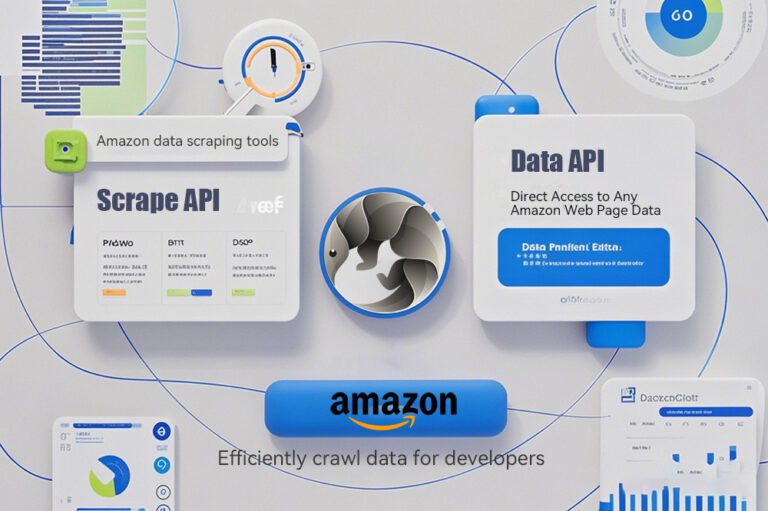
To address the challenges of Amazon data collection, Pangolinfo has introduced the Amazon Scrape API. This efficient and reliable data collection tool aims to assist businesses in effortlessly obtaining product information and reviews from the Amazon website.
The Pangolinfo Amazon Scrape API is a product designed for collecting data from any page on the Amazon website. It supports specifying postal codes to obtain consistent page data as seen by consumers. It supports both asynchronous and synchronous data retrieval. It helps developers easily overcome IP restrictions, robot detection, and captcha issues, enabling large-scale internet data collection.
Key Features of the Amazon Scrape API
- Simulates Browser Behavior: The Amazon Scrape API emulates user behavior in a browser, avoiding detection and achieving a success rate of up to 99.8%.
- Automated Captcha Resolution: The API intelligently solves Amazon’s captchas, ensuring smooth data collection.
- Supports On-Demand Crawling: Users only need to provide the URL of the page to be collected, and the API will return detailed product data and reviews.
- Postal Code-based Collection: Supports data collection based on geographical regions, meeting specific user requirements.
- Cost-Effective: The Pangolinfo Amazon Scrape API provides high-performance data collection services at a relatively low cost.
Usage Scenarios
The Amazon Scrape API finds application in various scenarios:
- Price Comparison: Quickly obtain competitor pricing information for pricing strategy reference.
- Product Data and Review Acquisition: Retrieve comprehensive product data and user reviews for informed product optimization.
- Market Trend Analysis: Identify new market trends and popular product categories, gaining early insights into market dynamics.
- Competitor Monitoring: Real-time monitoring of competitor pricing, discounts, etc., allowing for flexible strategy adjustments.
Synchronous Integration Examples
To help developers quickly integrate the data extraction capabilities into their systems, below are synchronous code examples using Python along with their expected JSON responses. For a comprehensive API calling guide, parameters, and advanced configurations, please refer to the official Pangolinfo API Documentation.
1. Scraping Keywords (Search Results)
This snippet demonstrates how to synchronously search for a keyword and retrieve product ranking data.
Request Example:
import requests

API_KEY = "YOUR_API_KEY"
BASE_URL = "[https://api.pangolinfo.com/amazon/scrape](https://api.pangolinfo.com/amazon/scrape)"
HEADERS = {"Authorization": f"Bearer {API_KEY}", "Content-Type": "application/json"}

def scrape_amazon_keywords(keyword, country="US"):
    payload = {
        "action": "search",
        "keyword": keyword,
        "country": country
    }
    response = requests.post(BASE_URL, json=payload, headers=HEADERS)
    return response.json()

# Example usage
# print(scrape_amazon_keywords("wireless earbuds"))
Response Example:
{
  "status": "success",
  "data": {
    "keyword": "wireless earbuds",
    "results": [
      {
        "asin": "B08N5WRWNW",
        "title": "Example Wireless Earbuds with Bluetooth 5.0",
        "price": "$29.99",
        "rating": 4.5,
        "review_count": 10234,
        "is_sponsored": false
      }
    ]
  }
}
2. Scraping Best Sellers
Retrieve the top-selling products in a specific category to analyze market trends.
Request Example:
import requests

API_KEY = "YOUR_API_KEY"
BASE_URL = "[https://api.pangolinfo.com/amazon/scrape](https://api.pangolinfo.com/amazon/scrape)"
HEADERS = {"Authorization": f"Bearer {API_KEY}", "Content-Type": "application/json"}

def scrape_amazon_bestsellers(category_url):
    payload = {
        "action": "bestsellers",
        "url": category_url
    }
    response = requests.post(BASE_URL, json=payload, headers=HEADERS)
    return response.json()

# Example usage
# print(scrape_amazon_bestsellers("[https://www.amazon.com/Best-Sellers-Electronics/zgbs/electronics/](https://www.amazon.com/Best-Sellers-Electronics/zgbs/electronics/)"))
Response Example:
{
  "status": "success",
  "data": {
    "category_name": "Electronics",
    "bestsellers": [
      {
        "rank": 1,
        "asin": "B07PGL2ZZD",
        "title": "Example Best Selling Electronic Device",
        "price": "$39.99",
        "rating": 4.8,
        "review_count": 45120
      }
    ]
  }
}
3. Scraping Product Reviews
Extract user reviews and ratings using the product ASIN for sentiment analysis.
Request Example:
import requests

API_KEY = "YOUR_API_KEY"
BASE_URL = "[https://api.pangolinfo.com/amazon/scrape](https://api.pangolinfo.com/amazon/scrape)"
HEADERS = {"Authorization": f"Bearer {API_KEY}", "Content-Type": "application/json"}

def scrape_amazon_reviews(asin):
    payload = {
        "action": "reviews",
        "asin": asin,
        "sort_by": "recent"
    }
    response = requests.post(BASE_URL, json=payload, headers=HEADERS)
    return response.json()

# Example usage
# print(scrape_amazon_reviews("B08N5WRWNW"))
Response Example:
{
  "status": "success",
  "data": {
    "asin": "B08N5WRWNW",
    "average_rating": 4.5,
    "total_reviews": 10234,
    "reviews": [
      {
        "id": "R1ABCD2EFGH3IJ",
        "author": "John Doe",
        "rating": 5.0,
        "title": "Great sound quality!",
        "text": "These earbuds exceed my expectations. Highly recommended.",
        "date": "2023-10-01",
        "verified_purchase": true
      }
    ]
  }
}
4. Scraping Product Details
Get comprehensive product information including price, availability, and variations.
Request Example:
import requests

API_KEY = "YOUR_API_KEY"
BASE_URL = "[https://api.pangolinfo.com/amazon/scrape](https://api.pangolinfo.com/amazon/scrape)"
HEADERS = {"Authorization": f"Bearer {API_KEY}", "Content-Type": "application/json"}

def scrape_product_details(asin):
    payload = {
        "action": "product_details",
        "asin": asin
    }
    response = requests.post(BASE_URL, json=payload, headers=HEADERS)
    return response.json()

# Example usage
# print(scrape_product_details("B08N5WRWNW"))
Response Example:
{
  "status": "success",
  "data": {
    "asin": "B08N5WRWNW",
    "title": "Example Wireless Earbuds with Bluetooth 5.0",
    "brand": "ExampleBrand",
    "price": "$29.99",
    "availability": "In Stock",
    "categories": ["Electronics", "Headphones"],
    "main_image_url": "[https://m.media-amazon.com/images/I/example.jpg](https://m.media-amazon.com/images/I/example.jpg)"
  }
}
5. Scraping Bullet Points (Five-Point Description)
Extract the key features (bullet points) highlighted on the product page.
Request Example:
import requests

API_KEY = "YOUR_API_KEY"
BASE_URL = "[https://api.pangolinfo.com/amazon/scrape](https://api.pangolinfo.com/amazon/scrape)"
HEADERS = {"Authorization": f"Bearer {API_KEY}", "Content-Type": "application/json"}

def scrape_bullet_points(asin):
    payload = {
        "action": "bullet_points",
        "asin": asin
    }
    # Using synchronous request to immediately get the data
    response = requests.post(BASE_URL, json=payload, headers=HEADERS)
    return response.json()

# Example usage
# print(scrape_bullet_points("B08N5WRWNW"))
Response Example:
{
  "status": "success",
  "data": {
    "asin": "B08N5WRWNW",
    "bullet_points": [
      "High-fidelity audio with deep bass.",
      "Up to 24 hours of playtime with the charging case.",
      "IPX7 waterproof and sweatproof design.",
      "Ergonomic fit for comfortable all-day wear.",
      "Touch controls for easy music and call management."
    ]
  }
}
Comparison with Other Products
Compared to other similar products on the market, the Pangolinfo Amazon Scrape API stands out with its unique advantages:
- High Success Rate: Using simulated browser behavior results in a success rate of up to 99.8%.
- Intelligent Captcha Resolution: The API automatically bypasses captchas without requiring manual intervention.
- Cost-Effectiveness: Providing high-performance data collection services at a lower cost.
- On-Demand Collection: Users simply provide the page URL to be collected, making it user-friendly.
- Postal Code-based Collection: Meets specific user requirements for geographical data.
Free Testing and Registration
To allow users to experience the powerful functionality of the Amazon Scrape API, Pangolinfo offers new users a free testing opportunity. Users only need to register on the Pangolinfo website to enjoy 1000 free requests, gaining comprehensive insights into the API’s performance and advantages.
Conclusion and Outlook
The Amazon Scrape API from Pangolinfo serves as a core solution for overcoming the challenges of Amazon data collection, providing businesses with an efficient, reliable, and cost-effective approach. As e-commerce competition continues to intensify, the demand for accurate market data will become increasingly urgent, making the Amazon Scrape API a crucial tool for gaining a competitive edge.
In the future, Pangolinfo will continually optimize and upgrade the Amazon Scrape API, enhancing its applicability and stability. Simultaneously, Pangolinfo will actively engage in and promote support for the data required for AI training, contributing to comprehensive industry development. Recognizing the critical role of data in artificial intelligence, Pangolinfo commits to actively participating in data sharing and openness, contributing to advancements in the field.
In addition to the Amazon Scrape API, Pangolinfo will introduce more data collection products based on advanced technologies, covering more fields to meet diverse user needs. Expanding the product line to provide more comprehensive data solutions is one of Pangolinfo’s development directions.
Throughout the usage of the Amazon Scrape API, users can receive timely assistance through detailed documentation and technical support teams. Pangolinfo is committed to establishing a stable, secure, and efficient data collection ecosystem, growing together with users and sharing success.
Closing Thoughts
In summary, the Amazon Scrape API is a powerful tool for unlocking Amazon data, providing an efficient way to overcome anti-scraping mechanisms. Pangolinfo stands out with its technological innovation, cost-effectiveness, and user experience, becoming a leader in the market. Through the Amazon Scrape API, businesses can easily access crucial Amazon data, offering reliable support for business decision-making.
With the flourishing development of e-commerce and artificial intelligence, Pangolinfo will continuously refine its products, elevate service levels, and meet the ever-changing market demands. In the future, we look forward to exploring new possibilities in the data collection field with users, contributing to the business development in the digital era.
If you are interested in the Amazon Scrape API, feel free to register on the Pangolinfo website for a free trial of 1000 requests. Pangolinfo anticipates becoming your long-term partner in the field of Amazon data collection, collectively creating a successful future.