
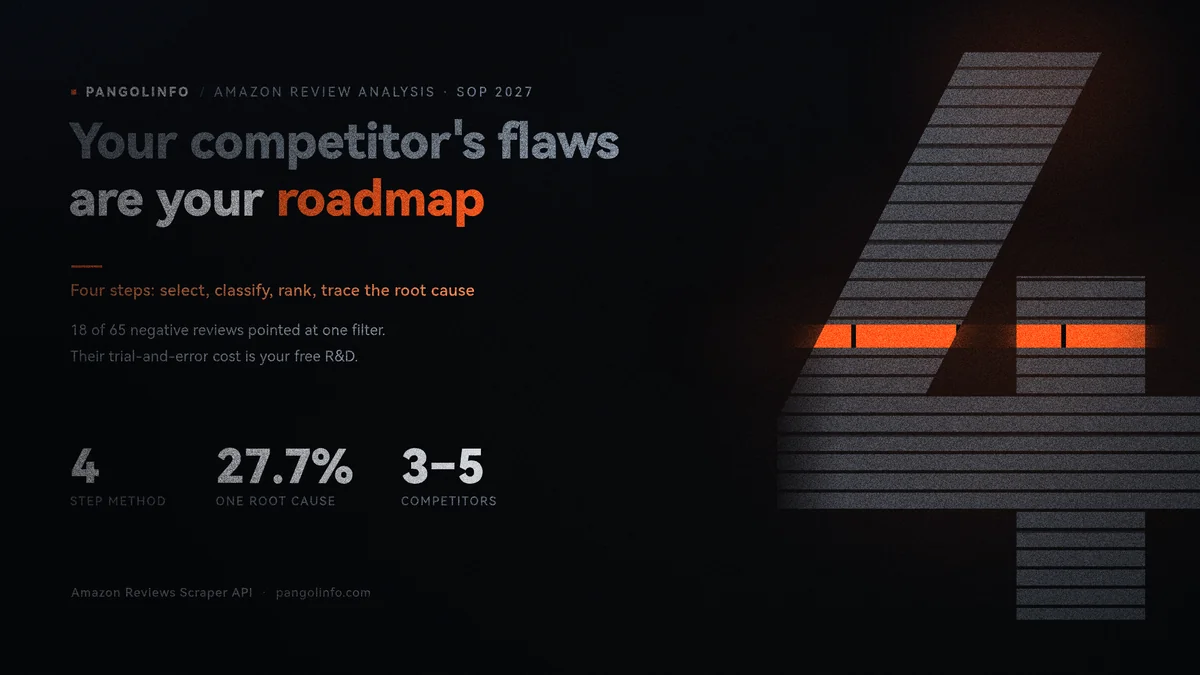
Amazon competitor review analysis is the most cost-effective, directly validated product development and differentiation strategy available in e-commerce, because your rivals have already paid the capital, inventory, and marketing tuition to discover what the market rejects. In the 2027 Amazon ecosystem, blindly opening molds or superficially cloning a top-ranking competitor’s design rarely yields a sustainable competitive advantage. Real market entry requires systematically dismantling the raw text of competitor reviews to identify unmet needs, glaring component failures, and the exact upgrades for which buyers are actively willing to pay a premium.
In our series pillar guide, How to Analyze Amazon Reviews: A Complete SOP (2027), we established the baseline six-step analytical workflow and 14-field data schema. Subsequent playbooks detailed how to triage your own critical feedback in How to Analyze Amazon Negative Reviews, evaluate commercial extraction platforms in Best Amazon Review Analysis Tools Compared, guard against statistical deception in Why Amazon Review Analysis Misleads, and navigate modern algorithmic visibility in Amazon AI Review Summaries & Alexa for Shopping. This sixth installment shifts the focus entirely to the competitor perspective, detailing how to strip-mine rival ASINs to define a superior product roadmap, validate new feature concepts, and craft high-converting listing copy without crossing strict regulatory boundaries.
Why Analyze Competitor Reviews: The Free R&D Laboratory
Competitor reviews offer a zero-cost product roadmap that reveals the exact mechanical failures buyers despise and the baseline features they refuse to live without.
Many cross-border teams, brand operators, and industrial designers initiate product research by scanning top-seller category ranks and keyword search volumes. They look at what is selling well today and instruct their sourcing teams to procure something that looks remarkably similar. By operating in this vacuum, they frequently end up reinventing a broken wheel—only discovering critical, industry-wide design flaws after their own first production run triggers a wave of costly returns and 1-star reviews. Systematically analyzing competitor reviews solves three strategic problems before you ever commit to a factory purchase order:
Their Negative Reviews Are Your Product-Opportunity List
Every 1- to 3-star Verified Purchase review on a competitor’s listing operates as a free, field-tested defect diagnostic report. The incumbent seller has already absorbed the staggering sunk costs of tooling, manufacturing, international shipping, and aggressive advertising just to place their product into real households, garages, and outdoor environments. When you observe the exact same hardware glitch, missing accessory, or setup friction across three to five top competitors, you are holding a market-validated product requirements document. You do not need to guess what target buyers want, nor do you need to run expensive consumer focus groups to gauge their daily frustrations; you simply need to engineer the specific components that the incumbents failed to deliver, leveraging their painful public missteps as your primary product-development blueprint.
Their Positive Reviews Define the Baseline You Must Defend
When brand teams focus exclusively on competitor 1-star complaints, they frequently engineer a lopsided product that solves the rival’s main weakness but completely abandons the rival’s core strength. Competitor 4- and 5-star reviews map out the category’s non-negotiable table stakes—the basic functional expectations that are so ingrained in the buyer’s mind that failing to deliver them guarantees immediate rejection, regardless of whatever novel features you have invented.
For example, if every 5-star review for a market-leading travel mug praises its “smooth, one-handed lid operation” and “perfect fit in a standard car cup holder,” that is your engineering baseline. No matter how many innovative temperature-control features, digital displays, or premium materials you add to your new version, if your lid requires two hands to open or your base diameter is half an inch too wide to fit securely in a sedan console, legacy buyers will reject it instantly. You must securely match the competitor’s 5-star baseline before you can successfully monetize their 1-star gaps.
The 2026 Variant Split and Alexa for Shopping Reshape the Battlefield
As documented in Amazon AI Review Summaries & Alexa for Shopping, Amazon rolled out a category-by-category variant review sharing split between February 12 and May 31, 2026. This foundational platform update restricted variations with different capacities, functionalities, or configurations from sharing a pooled review total. Shortly after, on May 13, 2026, Amazon rebranded Rufus to Alexa for Shopping, allowing the conversational assistant to instantly retrieve Verified Purchase reviews to compare competing brands on specific, highly granular attributes.
In 2027, an incumbent brand’s weaker secondary sizes or upgraded models can no longer hide safely behind the massive positive review count of their flagship variation. When a shopper asks Alexa for Shopping, “Which of these camping chairs is better for tall people?”, the assistant explicitly calls out the competitor’s negative dimensional attributes extracted directly from isolated child ASIN reviews. New entrants who design their products specifically to plug the exact attribute gaps exposed in those competitor child-ASIN reviews now enjoy unprecedented visibility in AI-generated buying recommendations, outflanking larger brands whose legacy listings are suddenly exposed.
The Four-Step Method for Competitor Review Analysis
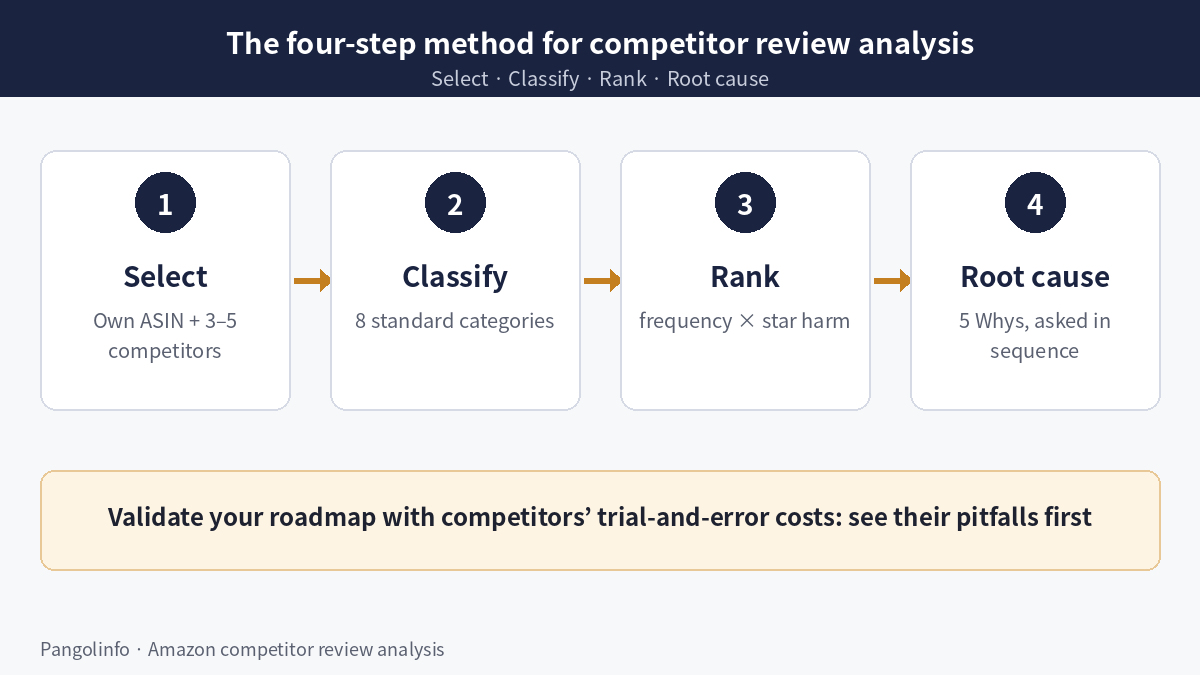
A rigorous competitor analysis requires isolating 3 to 5 direct child ASINs, categorizing their critical feedback alongside nuanced 5-star reservations, prioritizing issues by star-harm, and digging to the root cause.
To prevent competitor research from devolving into scattered, subjective reading that produces vague takeaways for the factory, teams should adapt the standardized analytical framework established in our previous playbooks specifically for the competitor context.
Step 1: Isolate 3 to 5 Direct Competitor Child ASINs
Effective competitor analysis begins with exceptionally tight scoping. Do not scrape the top twenty listings in a broad category, as blending premium brands with budget knockoffs will hopelessly pollute your data with conflicting buyer expectations. A shopper buying a budget item tolerates material compromises that a shopper paying premium prices will immediately punish. Instead, isolate 3 to 5 direct competitor child ASINs that match your intended product on three strict criteria: same price band (which dictates the buyer’s quality expectations and cost tolerance), same core functional category, and same target demographic.
Following the February 12 to May 31, 2026 variant split, you must pull and analyze data strictly at the single child-ASIN level. If you are developing a 32-ounce insulated water bottle, you cannot include reviews from the competitor’s 16-ounce kids’ version, nor can you rely on the blended review count historically displayed on the competitor’s parent page. Mixing those specifications will generate a confused defect list that applies to neither product perfectly. Aim to collect a minimum of 50 critical (1- to 3-star) reviews per target child ASIN to achieve qualitative theme saturation, ensuring that the recurring issues you spot are genuine patterns rather than isolated flukes. (For guidance on tool ingestion limits and sampling scopes, refer to Best Amazon Review Analysis Tools Compared; for current software pricing, check the official checkout page of your chosen vendor).
Step 2: Code 1- to 3-Star Reviews and the 5-Star “But…”
Route every collected competitor 1- to 3-star review through the eight-category operational taxonomy established in How to Analyze Amazon Negative Reviews: Quality, Sizing & Fit, Feature Gap, Packaging & Shipping, Instructions & UX, Appearance & Color, Safety & Health, and Installation & Compatibility. This forces messy, emotional buyer complaints into structured buckets that individual departments (like packaging, supplier management, or software engineering) can actually own and action.
For competitor research, you must add one highly lucrative step that is often ignored in self-audits: actively mine competitor 5-star reviews for the recurring “but…” (or “however”) clauses. A buyer who leaves a 5-star rating generally loves the core utility of the product, so their documented reservations represent the honest compromises of highly satisfied, high-intent users. They are attempting to justify their purchase while admitting a slight friction point. A review stating, “The espresso extraction is incredibly rich, 5 stars all the way, but the black MAX fill line inside the water tank is almost invisible under kitchen lighting,” offers a direct, highly monetizable product upgrade that a pure 1-star filter would miss entirely. These subtle compromises are exactly where premium brand positioning is born.
Step 3: Rank by Frequency × Star Harm (Safety P0)
Once competitor complaints are categorized into clear clusters, apply a transparent weighting formula to prevent high-frequency but trivial aesthetic complaints from distracting your engineering team from lower-frequency but catastrophic functional failures:
-
Star Harm = (5 – Average Stars) / 4 (An average 1.0-star rating yields a 1.00 maximum harm coefficient; an average 3.0-star rating yields a 0.50 harm coefficient).
Priority Score = Frequency Share × Star Harm
The P0 Override: Any competitor mention of Safety & Health (e.g., melting plastic, electrical sparks, chemical odors, or sharp burrs) bypasses the mathematical formula entirely and is locked at P0. These are the competitor’s most dangerous regulatory liabilities and represent strict compliance guardrails your new factory molds must absolutely avoid. A minor defect rate involving an electrical spark is infinitely more relevant to your product design team than a double-digit complaint rate about a slightly dull paint finish.
Step 4: The 5 Whys Root-Cause Diagnosis (Competitor Attack Perspective)
Review text only describes symptoms, never the underlying supply chain decisions that caused them. If you accept competitor reviews at face value, you might conclude, “We need to buy a stronger water pump.” Applying the 5 Whys root-cause framework reveals the actual structural vulnerability you can exploit.
Consider the portable espresso machine case introduced in article 2, now viewed from the perspective of an attacker analyzing an incumbent competitor: Out of 65 negative reviews on the incumbent’s child ASIN, 18 reviews (27.7 percent, averaging 1.3 stars) complained, “Stopped producing water after a week, just buzzing.”
-
Why did the competitor’s unit stop producing water? The water pump did not fail; the one-way silicone inlet valve was completely blocked by compacted fine coffee grounds.
Why did fines clog the valve? Buyers used Turkish (extra-fine) grind and overfilled the basket, creating extreme back-pressure that pushed fines into the valve.
Why did buyers overfill the basket? The competitor’s MAX fill line is a same-color dark print inside a black plastic basket, making it invisible, and they included no standard dosing spoon to regulate input.
Why didn’t buyers know to avoid extra-fine grinds? The competitor buried the warning on page 14 of a text-heavy manual and used a misleading close-up of extra-fine powder in their fourth listing image.
Why did this competitor’s failure rate jump recently? The incumbent factory cut costs by USD 0.15, swapping a double sintered stainless-steel filter mesh for a single punched metal mesh, halving their backflow tolerance.
As a new market entrant, this 5 Whys teardown hands you a precise, multi-departmental blueprint for a superior product: you launch your version with a double sintered mesh (Engineering), a high-contrast white laser-etched MAX line and a standard 8g dosing spoon included in the box (Packaging & Accessories), and a prominent grind-size infographic in your main image stack (Creative & Listing Ops). You immediately capture the exact buyer demographic the incumbent just alienated without guessing at the solution.
Translating Buyer Words Into Product Opportunities and Differentiation
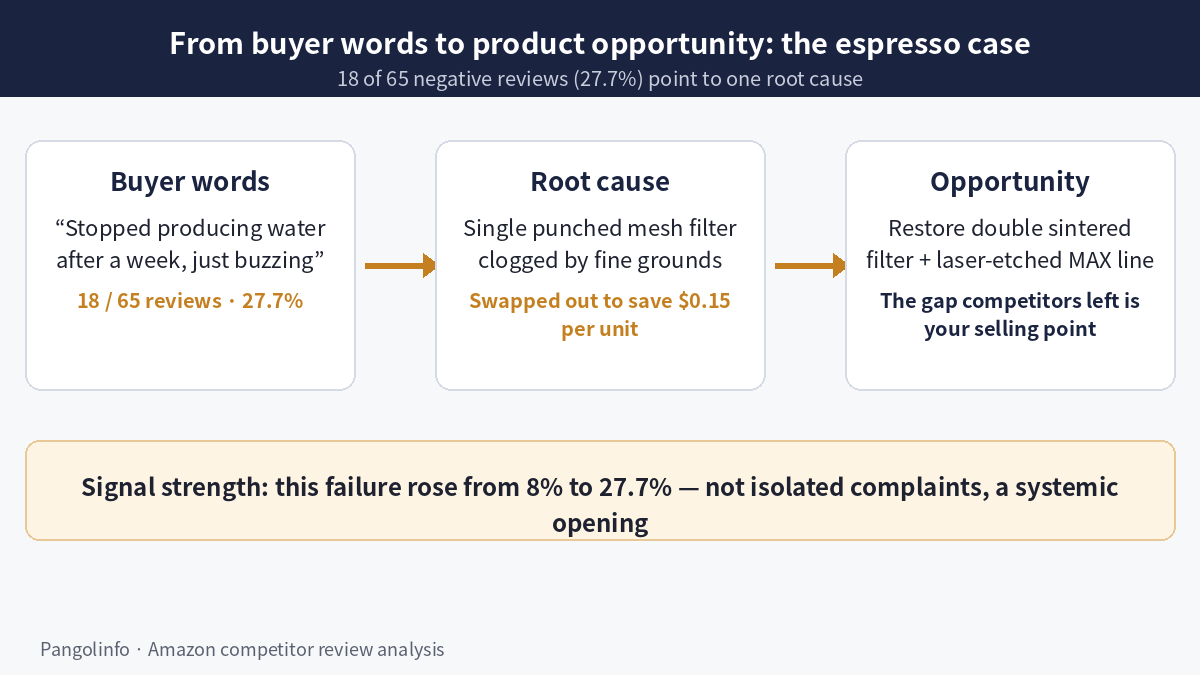
The ultimate goal of collecting competitor feedback is to translate high-frequency complaints into engineering specifications and transform their unarticulated strengths into your explicit marketing claims.
Translating Complaints Into a Five-Dimension Improvement List
A chronic failure point in e-commerce operations occurs when competitor insights remain trapped in marketing slide decks, completely ignored by the factory floor. To prevent this disconnect, translate the raw qualitative data into a structured engineering and operations checklist across five dimensions. The table below demonstrates how to bridge the gap between Amazon operations (who read the reviews) and product development (who actually build the product):
| Improvement Dimension |
Competitor Review Signal (Buyer Words) |
Translated Engineering & Operations Specification |
|---|---|---|
| Features (Function) |
Illustrative: “The espresso maker stopped pumping water and just buzzes after five days.” (18/65 reviews, 27.7%) | Standardize double sintered stainless-steel filter mesh to maximize backflow tolerance; redesign inlet valve shield. |
| Materials |
Illustrative: “The silicone sealing ring on their lid gets stiff and starts leaking after a month of dishwashing.” | Upgrade to food-grade, high-rebound platinum silicone for the gasket, and include two spare rings in the retail box. |
| Size & Dimensions |
Illustrative: “The base of this travel mug is slightly too wide to sit flat in my Honda Civic’s cup holder.” | Taper the bottom outer diameter to fit standard automotive cup-holder tolerances, and add millimeter dimensions to image 2. |
| Packaging |
Illustrative: “Arrived in a thin plastic bag; the glass carafe was completely shattered in transit.” | Specify high-density molded pulp inserts and corrugated outer cartons; mandate factory-level drop testing before FBA shipment. |
| Instructions & UX |
Illustrative: “The MAX line is black-on-black and impossible to read; no scoop was included.” | Use high-contrast white laser etching for the MAX line; bundle an 8g measuring spoon and a quick-start visual guide card. |
Turning Unarticulated Competitor Strengths Into Your Differentiation
When reading competitor 4- and 5-star reviews, analysts frequently uncover a highly lucrative marketing asymmetry: buyers consistently praise a specific physical benefit that the competitor completely fails to mention in their own listing copy.
For example, a competitor sells a collapsible trunk organizer. Dozens of 5-star reviews rave, “The hidden rubberized feet on the bottom are amazing—I stacked three of these in my SUV, slammed on the brakes, and they didn’t slide an inch.” Yet, the competitor’s title, bullet points, and A+ Content only mention “large capacity” and “easy to fold.” The competitor possesses the physical feature but lacks the operational awareness to monetize it. They have left money on the table by failing to communicate the very feature their buyers love most.
As a new entrant, you implement the same anti-slip rubberized feet on your molds, but you elevate this hidden consensus into an explicit differentiation driver. You highlight the “Anti-Slip Braking Grip” in your first bullet point, dedicate your third listing image to a gripping-friction diagram, and build an A+ Content module around vehicle safety. When a buyer searches Alexa for Shopping for a “non-slip trunk organizer,” your structured listing data and your subsequent Verified Purchase reviews will perfectly align, winning the AI recommendation effortlessly while the competitor is ignored.
Validating New-Product Concepts and Willingness to Pay
Before committing tens of thousands of dollars to open a new injection mold for a premium product concept, use competitor review gaps as a zero-cost concept validation test. Look for three specific types of verbatim evidence that prove demand exists before you spend a dime on production:
-
Explicit willingness to pay: Search for phrases like, “I would gladly pay $10 more if this had a magnetic charging dock instead of a plug,” or, “I wish they offered a premium version with a stainless-steel interior.” These statements directly prove price elasticity for specific feature upgrades, ensuring your premium pricing strategy is anchored in reality rather than wishful thinking.
Third-party aftermarket purchases (The “DIY” workaround): If multiple buyers mention spending their own money to buy aftermarket non-slip mats, replacement filters, 3D-printed brackets, or thread adapters to make the competitor’s product function properly, the pain point is severe enough to trigger independent spending. They are practically begging the manufacturer to solve the issue. Bundling that aftermarket solution as a factory standard creates a massive competitive moat.
Cross-brand recurring flaws: If you analyze the top 5 competitors in a category and discover they all suffer from the exact same structural failure, it indicates an industry-wide manufacturing blind spot rather than a single factory’s quality control lapse. Solving that specific defect grants your brand a unique, highly profitable differentiation window that cannot be easily copied overnight.
Boundaries, Compliance, and Credibility in Competitor Research
Ethical competitor analysis relies strictly on public data and transparent sampling, ensuring teams never cross FTC compliance red lines or mislead management with unanchored statistics.
Public Data and Anti-Smearing Compliance (FTC 16 CFR Part 465)
When executing competitor research and launching your counter-product, teams must strictly observe three non-negotiable legal and platform boundaries to protect their brand equity and seller accounts:
-
Analyze only public data: All competitor intelligence must be derived exclusively from publicly visible Amazon detail pages, customer reviews, Q&A sections, and frontend storefronts. Never attempt to purchase, hack, or illicitly acquire a competitor’s backend return reports, proprietary sales data, or factory BOM sheets.
No copyright infringement: When you identify a product gap from competitor reviews, you must address it using your own original engineering, your own product photography, and your own independent English copywriting. Do not copy and paste a competitor’s bullet points, A+ modules, or lifestyle images, as this immediately exposes you to intellectual property takedowns.
Anti-smearing and FTC compliance: Under the FTC Consumer Review Rule (16 CFR Part 465), which took effect on October 21, 2024, and the binding commitments Amazon made to the UK CMA on June 6, 2025, fabricating reviews to damage a competitor is a severe federal offense and a platform violation. You must never hire proxy networks to leave fake 1-star reviews on a competitor’s listing, upvote a competitor’s negative reviews to manipulate their page layout, or falsely report safety violations. Violations of the FTC rule carry civil penalties of up to USD 53,088 per violation, alongside permanent Amazon account suspension and the potential for devastating public relations fallout.
Enforcing the Credibility Checklist and Single Child-ASIN Attribution
Because competitor reviews represent a non-random, self-selected sample (the J-shaped distribution discussed in Why Amazon Review Analysis Misleads), they provide product development clues, not definitive population statistics. To maintain internal credibility when presenting a competitor teardown to your executive team in boardroom settings, you must enforce strict data hygiene so leadership does not mistake qualitative patterns for absolute facts:
-
Always report sample size n and the denominator: Never claim, “30 percent of the competitor’s buyers experience leaks,” as this sounds like a verified failure rate across all shipments. You must explicitly state, “Out of 58 critical reviews sampled from the competitor’s 850 total ratings, 18 reviews (31 percent of the negative sample) cited leakage.”
Attribute strictly by single child ASIN: Ensure all competitor data respects the February 12 to May 31, 2026 variant review split. If you are targeting a competitor’s 10-inch frying pan, you must isolate the review text and star ratings belonging exclusively to the 10-inch child ASIN, actively filtering out noise from their 8-inch or 12-inch variations.
Retain manual visual verification: Do not rely solely on third-party sentiment word clouds. Force your analysts to manually read 20 to 30 original competitor reviews and inspect the attached customer photos to verify the physical reality of the reported defect before instructing the factory to modify your product design.
Closing the Loop: Automating Your Competitor Intelligence
A one-off competitor teardown during the initial product launch phase provides a valuable snapshot, but sustainable market dominance requires continuous, structured monitoring. When your team needs to track how 3 to 5 core competitor child ASINs evolve over time, how their buyers react to their latest product batch, or whether your own newly launched product successfully captured their alienated customers, relying on manual browser refreshing or capped browser extensions rapidly becomes an operational bottleneck.
Rigorous competitor review analysis always presupposes solving structured data acquisition first. To feed your product development pipeline with clean, un-truncated competitor review records—preserving exact star ratings, review dates, Verified Purchase badges, and the critical child-ASIN variant metadata required by the 2026 split rules—explore the Pangolinfo Amazon Review API (for current tier capabilities and billing, check the official checkout page). To integrate these competitor insights into a comprehensive operational ecosystem, revisit our foundational framework in How to Analyze Amazon Reviews: A Complete SOP (2027), master defect sorting in How to Analyze Amazon Negative Reviews, evaluate analytics software boundaries in Best Amazon Review Analysis Tools Compared, audit data trustworthiness in Why Amazon Review Analysis Misleads, align your listing with the latest algorithmic rules in Amazon AI Review Summaries & Alexa for Shopping, or explore advanced extraction workflows in How to Scrape Amazon Reviews for Complaint Analysis. (See the Review API reference docs.)
Frequently Asked Questions About Amazon Competitor Review Analysis
The five answers below address the most critical scoping, validation, and compliance questions teams face when extracting product intelligence from competitor listings.
1. Why should I read a competitor’s 5-star reviews if I am looking for their product flaws?
Competitor 5-star reviews define the baseline table stakes that your new product must match to be considered viable in the category. Furthermore, highly satisfied buyers frequently include “but…” or “however” clauses in their 5-star feedback, revealing nuanced compromises and minor friction points they are willing to tolerate—which often translate into highly profitable premium features for your own product iteration.
2. How many competitor ASINs and reviews should I analyze to find reliable product gaps?
Select 3 to 5 direct competitor child ASINs that share the exact same price band, core functionality, and target demographic as your planned product. Aim to collect a minimum of 50 critical (1- to 3-star) reviews per target child ASIN to achieve qualitative theme saturation. Always report the exact sample size and total review denominator rather than treating the sample as statistically definitive.
3. How does the 2026 variant review split affect how I research competitor products?
Following the variant review sharing split rolled out between February 12 and May 31, 2026, child variations with different capacities, sizes, or functional configurations no longer share review pools. When analyzing a competitor, you must isolate the review text and ratings belonging strictly to the exact functional child ASIN you intend to compete against, avoiding merged parent-level data that dilutes specific component flaws.
4. How can I use competitor reviews to validate a new product feature before manufacturing?
Look for explicit willingness to pay (e.g., buyers stating they would pay more for a specific material upgrade), instances of buyers independently purchasing third-party aftermarket accessories to fix the competitor’s flaw, or cross-brand recurring defects that plague all top competitors. These signals confirm that the unmet need is genuine and commercially viable.
5. What are the legal risks of analyzing or interacting with competitor listings?
You must rely exclusively on publicly available data. Under the U.S. FTC Consumer Review Rule (16 CFR Part 465, effective October 21, 2024, with fines up to USD 53,088 per violation), you are strictly prohibited from hiring proxy networks to post fake 1-star reviews on a competitor’s page, artificially upvoting their negative reviews, or fabricating safety complaints to trigger algorithmic suppression.