

Amazon’s customer review section has evolved from a chronological archive that shoppers scroll through manually into an active, AI-mediated decision layer led by on-page review summaries and Alexa for Shopping—meaning 2027 review optimization is no longer about inflating parent-level star counts, but about engineering verified attribute signals and standalone child-ASIN health. Between 2023 and 2026, Amazon and global regulators reshaped every structural rule governing how reviews are collected, pooled across variations, summarized by generative models, and policed for manipulation.
In our series pillar guide, How to Analyze Amazon Reviews: A Complete SOP (2027), we established the end-to-end six-step analytical workflow and 14-field data schema. Subsequent playbooks detailed how to triage critical feedback in How to Analyze Amazon Negative Reviews, evaluate third-party platforms in Best Amazon Review Analysis Tools Compared, and guard against statistical and manipulation traps in Why Amazon Review Analysis Misleads. This fifth installment synthesizes the major platform and regulatory shifts completed through 2026 and translates them into a concrete, highly detailed 2027 operating playbook for sellers, brand managers, and product development teams.
How Amazon AI Review Summaries and Alexa for Shopping Work
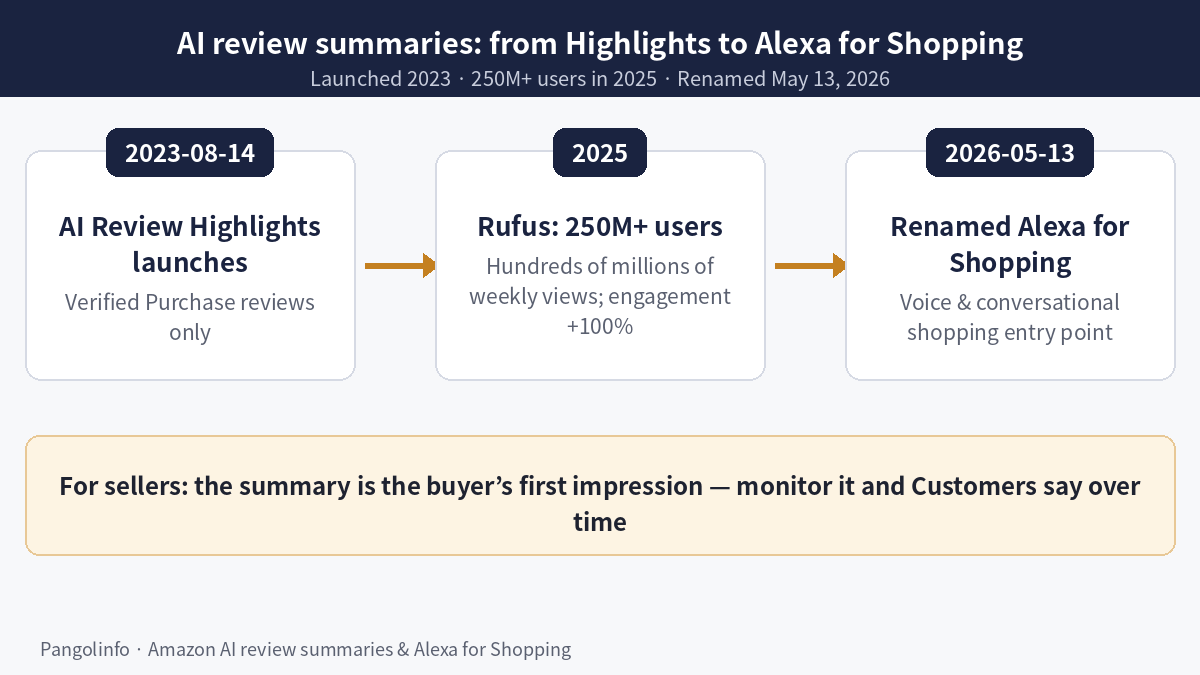
Amazon’s AI review summaries filter buyer feedback exclusively through Verified Purchase text and now power conversational product discovery via Alexa for Shopping, yet they operate as second-layer compression that systematically hides low-frequency safety and quality risks.
The August 2023 Launch and the Verified Purchase Gatekeeper
Amazon officially launched AI Review Highlights—rendered prominently on product detail pages under the “Customers say” heading—on August 14, 2023. Rather than forcing shoppers to read dozens of individual posts to identify recurring pros and cons, Amazon’s generative models synthesize buyer sentiment into a concise summary paragraph paired with clickable attribute chips. These chips are displayed in green for predominantly positive themes and yellow or neutral tones for mixed or contested attributes, visually anchoring the buyer’s first impression before they ever scroll to the A+ Content.
From day one, Amazon enforced a strict, non-negotiable corpus boundary on this feature: Amazon AI review summaries are generated exclusively from Verified Purchase reviews. Unverified ratings submitted without a confirmed Amazon order transaction are permanently excluded from the summarization pipeline. This single architectural rule fundamentally altered the return on investment of review acquisition and forced customer service teams to completely rethink their post-purchase workflows:
-
Non-verified volume no longer shapes on-page perception: Legacy operational tactics that relied on unverified reviews or external traffic to pad overall star averages have zero influence over the “Customers say” narrative or clickable attribute tags. A product with thousands of unverified five-star ratings will still display an empty or highly vulnerable AI summary.
Attribute density matters more than generic praise: The generative models powering the summaries look for specific nouns, adjectives, and use cases. Ten detailed Verified Purchase reviews explaining exactly why a silicone gasket seals reliably in a high-temperature dishwasher carry far more semantic weight in the AI summary generation process than a hundred one-word “Great!” or “Awesome!” ratings. Brands must now optimize for descriptive, noun-heavy text rather than just chasing a high star rating.
From 250M+ Rufus Users in 2025 to the May 2026 Alexa for Shopping Rebrand
Over the two years following its initial launch, Amazon transformed AI review summarization from a passive detail-page widget into the core knowledge layer of its conversational retail engine. According to figures disclosed by Amazon, its AI shopping assistant Rufus surpassed 250 million active users in 2025, while AI review highlights generated hundreds of millions of weekly impressions and saw customer engagement increase by 100 percent year over year. The era of shoppers manually evaluating product flaws was decisively replaced by algorithmically curated insights.
On May 13, 2026, Amazon formally renamed Rufus to Alexa for Shopping, unifying its in-app conversational search assistant with Amazon’s broader voice and multimodal shopping ecosystem. Under the Alexa for Shopping architecture, review text no longer sits passively below the fold waiting to be read; it actively intercepts the buyer’s path to purchase:
-
Pre-purchase conversational synthesis: When a shopper types or speaks a highly specific, multi-turn question—such as “Does this travel kettle leak inside a backpack?” or “How does the sizing run for wide feet?”—Alexa for Shopping dynamically retrieves relevant Verified Purchase review passages alongside structured catalog attributes to deliver an immediate, synthesized answer. If the product’s marketing claims conflict with the verified buyer text, the AI assistant will highlight the discrepancy to the shopper.
Comparison-table and search-level surfacing: Attribute consensus distilled from Verified Purchase reviews increasingly informs how Alexa for Shopping filters, compares, and recommends competing ASINs during dynamic shopping sessions. A product lacking verified attribute signals for a specific use case is simply omitted from the assistant’s recommendation output.
Why Second-Layer Compression Still Hides Critical Product Risks
While AI review summaries dramatically accelerate consumer browsing and boost conversion for well-aligned products, brand operators and quality assurance teams must never mistake the on-page “Customers say” paragraph for a complete diagnostic readout. As demonstrated in Why Amazon Review Analysis Misleads, AI review summaries perform second-layer compression. They first compress a buyer’s complex, multi-week physical ownership experience into a short paragraph of text, and then the algorithm compresses hundreds of those buyer paragraphs into three simple summary sentences.
Because generative summarization is mathematically optimized for high-frequency consensus, it systematically erases low-frequency, high-severity outliers from visibility. If 280 Verified Purchase buyers praise a portable blender’s compact size and attractive color options while 3 buyers report that the internal charging port overheats or the blade assembly detaches mid-cycle, the “Customers say” summary will enthusiastically highlight portability and aesthetics while omitting the catastrophic physical hazard entirely. Sellers and product managers must therefore pair front-end summary monitoring with disciplined back-end triage of all 1- to 3-star reviews, ensuring that human analysts uncover what the AI smooths over.
The 2026 Variant Review Split and Pre-Launch Vine Restructuring
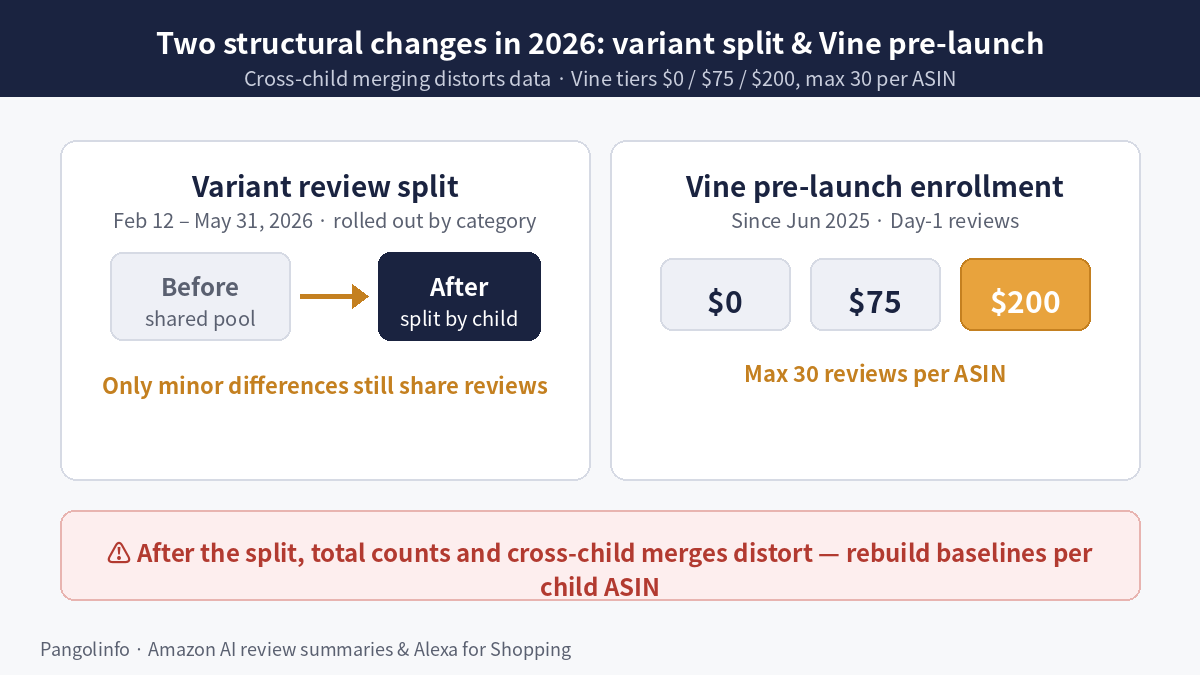
Amazon’s category-by-category variant review split dismantled parent-level rating shields in 2026, making June 2025’s pre-launch Vine enrollment essential for launching standalone child ASINs with credible Day-1 feedback.
What Changed Between February 12 and May 31, 2026
Between February 12 and May 31, 2026, Amazon executed a massive, phased, category-by-category rollout of its variant review sharing split. Prior to this platform change, sellers routinely grouped multiple sizes, capacities, materials, bundle configurations, and upgraded hardware generations under a single overarching parent ASIN. This allowed every newly launched child variation to instantly display the combined lifetime review total of the entire established product family, masking early defects on new variations.
Under the post-split policy, only variations with tiny differences—such as pure cosmetic color or pattern swaps that do not alter core product function, capacity, material construction, or technical specifications—are permitted to continue sharing reviews. Child ASINs that differ meaningfully in functional attributes, dimensions, performance tiers, or included accessories now have their review counts, star averages, and AI review summaries strictly isolated to their own individual detail pages.
This structural separation creates three immediate, unavoidable operational consequences for 2027:
-
Judging products by total parent-level review counts is deeply misleading: A newly launched Pro model, a larger capacity variation, or a redesigned ergonomic version can no longer borrow social proof from a legacy bestseller sitting under the same parent listing. Each functional child ASIN wins or loses retail conversion based entirely on its own standalone, isolated review corpus.
Merging reviews across child variations corrupts internal diagnostics: Analysts and operations teams who continue aggregating review exports at the parent ASIN level end up blending incompatible bills of materials. This dilutes acute defect clusters on vulnerable variations while misattributing accessory or fitment complaints across distinct SKUs, rendering engineering work orders useless.
Smaller child-level denominators accelerate AI summary shifts: When a standalone child ASIN holds a concentrated pool of 45 reviews instead of 2,500 pooled parent reviews, the algorithmic threshold for a summary change plummets. A single bad factory lot generating just 10 Verified Purchase complaints about a broken latch will rapidly flip that specific variation’s “Customers say” narrative from a green positive endorsement to a yellow cautionary warning.
Pre-Launch Vine Enrollment and Day-1 Review Economics
To give newly minted listings and newly split functional child ASINs a compliant path out of the zero-review cold-start trap, Amazon introduced Amazon Vine pre-launch enrollment starting in June 2025. Brand-registered sellers with FBA inventory successfully checked into fulfillment centers can now enroll eligible products into the Vine program before the public launch date. This allows vetted Vine Voices to receive units, physically test them, and submit comprehensive reviews prior to general catalog availability.
When building pre-launch Vine enrollment into your 2027 launch SOP, product and marketing teams must anchor their planning around three verified program parameters:
-
Day-1 review readiness: Completed Vine evaluations are held in the system and publish the moment the ASIN goes live for public purchase. This equips the detail page with Verified Purchase-equivalent social proof and initial attribute coverage from Day 1, ensuring the AI summary engine has immediate text to process.
Tiered enrollment fees and lifetime cap: Amazon Vine operates across three strict enrollment tiers priced at USD 0 (up to 2 units), USD 75 (up to 10 units), and USD 200 (up to 30 units), subject to an absolute maximum cap of 30 Vine reviews per ASIN over its lifetime.
Pre-scale engineering and listing validation: Vine reviewers are known for consistently writing structured, multi-paragraph assessments that meticulously weigh pros and cons. Enrolling 10 to 30 units prior to full paid-traffic launch functions as a live, pre-market stress test. Product managers must read these initial reviews carefully to expose ambiguous setup instructions, fragile inner packaging, or sizing mismatches early enough to fix the listing copy and warehouse prep before committing heavy ad spend.
US and UK Regulatory Enforcement: FTC 16 CFR Part 465 and CMA Commitments
Binding federal rules in the United States and formal regulatory commitments in the United Kingdom have eliminated gray-hat review recovery tactics, leaving genuine product and listing alignment as the only compliant path to stronger AI summaries.
FTC Consumer Review Rule (16 CFR Part 465) and Per-Violation Penalties
In the United States, the Federal Trade Commission’s final Consumer Review Rule (16 CFR Part 465) took full legal effect on October 21, 2024. The rule codifies strict, unambiguous federal prohibitions against deceptive review practices across all e-commerce marketplaces and brand-owned websites, officially turning what used to be platform policy violations into matters of federal statutory liability.
The rule explicitly targets the following practices:
-
Fake or fabricated reviews: Buying, selling, commissioning, or disseminating consumer reviews or testimonials that misrepresent that the reviewer actually used or had experience with the product.
Conditional incentives and review-edit coercion: Offering refunds, gift cards, discounts, free replacement units, or extended warranties strictly conditioned on a buyer leaving a positive rating or editing, updating, or deleting an existing negative review.
Undisclosed insider reviews: Publishing reviews written by company officers, employees, agents, or their relatives without clear, conspicuous, and unavoidable disclosure of the material connection to the brand.
Review gating and selective suppression: Using post-purchase funnels, QR code inserts, or customer-service routing software to steer satisfied buyers toward Amazon’s public review form while deliberately diverting dissatisfied buyers into private feedback channels to suppress critical reviews.
Violations of 16 CFR Part 465 carry staggering civil penalties of up to USD 53,088 per violation. Because these penalties can be assessed individually per non-compliant review or per deceptive solicitation, brands using non-compliant insert cards or aggressive, conditional customer-service scripts face rapid, business-ending financial exposure.
UK CMA Commitments and Catalog-Abuse Crackdowns
In the United Kingdom, the Competition and Markets Authority (CMA) formally accepted legally binding fake-review commitments from Amazon on June 6, 2025. Under these comprehensive commitments, Amazon agreed to strengthen its automated detection systems targeting fake reviews and catalog abuse. This specifically includes cracking down on variation hijacking—the illicit practice of merging unrelated, obsolete, or discontinued ASINs solely to inherit their historical positive ratings and reviews.
The CMA agreement forces Amazon to enforce stricter sanctions against non-compliant sellers and reviewer networks, including permanent account suspension and asset freezing, while providing clearer reporting mechanisms for shoppers. Together with the February to May 2026 variant review split, the FTC rule and UK CMA commitments close off every historical shortcut for artificially boosting ratings. In 2027, attempting to rescue a struggling ASIN through variation merging, gating, or incentivized review edits carries both immediate technical futility and severe legal liability. The only sustainable strategy is engineering a better product.
What Sellers Must Do Differently in 2027: Operational Playbook and First-Impression Checklist
Winning visibility inside AI review summaries and Alexa for Shopping in 2027 requires engineering natural attribute density in Verified Purchase reviews, aligning detail-page copy with spoken buyer queries, and auditing the “Customers say” module as your primary storefront first impression.
How Review Content Feeds AI Summaries: Quality Signals, Structure, and Attribute Words
Because AI Review Highlights distills recurring factual patterns exclusively from Verified Purchase feedback, the vocabulary and specificity of your organic and Vine reviews directly govern what shoppers see at the top of your review section. Sellers must transition their post-purchase operations from merely asking for a star rating to prompting for descriptive, scenario-based text.
-
Specific usage context outperforms generic praise: A Verified Purchase review stating “Used this 20,000mAh power bank on a four-day camping trip; charged two phones fully with LED indicators still showing 40 percent” supplies concrete capacity, scenario, and reliability signals that generative models readily extract and prioritize. By contrast, a review stating “Awesome charger, 5 stars!” adds zero semantic attributes to your summary profile and is largely ignored by the summarizer.
Component nouns generate clickable attribute chips: When multiple Verified Purchase buyers repeatedly name the exact physical features that solved their problem—such as “magnetic charging dock,” “non-slip silicone base,” or “quiet brushless motor”—those exact noun phrases surface as green attribute chips beneath the “Customers say” summary.
Compliant post-purchase prompts: Sellers can encourage richer, higher-signal reviews without violating FTC 16 CFR Part 465 by keeping neutral, non-conditional post-purchase packaging inserts and Amazon “Request a Review” workflows focused on honest usage context. Brand managers should invite buyers to share exactly how they use the product, which size worked best for their space, or how it held up to daily wear, always with zero incentives and zero sentiment filtering.
Optimizing Review Visibility for Voice and Conversational Shopping Under Alexa for Shopping
Following the May 13, 2026 rebrand of Rufus to Alexa for Shopping, product discovery increasingly happens through multi-turn conversational prompts and voice queries where shoppers state exact constraints and uncompromising requirements (“Find a dishwasher-safe stainless-steel French press under 34 ounces that doesn’t let coffee grounds through”).
Alexa for Shopping cross-examines two data sources simultaneously to formulate its answer: your structured catalog attributes and listing copy (title, bullet points, backend fields, A+ Content), and your Verified Purchase review corpus. When a mismatch emerges between your marketing claims and the actual buyer experience—for instance, your second bullet explicitly claims a “zero-leak travel lid” while 18 Verified Purchase reviews report that it “leaks when tipped sideways in a tote bag”—Alexa for Shopping surfaces that contradiction directly to high-intent shoppers and actively downgrades recommendation confidence.
To maximize conversational visibility in 2027, brands must implement rigorous bidirectional listing-to-review alignment:
-
Eliminate negative review attributes at the source: Whenever a recurring negative attribute chip appears on a child ASIN, resolve the underlying hardware, packaging, or instruction defect using the 5 Whys root-cause workflow. You cannot out-market a physical defect that Alexa for Shopping is actively reading about in your reviews.
Mirror validated buyer language back into listing copy: Extract the exact use cases, room sizes, compatibility scenarios, and durability proofs that Verified Purchase buyers praise organically, and incorporate those verified phrases verbatim into your bullet points and A+ Content. This ensures your structured listing metadata flawlessly reinforces your organic review signals, giving Alexa for Shopping maximum confidence in recommending your ASIN.
Monitoring AI Summaries and On-Page “Customers say” Shifts Over Time
Amazon’s “Customers say” narrative and attribute chips are highly dynamic outputs that recalculate as new Verified Purchase reviews accumulate. Treating them as a one-time check during product launch leaves teams completely blind to silent conversion erosion over the product lifecycle.
Brand managers must build a biweekly or monthly monitoring cadence around three vital operational checks:
-
Track attribute-chip turnover on every core child ASIN: Log the exact summary paragraph and every positive (green) and negative/mixed (yellow) attribute chip displayed on your standalone child variations. Maintain a running spreadsheet to document when new chips appear and old ones vanish.
Measure post-fix summary recovery: After shipping a product batch improvement, a packaging insert upgrade, or a main-image expectation fix, monitor new Verified Purchase reviews over the following 30 to 60 days. The goal is to track exactly when incoming positive reviews successfully dilute the legacy complaints, allowing you to watch a yellow attribute chip disappear and be replaced by a green one.
Benchmark competitor child-ASIN summaries: Capture the “Customers say” text and attribute pills across 3 to 5 direct functional competitors. This allows product development teams to spot category-wide pain points (such as “battery drains fast” or “hard to clean”) that your upcoming product iteration can solve and highlight explicitly in main images and A+ comparison charts.
The 2027 First-Impression Audit Checklist for AI Review Summaries
Whenever you launch a new functional child ASIN through pre-launch Vine enrollment or deploy a post-audit product revision, run your detail page through this First-Impression Audit Checklist before scaling your advertising spend:
| Audit Dimension |
Diagnostic Question |
Passing Standard & Corrective Action |
|---|---|---|
| 1. Child-ASIN Review Independence |
Following the February-May 2026 variant split, does each functional child ASIN carry its own standalone review base and AI summary? | Never rely on legacy parent totals; schedule pre-launch Vine enrollment (USD 0 / USD 75 / USD 200 tiers, up to 30 reviews) for new functional variations. |
| 2. Attribute-Chip Polarity Balance |
Do positive green attribute chips lead the “Customers say” bar, and are any high-friction yellow chips present? | If negative chips (e.g., “leaks,” “runs small,” “flimsy latch”) appear, open a cross-functional engineering, packaging, or listing work order immediately. |
| 3. Listing-to-Review Claim Alignment |
Do your bullets, main images, and A+ Content match the real-world usage scenarios confirmed in Verified Purchase reviews? | Remove exaggerated visual claims causing expectation gaps, and weave buyer-validated use cases into bullet points and A+ text. |
| 4. Alexa for Shopping Query Readiness |
If a shopper asks Alexa for Shopping about durability, sizing, or compatibility, will your Verified Purchase reviews corroborate your specs? | Ensure key fitment, voltage, capacity, and care instructions are stated clearly both in backend catalog fields and on-box quick-start guides. |
| 5. Hidden Low-Frequency Risk Check |
Have you verified that second-layer AI compression is not masking 1 to 3 low-frequency safety or thermal complaints? | Manually read 20 to 30 recent 1- to 3-star original reviews every month and escalate any Safety & Health signal to P0 immediately. |
| 6. FTC & UK CMA Compliance Verification |
Are all post-purchase inserts, Buyer-Seller messages, and Vine enrollments free of conditional incentives or review gating? | Audit every insert card and support macro against FTC 16 CFR Part 465 (up to USD 53,088 per violation) and UK CMA rules. |
Closing the Loop: Connecting AI Summary Monitoring to Raw Review Acquisition
On-page AI review summaries reveal exactly how Amazon’s retail algorithms interpret your product, but sustained improvement depends entirely on capturing un-truncated, child-ASIN-level review records before summarization compresses away critical operational detail. Because Amazon’s detail page displays only the latest compressed summary—without offering historical version tracking, exact review-date filtering, or bulk export of Verified Purchase text across competing child ASINs—manual browser checks quickly break down and become unmanageable across multi-SKU catalogs.
Reliable AI summary optimization and rigorous review diagnostics always presuppose solving structured review acquisition first. If your analytics, product, or engineering team needs programmatic access to complete, un-truncated review records—preserving exact star ratings, review dates, child-ASIN variant attributes, and Verified Purchase flags across your entire catalog and competitors—explore the Pangolinfo Amazon Review API (for current usage plans and billing details, check the official checkout page). To connect clean review extraction into your broader operating cadence, revisit our pillar guide, How to Analyze Amazon Reviews: A Complete SOP (2027), apply the defect triage matrix in How to Analyze Amazon Negative Reviews, compare platform sampling boundaries in Best Amazon Review Analysis Tools Compared, audit data trustworthiness in Why Amazon Review Analysis Misleads, or review technical field-extraction workflows in How to Scrape Amazon Reviews for Complaint Analysis. (See the Review API reference docs.)
Frequently Asked Questions About Amazon AI Review Summaries and 2027 Strategy
The five answers below address the most common operational, programmatic, and compliance questions sellers face when adapting to AI review summaries and 2026 platform rules.
1. Which reviews does Amazon use to generate AI Review Highlights (“Customers say”)?
Launched on August 14, 2023, Amazon AI Review Highlights are generated exclusively from Verified Purchase reviews. Unverified ratings submitted without a confirmed Amazon order are completely excluded from the summarization model. To influence your detail page’s “Customers say” summary and clickable attribute chips, focus on delivering reliable product performance and compliant post-purchase communication that encourages detailed, honest feedback from verified buyers.
2. Why can’t sellers rely on the “Customers say” summary to catch product defects?
AI review summaries perform second-layer compression that synthesizes high-frequency consensus while smoothing out low-frequency outliers. If 250 buyers praise a product’s design while only 2 or 3 report an overheating plug or a sharp edge, the AI summary will almost certainly omit the hazard. Sellers must manually inspect 20 to 30 recent 1- to 3-star reviews each round and treat any Safety & Health report as a P0 priority regardless of its AI summary presence.
3. How did Amazon’s 2026 variant review split change how sellers manage variations?
Between February 12 and May 31, 2026, Amazon rolled out category-by-category restrictions so that only variations with tiny differences—such as pure cosmetic color changes that do not alter function or specs—continue sharing reviews. Functional, capacity, size, or bundle variations now display standalone review counts and AI summaries, meaning new variations can no longer hide behind a bestseller sibling’s pooled rating total.
4. How does Amazon Vine pre-launch enrollment help newly launched or split child ASINs?
Introduced in June 2025, Amazon Vine pre-launch enrollment lets brand-registered sellers submit FBA inventory before the public launch date so vetted Vine Voices can test the item and publish reviews on Day 1. Available across USD 0, USD 75, and USD 200 tiers up to a 30-review cap per ASIN, pre-launch Vine builds immediate attribute coverage and surfaces early packaging or instruction flaws before scaling ad spend.
5. What compliance rules govern review requests and negative-review follow-up in 2027?
Sellers must comply strictly with the U.S. FTC Consumer Review Rule (16 CFR Part 465, effective October 21, 2024, carrying penalties up to USD 53,088 per violation) and Amazon’s June 6, 2025 binding commitments to the UK CMA. Never buy fake reviews, never offer refunds or gift cards conditioned on positive reviews or negative-review edits, and never use review gating to divert unhappy buyers away from leaving public reviews.