
TL;DR
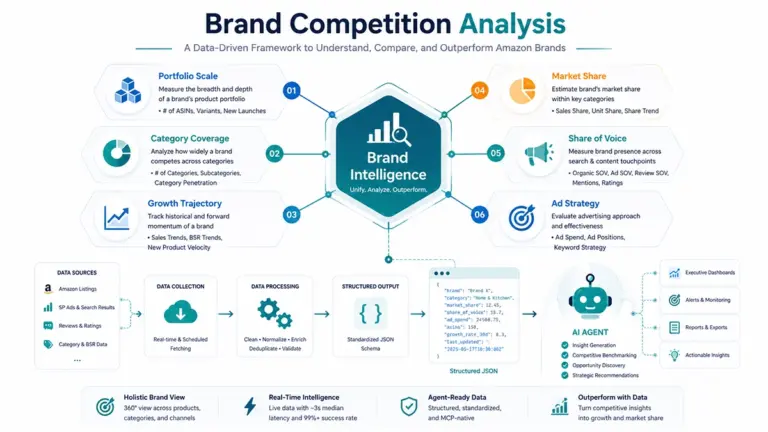
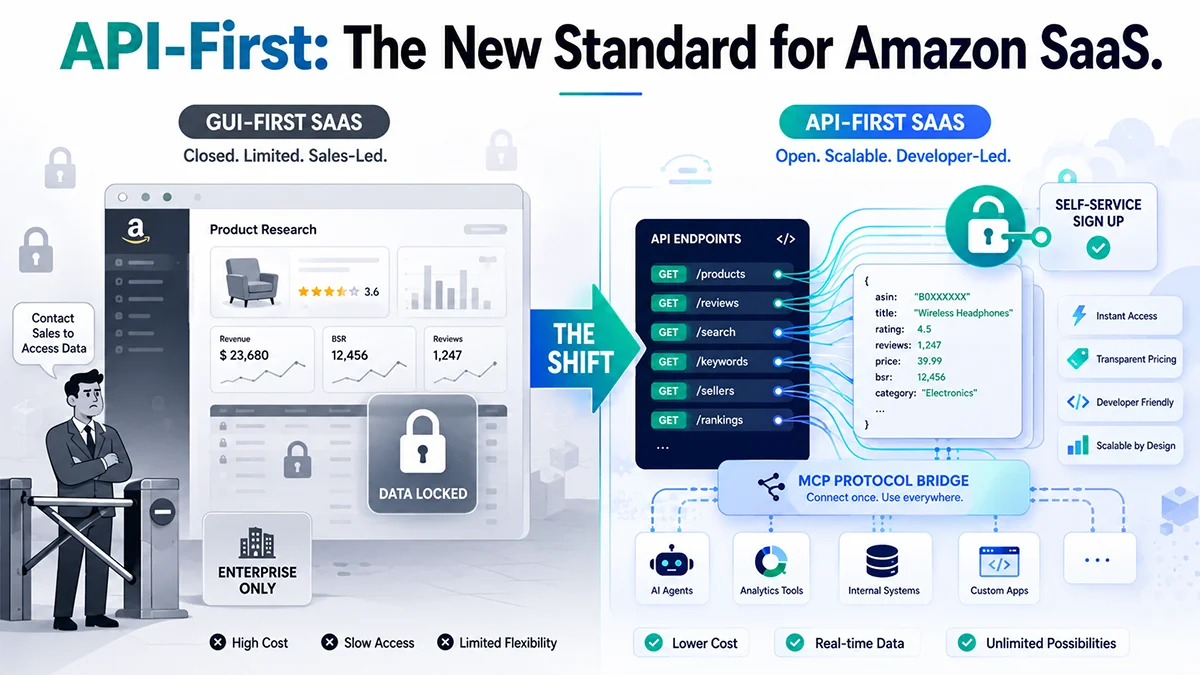
Yes — API-first is becoming the standard, and not because of hype. We audited the three dominant Amazon SaaS tools (Helium 10, Jungle Scout, Keepa) and found a consistent pattern: their APIs are bolted onto GUI-first products, gated behind enterprise sales, priced opaquely, serving estimated (not real-time) data, with query caps designed for human pace. Meanwhile, 80%+ of organizations adopted some form of API-first approach by 2026, and AI agents now demand programmatic access that GUI-first tools structurally can’t provide. This article audits the current state, exposes seven structural defects in traditional Amazon SaaS APIs, and shows what a genuine API-first Amazon data platform looks like — using Pangolinfo’s architecture as the reference implementation.
The Verdict: Yes, and It’s Already Happening
Let’s start with the answer, then earn it. API-first will become the standard for next-generation Amazon SaaS — not because developers prefer clean architecture (though they do), but because the alternative is becoming commercially unviable. Three forces are converging:
First, AI agents. By 2026, AI coding agents (Claude Code, Codex, Cursor) and AI assistants are the fastest-growing consumer of SaaS functionality. They can’t click through dashboards. They need structured, programmatically accessible data. A SaaS tool that can’t be consumed by an agent is a tool that agents will bypass — and their human operators will follow.
Second, enterprise procurement. According to API-first development research from 2026, enterprise buyers now require API documentation during vendor evaluation, not after the sale. If your SaaS can’t provide a clean OpenAPI spec, sandbox environment, and transparent rate limits during the RFP phase, you don’t make the shortlist.
Third, integration gravity. API-last teams spend 40-60% of their engineering capacity on integration work that wouldn’t exist with API-first design, according to software development firms migrating clients to API-first architectures. In a market where speed-to-integration determines revenue, that’s a structural disadvantage that compounds.
But here’s the nuance that most “API-first is the future” articles miss: in the Amazon SaaS ecosystem specifically, “API-first” means something more demanding than in general SaaS. It means real-time data (not estimates), agent-native protocols (MCP, not just REST), transparent pricing (not enterprise-only sales gates), and scale capacity measured in millions of daily requests (not 10,000/month caps). Most tools claiming “API access” today fail on at least two of these.
Let’s audit the current state to see exactly how.
The Audit: What Amazon SaaS APIs Actually Look Like in 2026
We evaluated the three most-used Amazon seller SaaS tools by their API offerings. The findings reveal a market that has API access in name but not in substance.
Helium 10: Enterprise-Only, Opaque, Estimated
Helium 10’s API is available exclusively under the Enterprise Plan. You cannot self-register — you must book a demo, wait for a Sales and Success Manager to contact you within 24 hours, and negotiate custom pricing with no published rate card. The API documentation itself notes: “Helium 10 does not offer a traditional open API but provides an API under the Enterprise Plan.”
Even when you get access, the data is a mix of real-time (pulled from Amazon’s API for profits, refunds, inventory, alerts) and estimated (machine learning models for competitor sales estimates, keyword search volumes, and product rankings). The estimation methods are proprietary and undisclosed — you’re trusting Helium 10’s models without being able to verify them. For human dashboard analysis, this is acceptable. For an AI agent making automated decisions, “we estimated this” is a liability.
Rate limits exist but aren’t publicly documented. Usage caps are custom-negotiated. There’s no MCP support. No self-service sandbox. No transparent path from “I want to try this” to “I’m making API calls” without a sales conversation.
Jungle Scout: Better, But Capped and Estimated
Jungle Scout offers a more accessible API than Helium 10 — you can get API access with a Growth Accelerator or Brand Owner plan, and the first 100 requests are free. But the pricing structure reveals the GUI-first DNA: add-on tiers are 1,000 requests for $29/month, 4,000 for $99/month, or 10,000 for $199/month, with a $0.05/request overage fee. Exceed 10,000 requests? You need to talk to enterprise sales.
Consider what 10,000 requests/month actually means. A single AI agent doing a category analysis — fetching 100 Best Sellers products with 10 data points each — uses 1,000 requests in one workflow. Run that workflow 10 times in a month and you’ve hit the ceiling, before any monitoring, research, or ad-hoc analysis. The cap is designed for a human making a few dozen queries per day through a GUI, not for an agent making thousands of programmatic calls.
The data itself is primarily estimated: “keyword search estimates,” “estimated sales,” “share of voice.” These are Jungle Scout’s proprietary models, not raw Amazon data. For strategic human review, estimates are useful. For automated agent decisions, you need ground truth.
Jungle Scout does provide a Python client, Postman collection, and Zapier integration — better developer experience than Helium 10. But no MCP support, no real-time data, and the 10,000/month wall remains.
Keepa: Niche, Delayed, Price-Focused
Keepa’s API (€19/month starting) is the most accessible of the three, with a Python client and clear documentation. But Keepa is fundamentally a price history tracker — it doesn’t cover reviews, category trees, Best Sellers rankings (beyond price context), or front-page product data. The data also has inherent delay: Keepa’s price tracking refreshes on its own schedule, not on-demand. For a human checking price history once a day, this is fine. For an agent monitoring Buy Box flips in real-time, it’s structurally inadequate.
Seven Structural Defects in Traditional Amazon SaaS APIs
The audit reveals a pattern. These aren’t accidental shortcomings — they’re symptoms of a deeper architectural choice. When you build GUI-first and bolt on an API later, seven defects emerge:
| # | Defect | What It Looks Like | Why It Exists |
|---|---|---|---|
| 1 | Sales-gated access | Must book a demo, talk to sales, negotiate pricing before first API call | Per-seat business model can’t handle programmatic usage; sales gate slows consumption to human pace |
| 2 | Opaque pricing | No published rate card; “contact us for custom pricing” | Custom pricing maximizes revenue per enterprise deal but blocks SMB and developer adoption |
| 3 | Estimated, not real-time data | “Sales estimates” from ML models, not actual Amazon data | GUI-first tools optimize for display; estimates look good in dashboards but can’t be verified or trusted for automation |
| 4 | Human-pace query caps | 10,000 requests/month ceilings, $0.05 overage fees | Infrastructure sized for GUI display, not programmatic access; caps protect backend from volume it wasn’t built for |
| 5 | No MCP / agent protocol | REST only, no tool discoverability, agents can’t self-learn capabilities | API was designed before MCP existed; retrofitting requires architectural changes, not just an endpoint |
| 6 | Incomplete data coverage | No full review text, no real-time Best Sellers, no SP ad positions, no category tree traversal | GUI-first tools built data for what humans look at in dashboards, not what agents need for multi-step workflows |
| 7 | Data source opacity | “Proprietary estimation methods” with no way to verify | Estimation models are competitive moats; transparency would undermine the differentiation, but it also blocks trust for automated use |
None of these defects exist because the tools are poorly built. They exist because the tools were built for a different era — an era where a human stared at a dashboard and made decisions at human pace. The API was a courtesy extended to enterprise customers who demanded it, not a product designed for the agent era.
This is why “adding an API” doesn’t fix the problem. The seven defects are architectural, not incremental. You can’t patch your way from GUI-first to API-first — you have to build API-first from the start.
What Real API-First Amazon Data Looks Like
Having diagnosed the problem, let’s show the solution. A genuine API-first Amazon data platform — built for the agent era, not retrofitted for it — looks fundamentally different. Here’s what Pangolinfo’s architecture delivers, and why each element matters:
1. Self-Service Access, Transparent Pricing
No sales calls. No “book a demo.” You register, get an API key, and start making calls. Pricing is usage-based and published: you pay for what you use, failed requests don’t count, and there’s no 10,000/month wall that triggers an enterprise conversation. An individual developer testing a workflow and a company running 100,000 daily monitoring checks use the same self-service infrastructure.
Why this matters: The sales gate isn’t just friction — it’s a signal. If a tool requires a sales conversation before you can make an API call, the API wasn’t designed for programmatic consumption. It was designed as a value-add for enterprise GUI customers. Real API-first tools treat the API as the product, not the upsell.
2. Real-Time Data, Not Estimates
When you call pangolinfo_product_detail for an ASIN, you get the product’s current price, BSR, review count, and Buy Box owner as they are right now on Amazon — not an estimate from a model, not a cached snapshot from hours ago. Median response time: ~3 seconds. This is live data fetched from Amazon on-demand, the same way a human browser would see it.
Why this matters: AI agents process whatever data they’re given with equal confidence. An agent can’t tell the difference between “actual price: $29.99” and “estimated price: $29.99 (±15% margin of error).” When the agent recommends “match the competitor’s price at $29.99,” the recommendation is only as reliable as the underlying number. Real-time data makes the agent’s confidence warranted; estimated data makes it a gamble.
3. Scale: 30M+ Daily Requests
Pangolinfo’s infrastructure handles 30 million+ requests per day across all customers at 99% success rate. There’s no per-customer query cap that triggers a sales conversation. An agent workflow that makes 5,000 calls in a single session — a full category scan, for example — completes without hitting rate limits or being told “you’ve exceeded your plan.”
Why this matters: The value proposition of an AI agent is scale — analyzing 500 products instead of 5, monitoring 100 competitors instead of 10. But if your data provider caps you at 10,000 requests/month, the agent is throttled back to human pace. The Ferrari is on a 30 mph road. Real API-first infrastructure is sized for agent volume from day one.
4. MCP-Native: Agent-First Protocol
Pangolinfo exposes 19 tools through an MCP (Model Context Protocol) server. When an AI agent connects, it automatically discovers all available tools, their parameters, and their return types — without reading documentation. The agent knows pangolinfo_amazon_search exists, takes a keyword and marketplace parameter, and returns search results. No human integration code required.
Why this matters: MCP is what separates “an API an agent can use” from “an API an agent can discover and use autonomously.” Without MCP, every new data source requires a human to read docs, write wrappers, and configure the agent. With MCP, an agent can be pointed at a new server and start using it immediately. This is the difference between API-first and agent-native — and in 2026, agent-native is the bar.
5. Complete Data Coverage
The 19 tools cover what agents need for multi-step workflows, not just what humans look at in dashboards: product details, full review text (including Customer Says), Best Sellers and New Releases rankings, category tree traversal, AI Overview SERP data, Alexa traffic data, WIPO trademark records, PACER litigation data, and SP ad positions (98% capture rate — industry highest).
Why this matters: Traditional tools built data for dashboard metrics (BSR, review count, keyword volume). Agents need the underlying raw data — full review text for sentiment analysis, category trees for niche discovery, IP databases for compliance checks. If your data provider doesn’t cover these, your agent’s workflow hits a wall mid-analysis.
The API-First Test: Score Your Amazon Data Provider
If you’re evaluating any Amazon SaaS tool for API-first readiness — whether it’s Helium 10, Jungle Scout, Keepa, or Pangolinfo — run it through this seven-point checklist:
| Criterion | GUI-First (Fails) | API-First (Passes) |
|---|---|---|
| Can I register and make API calls without talking to sales? | No — demo required | Yes — self-service |
| Is pricing published and usage-based? | No — custom quote | Yes — transparent per-query |
| Is the data real-time or estimated? | Estimated (ML models) | Real-time (live Amazon) |
| Can an agent make 100,000+ calls without hitting a wall? | No — 10K/month cap | Yes — 30M+/day capacity |
| Does it support MCP for agent tool discovery? | No — REST only | Yes — MCP-native |
| Does it cover full review text, category trees, IP data? | Partial — dashboard metrics | Yes — 19 tools, full coverage |
| Can I see the data source methodology? | No — proprietary | Yes — transparent (live fetch) |
If your provider fails 3 or more of these, you’re working with a GUI-first tool that has an API bolted on. It might work for human-driven dashboard analysis. It will not work for agent-driven workflows — and in 2026, agent-driven workflows are where the competitive advantage lives.
What This Means for You
For Amazon Sellers
If you’re using AI agents (Claude Code, Codex, Cursor) for product research, competitor monitoring, or review analysis, your data provider needs to be agent-native — not just “has an API.” The difference between estimated data and real-time data is the difference between an agent that amplifies your judgment and one that quietly undermines it. Evaluate your tools against the seven-point test above.
For SaaS Product Managers
If you’re building an Amazon SaaS tool and your team is still designing the dashboard first, you’re building for the previous era. The API is the product; the GUI is a consumer of the API. Enterprise buyers in 2026 require API documentation during evaluation, AI agents require MCP for tool discovery, and your competitors who went API-first from day one have a 40-60% engineering efficiency advantage that compounds over time.
For Developers Building on Amazon Data
Stop fighting with sales-gated, estimated, capped APIs. If your data provider requires a sales call before you can make an API request, they’re not building for you — they’re building for enterprise GUI customers and offering API access as a courtesy. Real API-first infrastructure is self-service, transparent, real-time, and agent-native. Pangolinfo is one option; the broader point is that the bar has moved, and “we have an API” is no longer sufficient.
FAQ
Does Helium 10 have a public API?
No. Helium 10’s API is available only under the Enterprise Plan, requires a sales consultation, and uses custom pricing with no published rate card. It is not a traditional open API — you cannot self-register. This excludes individual sellers, small teams, and most AI agent workflows.
Is Jungle Scout’s API worth it for developers?
It depends. Jungle Scout offers API access starting at $29/month for 1,000 requests, with $0.05/request overage. The data is primarily estimated (not real-time), and the 10,000/month cap requires enterprise contact. For production pipelines or AI agent workflows, estimated data plus strict caps plus per-request overage makes it expensive at scale.
What does API-first mean for Amazon seller tools?
API-first means the API is designed before the GUI, data is accessible programmatically without sales gates, pricing is transparent and usage-based, and the architecture supports AI agent consumption via MCP. Most current Amazon SaaS tools are GUI-first with API bolted on — they fail this definition.
Why can’t traditional Amazon SaaS tools serve AI agents?
Three structural reasons: no MCP support (agents can’t discover tools), estimated data (agents produce confidently wrong recommendations), and query caps designed for human pace (agents need 100-1000x more volume).
How is Pangolinfo different from Helium 10 or Jungle Scout?
Pangolinfo is API-first and agent-native from day one: self-service registration, transparent usage-based pricing, real-time Amazon data (~3 second response, not estimates), 30M+ daily capacity (no 10,000/month caps), MCP support, and 19 tools covering full data including reviews, category trees, and IP databases. No sales calls required.
Next Steps
If you’re ready to move from GUI-first to API-first Amazon data access, here’s how to start:
- Get a free Pangolinfo API key — self-service registration, no sales call, enough trial quota to run real workflows. Start here.
- Connect your AI agent — setup guides for Claude Code, Codex, Cursor, or any MCP-compatible tool.
- Run the seven-point test on your current Amazon data tools — if they fail 3+, it’s time to switch.
For the broader context on why agents need real-time, scalable, agent-native Amazon data infrastructure, see our complete guide to connecting AI agents to Amazon real-time data.
Experience API-first Amazon data → Get your free API key — self-service, real-time, MCP-native. No sales calls.
About the Author: Leo is the Lead Architect at Pangolinfo, overseeing the API-first infrastructure that handles 30M+ daily Amazon data requests at 99% success rate and ~3 second median latency. He designed the Pangolinfo MCP server and API architecture from the ground up for agent-native consumption.