
Building an Amazon Operations Agent
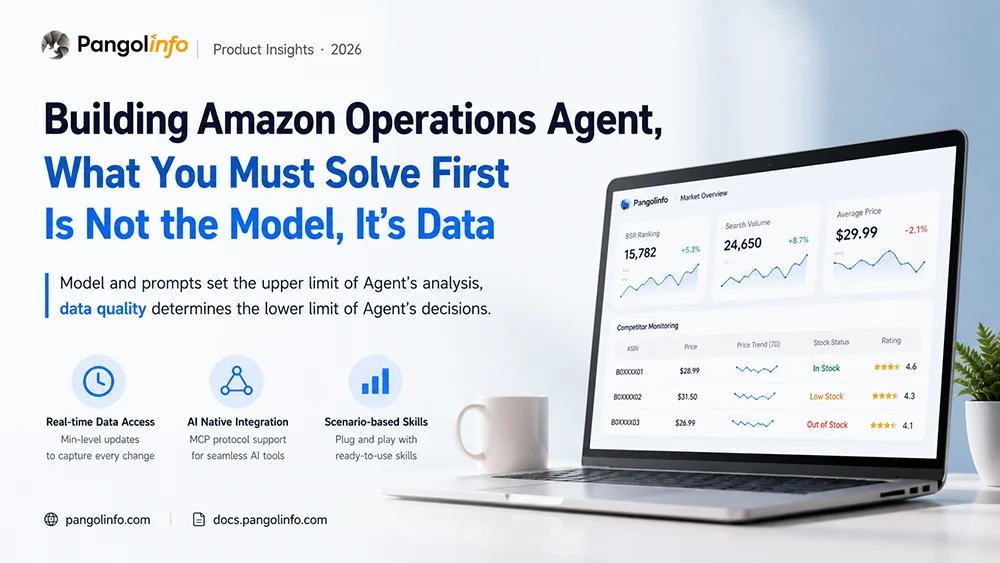
Core thesis: The model and the prompt determine the ceiling of what your Agent can analyze. Data quality determines the floor of what your Agent can actually decide correctly. In Amazon operations, real-time, accurate, and comprehensive data access is the most foundational infrastructure problem to solve — before anything else.
Why Does Your Agent Keep Making Wrong Calls?
Teams building Amazon operations agents tend to hit the same wall at the same point in the process.
The technical architecture looks solid. Task orchestration is clean. The prompts have been through multiple iterations. The model was selected after serious evaluation. But in practice — product selection recommendations that look reasonable produce disappointing results. Ad optimization suggestions are data-rich but ACoS climbs after implementation. Inventory timing calls miss their windows.
Tracing back to root cause, the answer is almost always the same:
The Agent is analyzing a market from three days ago. Or last week. Or whenever the data was last exported.
This is not a model capability problem. It is not a prompt quality problem. It is a data pipeline problem.
Paper Trading vs. Live Trading: A Clarifying Analogy
Paper trading systems look identical to live trading platforms. Same interface, same order logic, same analytical tools. One fundamental difference: the data is delayed, and sometimes simulated.
A strategy validated entirely in paper trading can fail completely in live markets — not because the strategy is wrong, but because the market reality it depends on does not exist in the actual environment.
Amazon operations agents face exactly the same situation.
- Debugging your Agent with historical data exports — that is paper trading
- Feeding your AI with weekly tool reports — that is paper trading
- Manually screenshotting competitor information and pasting it into a chat window — still paper trading
The real Amazon marketplace moves every 10 minutes on pricing. A competitor stockout redistributes organic traffic within 6-12 hours. Keyword search volume inflection points appear in real-time monitoring 2-4 weeks before they surface in monthly exports. During peak holiday windows, pricing dynamics move at minute-level granularity across critical 72-hour periods.
Every recommendation your Agent produces is only as current as the data it received. Stale data means recommendations are responses to a market state that has already disappeared.
The Two Data Layers Every Amazon Agent Needs
Layer 1: Your Own Store’s Internal Data
Your operational data — ad spend and ACoS by ASIN, conversion rates, return rates, inventory levels, replenishment cycles, buyer feedback — is real, accurate data that belongs to you. Most sellers are dramatically underutilizing it.
It sits scattered across different modules of Seller Central, manually exported on a schedule, rarely integrated into any real-time monitoring or automated response system.
Yet this is the most direct input for Agent decisions like: should this campaign increase budget, does this ASIN need emergency replenishment, is there a product quality issue emerging.
Layer 2: Amazon Front-End Market Data
Competitor data, category data, consumer behavior signals — these are what the Agent needs to make market-level judgments. None of this is visible in your own Seller Central.
- Competitor real-time pricing and historical price curves — understanding the cadence of price competition
- BSR ranking real-time changes — detecting traffic reallocation signals
- Competitor inventory status (in stock / low stock / out of stock) — identifying opportunity windows
- Keyword search volume real-time trends — catching inflection points early
- Competitor review velocity and negative review keyword clusters — locating quality differentiation opportunities
Both layers need to be connected and current for the Agent to have the complete information picture required for sound decisions. Any layer missing or lagging systematically degrades decision quality.
Why Building This Yourself Almost Never Works
After recognizing the importance of real-time data, many teams’ first instinct is to build their own data collection system. This path consistently runs into the same four obstacles:
1. Amazon’s Anti-Scraping Infrastructure
Amazon operates sophisticated automated-access prevention. Constantly updated anti-bot rules, IP blocking strategies, and CAPTCHA systems make self-built crawlers expensive to maintain and impossible to keep reliably stable.
2. Data Cleaning and Standardization
Raw collected data arrives with inconsistent formats, misaligned fields, and substantial noise. Making it genuinely usable requires a sustained data cleaning and normalization pipeline — its own ongoing engineering workload.
3. Infrastructure Cost of High-Frequency, Broad-Coverage Collection
Minute-level updates across full category coverage require server resources, network capacity, and engineering operations capacity that most seller teams simply don’t have configured for this purpose.
4. AI Framework Compatibility
Data also needs to arrive in a form Agents can directly consume: standardized API endpoints, MCP protocol support, Webhook event delivery. These are engineering capabilities, not business capabilities — many teams don’t have them.
Combined, these four barriers mean self-built systems typically cost hundreds of thousands of dollars and fail due to stability problems before delivering consistent value.
Pangolinfo’s Product Stack: The Complete Data Pipeline
Pangolinfo’s product design targets these specific barriers, providing a solution that spans the complete chain from data collection through data use.
API Product: Real-Time Market Data, Standardized Access
Minute-level updated Amazon market data across all categories, delivered via standardized RESTful API:
- Pricing: Buy Box price, third-party seller range, historical price curves — 1-3 minute refresh
- BSR ranking: Main category + subcategory ranks, real-time change curves, hourly updates
- Inventory: In stock / low stock / out of stock status, competitor inventory depth estimation
- Reviews: Review velocity, rating trend, negative review keyword clustering
- Search trends: Keyword volume trends, related keyword expansion, seasonal pattern modeling
Clean field definitions. Complete documentation. Basic integration completable in 15 minutes. Every data point the Agent calls is the current market state.
MCP Product: Native AI Tool Access to Amazon Data
MCP (Model Context Protocol) is the tool-calling protocol supported by leading AI Agent frameworks. Pangolinfo’s MCP product wraps data endpoints directly as native AI-callable tools.
In practice: Claude or any MCP-compatible AI can pull live Amazon data directly within a conversation. No data-piping code to write. No manual copy-paste. The data flow is fully automated.
From ‘human moves data to AI for analysis’ → to ‘AI retrieves data and analyzes.’ This is a change in the nature of the workflow, not just its speed.
Skill Product: Pre-Built Amazon Operations Capabilities
Skills address the question: once the AI has real-time data, how does it use it well?
Pangolinfo Skill modules pre-build the most common analytical capabilities for Amazon operations:
- Product opportunity analysis: real-time search trend + competitor data → category opportunity matrix
- Competitor monitoring and stockout alerts: automatic push when competitor inventory drops below threshold
- Keyword strategy: search volume × competition intensity × ad density → tiered keyword list ready for ad group use
- Ad anomaly detection: ACoS shifts, impression volume changes, keyword ranking movements — root cause identification
Skills plug directly into your Agent workflow. No prompt framework to build from scratch. API + MCP + Skill covers the complete pipeline from data collection to decision output.
Three Questions to Assess Whether Data Is Your Immediate Priority
- How old is the data your Agent is currently receiving?
- How long does it take from when a competitor goes out of stock to when you know about it?
- How large is the gap between the data environment you use to build and test your Agent, and the actual Amazon marketplace?
If the answers are uncomfortable, data is the first problem to solve. Not the prompt. Not the model.
Connect the data pipeline. Then AI earns its price.
Learn more: pangolinfo.com
Developer documentation: https://docs.pangolinfo.com/en-help-center/skills