

1. A Viral Video and the Backlash: Can You Still Make Easy Money on Amazon?
On April 28, 2026, Cheng Qian, a popular Chinese business interviewer, released a video titled “How a 2002-born guy makes overseas money without leaving home.” The protagonist, a recent graduate, claimed his product launched in late 2025 sold 700+ units per month at $36 with a ¥40 procurement cost, netting ¥47,000 monthly. Within hours, the video went viral – but not for inspiration. Seasoned Amazon sellers flooded the comments with critiques.
“$36 price, ¥40 cost? International shipping alone is $4 per unit, Amazon commission 15% ($5.4), FBA fee $2-3, and average ACoS over 40% – none of these are included,” one seller calculated. Worse, the video ignored storage fees, returns, and account suspension risks. Q1 2026 data shows 72% of small to mid-sized Amazon sellers are barely breaking even or losing money. Such “get rich quick” stories either hide real costs or betray deep ignorance of Amazon operations.
Why do these myths persist? Because people crave shortcuts. But genuine Amazon competitor analysis has never been about listing a product and waiting for sales. In 2026, average CPC on Amazon US has risen to $1.04, with top keywords exceeding $3. Over 12,000 seller accounts were banned in 2025. The only way to survive is data-driven, refined operations – starting with systematic competitor keyword research. Most sellers only scratch the surface.
2. Beyond the Hype: Real Cost Structure and Barriers to Entry on Amazon
Let’s dissect that “$5,000/month” claim properly. Assume 700 units monthly at $36: revenue = $25,200 (~¥181,440 at 7.2 exchange). Procurement = ¥40/unit = ¥28,000. International shipping = $4/unit = ¥20,160. Amazon commission 15% = $3,780 (¥27,216). FBA fee = $2.50/unit = $1,750 (¥12,600). PPC at 30% ACoS (below industry avg) = $7,560 (¥54,432). Summing variable costs: ¥28k+¥20k+¥27k+¥12.6k+¥54.4k ≈ ¥142k, leaving ¥39k gross profit. Subtract storage, returns, insurance – net profit could be under ¥15k or even negative. The video’s “¥47,000” is pure fantasy.
More importantly, such stories mislead newcomers about real barriers. Amazon 2026 is not Amazon 2016 – you need product development, supply chain leverage, compliance management, and data-driven marketing. In 2025, 23% of banned accounts were Chinese sellers, mostly for policy violations. Hijackers and bots can steal your listing within days. Every decision must be backed by accurate data, especially deep competitor intelligence.
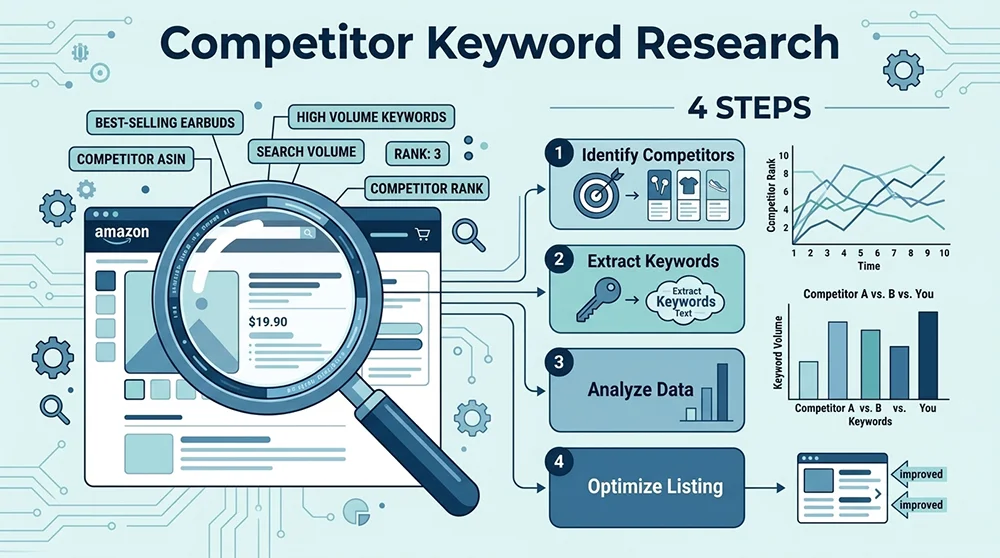
Many sellers’ idea of Amazon competitor analysis is copying a rival’s title, extracting a few words, and checking search volume on free tools. That’s not analysis – it’s a glance. True keyword research goes much deeper: you need to capture PPC keywords, review frequency words, and ranking trends. A complete systematic approach requires four steps, each addressing a critical gap.
3. From Gut Feeling to Data-Driven: Traditional vs. Systematic 4-Step Keyword Research
Traditional workflow: open a competitor’s detail page, copy title and bullet points, paste into Excel, remove duplicates manually, run through Google Keyword Planner, then start writing your listing. This method has four fatal flaws: (1) Title keywords aren’t necessarily converting keywords; (2) Competitors’ PPC keywords – the most expensive and often most converting – are completely ignored; (3) Customer pain points hidden in reviews are missed; (4) There’s no tracking of ranking changes over time, so you can’t spot rising or declining terms.
A systematic Amazon competitor analysis follows four steps:
- Step 1 – Identify True Competitors: Not just any similar product, but those appearing in Best Sellers, New Releases, and top organic/Sponsored positions for your core keywords. Build a pool of 20-30 direct and indirect competitors.
- Step 2 – Multi-Source Keyword Collection: Gather keywords from competitor titles/descriptions, backend search terms (reverse-engineered), Sponsored ad positions, natural ranking high-frequency terms, review word frequency, and Amazon search suggestions.
- Step 3 – Cleaning and Weighting: Deduplicate, categorize (head/body/long-tail/attribute/scenario), and assign weights – e.g., 5 points for appearing in title, 3 for ads, 1 for reviews. Combine with search volume and competition scores.
- Step 4 – Tiered Strategy Output: Segment keywords into head terms (high traffic, high competition) for precise PPC and brand ads; body terms (medium) for broad match and product targeting; long-tail (low competition) for organic optimization and low-cost ads; negative keywords for wasted spend.
Doing this manually is impossible. You need to track dozens of competitors daily – their keyword ranks, ad positions, new review terms. That’s where Amazon data monitoring APIs come in.
4. API-Driven Competitor Analysis: How Pangolinfo Provides Real-Time Data
Executing the 4-step method faces one bottleneck: data breadth, depth, and timeliness. Manual copying doesn’t scale, and off-the-shelf SaaS tools either lag (weekly or monthly updates) or only show superficial metrics. Professional data teams use APIs to fetch raw data and analyze it in their own systems. Pangolinfo offers a suite of Amazon data extraction APIs purpose-built for each step of competitor keyword research.
4.1 Step 1 – Batch Fetch Competitor Lists
To identify true competitors, you need to scrape category BSR, New Releases, and keyword search results. The Scrape API can retrieve product listings from any Amazon category, returning structured JSON with ASIN, price, rank, variations, and more. You can even set postal codes and languages to simulate different marketplaces. For example, calling the API for “Wireless Earbuds” search results top 100 gives you a complete competitor candidate pool in minutes.
4.2 Step 2 – Deep Collection of Competitor Keywords
Keyword sources per competitor include: listing copy, ad positions, and review terms. The Amazon Scraper Skill automatically extracts listing text, backend search terms (via reverse rules), and ad keywords displayed on product pages. The more powerful Reviews Scraper API batch-collects all reviews of any ASIN and performs word frequency and sentiment analysis. Want to know what customers dislike most about a rival? Fetch the last 100 one-star reviews, extract the most frequent nouns – “battery life”, “connection” – those become high-value long-tail keywords for you.
4.3 Step 3 – Automated Cleaning & Weighting
Import the massive data (potentially tens of thousands of records daily) into your data warehouse or Python script, and automatically deduplicate, categorize, and score. Pangolinfo APIs output raw HTML, Markdown, or structured JSON, easily integrable with any ETL pipeline. Schedule daily refreshes of competitor keyword ranking to track trends. Keywords that are steadily rising represent traffic opportunities – prioritize them.
4.4 Step 4 – Visual Monitoring & Iteration
If you prefer no-code, Pangolinfo offers AMZ Data Tracker, a visual Amazon data monitoring dashboard. Add ASINs to automatically track keyword rankings, review growth, price changes, Buy Box owners, and more. System-generated trend charts help you spot which competitors are increasing ad spend and which long-tail keywords are suddenly gaining rank. For team collaboration, AMZ Data Tracker supports multi-dimensional table exports and ERP integration.
With this API + tools solution, your Amazon competitor analysis shifts from a monthly manual report to a daily updated intelligence system. When a competitor changes their keyword strategy, you’ll know the same day and can respond – that’s the essence of refined operations.
5. Practical Example: Python Script to Extract Competitor Review Keywords
Below is a simple Python example using the Reviews Scraper API to get reviews for an ASIN and extract high-frequency nouns as candidate keywords.
import requests
from collections import Counter
from nltk.tokenize import word_tokenize
from nltk.corpus import stopwords
import nltk
nltk.download('punkt')
nltk.download('stopwords')

api_key = "YOUR_API_KEY"
asin = "B0XXXXXXXX"
url = f"https://api.pangolinfo.com/v1/reviews?asin={asin}&country=US&api_key={api_key}"

response = requests.get(url)
data = response.json()

reviews_text = [review['content'] for review in data.get('reviews', [])]

stop_words = set(stopwords.words('english'))
all_words = []
for text in reviews_text:
    tokens = word_tokenize(text.lower())
    filtered = [w for w in tokens if w.isalpha() and w not in stop_words]
    all_words.extend(filtered)

word_freq = Counter(all_words)
top_keywords = word_freq.most_common(20)

print("Top 20 words in competitor reviews:")
for word, freq in top_keywords:
    print(f"{word}: {freq}")

# These high-frequency words often represent features customers care about – use them as long-tail keywords or product improvement cues.
Extend this script to process multiple competitors, merge frequencies, and cross-reference with search volume data from other APIs. Run it daily to keep your keyword pool fresh.
For more API endpoints and parameters, visit Pangolinfo Documentation.
6. Conclusion: Abandon Illusions, Embrace Data-Driven Amazon Selling
The Cheng Qian video is just the tip of an iceberg – it reveals the long-standing “get rich quick” narrative in cross-border ecommerce. Serious sellers know that Amazon is now a mature, data-intensive, compliance-heavy platform. The foundation of success is rigorous Amazon competitor analysis and keyword research. Stop copying titles. Adopt the 4-step systematic process: identify true competitors, multi-source keyword collection, cleaning and weighting, and tiered strategy output.
To execute these steps efficiently, you need reliable data infrastructure. Pangolinfo’s Scrape API, Reviews Scraper API, Amazon Scraper Skill, and AMZ Data Tracker deliver real-time, comprehensive, structured Amazon public data. Whether you’re a small seller or a large brand, integrate competitor monitoring into your daily workflow via API and transform raw data into actionable insights.
Visit Pangolinfo Scrape API page to start your free trial and get your API key. Arm your Amazon business with data – and thrive in a competitive marketplace.