
Why Most Sellers Misjudge Category Opportunity
The most common mistake in Amazon category opportunity analysis is reducing the decision to two numbers: search volume and top seller revenue. Both matter, but neither tells you whether you can win. Search volume shows demand, not access. Top seller revenue shows category size, not your ability to capture that size. What actually determines viability is your acquisition cost, your conversion potential, your traffic entry points, and your operational ability to keep improving the offer.
A lot of products do not fail because demand is missing. They fail because traffic is too expensive to buy, organic ranking windows are too narrow, branded players dominate recommendation placements, review barriers are too deep, or the price band is already compressed beyond a healthy margin. In those markets, using ads to “test first” is not a smart shortcut. It is often an expensive way to pay for a weak decision.
The better mindset is simple: you are not looking for the hottest category. You are looking for a category your current cash flow, content quality, supply chain, and data discipline can realistically break into. That is the core correction many operators need. High demand is not automatically opportunity. Low competition is not automatically opportunity either. Real opportunity requires demand, margin capacity, accessible traffic, and recoverable investment.
Product Opportunity Assessment: Look at the Intersection of Demand, Competition, Margin and Execution
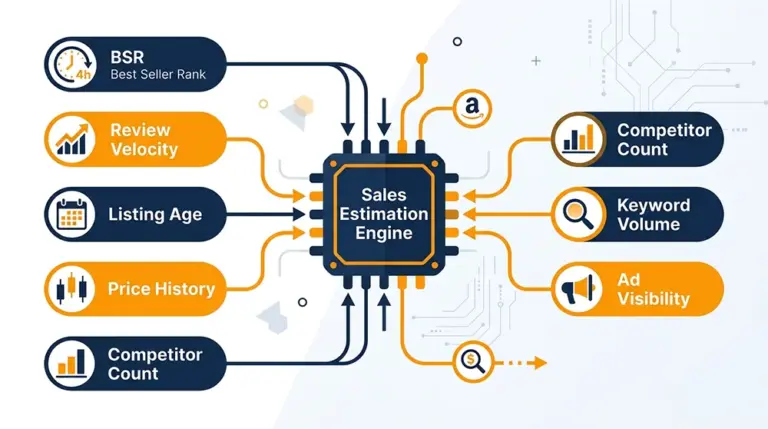
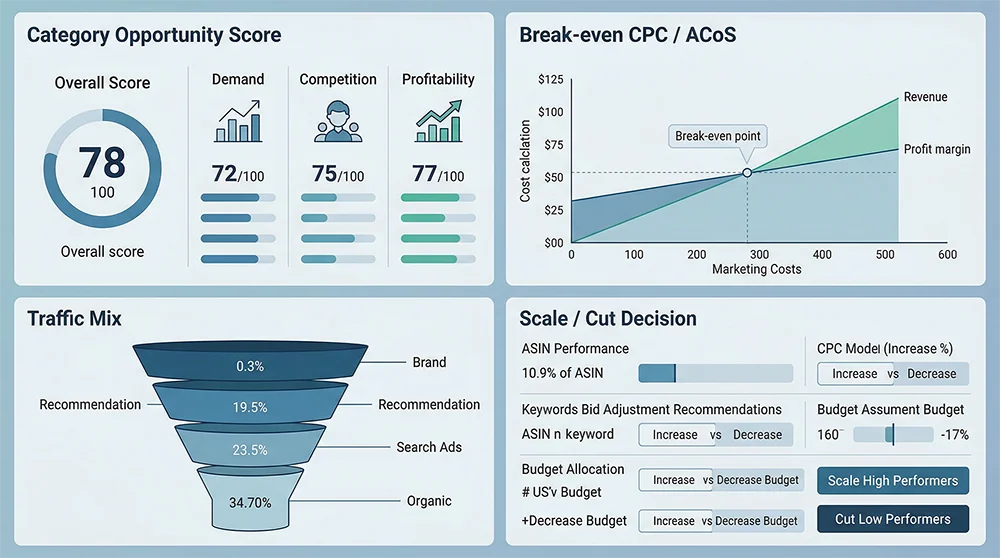
If you want your category decisions to feel more like investment underwriting and less like intuition, evaluate six dimensions together: demand strength, supply density, profit structure, advertising cost elasticity, traffic structure health, and execution difficulty. A category becomes commercially meaningful only when those dimensions align.
Demand strength has layers. Start with core keyword volume and result-page depth. Then look at long-tail expansion and related intent clusters. Finally, check whether demand is stable over time or tied to a short-lived trend. A category powered by one breakout keyword but supported by weak long-tail demand is fragile. You may win briefly, then lose quickly when seasonality shifts or competitors flood the same term.
Supply density should not be measured by seller count alone. What matters more is concentration. Are the top ten ASINs controlling most of the page? Are they established brands with strong review depth? Is pricing already locked into a narrow and aggressive band? A $5M category can be harder than a $2M category if visibility is tightly controlled by a few durable listings.
Profit structure is where many teams underthink. A useful model includes landed cost, fulfillment, referral fees, return risk, coupons, deals, creative production, and advertising. Gross margin without traffic cost is incomplete. Per-order profit without testing cost is incomplete too. The real question is how much cash the listing consumes before it earns stable placement, and whether the steady-state profit is strong enough to justify that path.
| Dimension | What to Observe | Danger Signal | Positive Signal |
|---|---|---|---|
| Demand Strength | Core volume, long-tail depth, trend stability | Over-reliance on one hot term | Multiple keywords drive steady traffic |
| Supply Density | Concentration, brand control, review barriers | Top ASINs dominate visibility | Traffic is fragmented and rankings move |
| Profit Structure | Gross margin, net margin, returns, discounts | Testing losses cannot be absorbed | Healthy margin and fast cash recovery |
| Ad Cost Elasticity | CPC, CTR, CVR, break-even ACoS | High CPC with weak conversion | Reasonable clicks with upside in CVR |
| Traffic Structure | Organic share, placements, recommendation paths | Only one traffic door exists | Search, recommendation and related traffic all open |
| Execution Difficulty | Supply chain speed, content strength, reaction speed | Slow replenishment and weak creatives | Fast iteration and responsive operations |
Correction one: low competition can be a warning, not an opportunity. Some weak categories look empty because demand is thin or conversion economics are bad. Correction two: higher price does not automatically mean better profit. It often comes with higher CPC, slower purchase decisions, and greater return risk. Correction three: high launch ACoS is not always bad. The real question is whether that spend is building rank and future organic share, or simply buying low-quality clicks.
Promotion Cost Forecasting and Budget Control: Calculate the Break-Even Line Before You Launch
A large share of budget waste comes from treating launch budget like a motivational statement. Teams say they are willing to “invest aggressively,” but never translate that idea into an operating model. A better sequence is: define break-even ACoS, estimate break-even CPC, set a test budget ceiling, and only then decide whether the category deserves a serious launch.
The first number is break-even ACoS. In a simplified sense, it is close to your contribution margin ratio. If your true contribution margin is 28%, a long-term ACoS above 28% means the advertising engine is eroding operating profit. The second number is break-even CPC. This tells you whether the current category click environment is even compatible with your product economics. The third number is your maximum test tuition fee: how much you are willing to lose in order to learn whether the product can become viable.
Break-even ACoS = Contribution Margin / Selling Price
Target CPC = Selling Price × Expected Conversion Rate × Target ACoS
Initial Test Budget = Daily Target Clicks × Target CPC × Test Days
Cash Safety Buffer = Initial Test Budget × 1.3 to 1.5
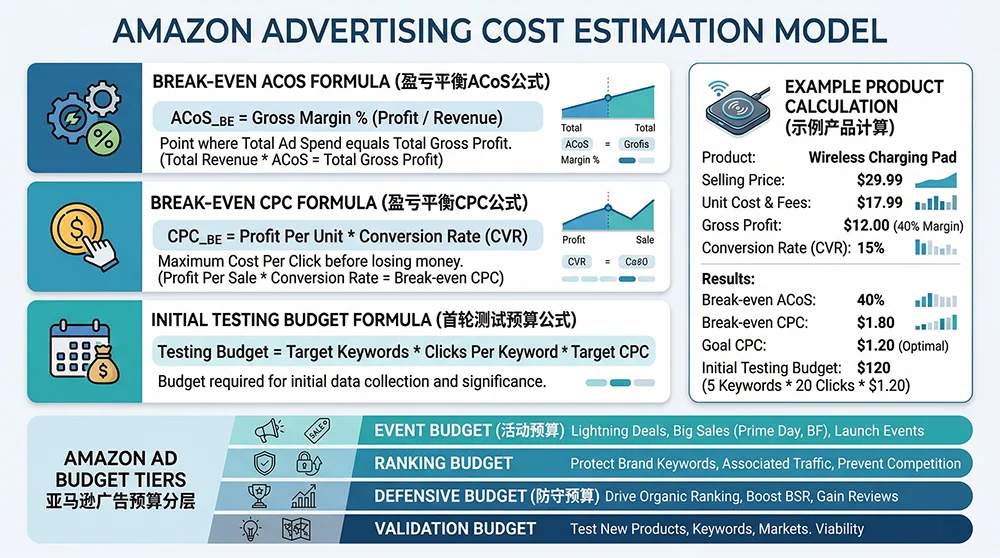
Suppose a home product sells for $39.99 and contributes $11.2 after product cost, shipping, FBA, fees and discounts. Break-even ACoS is roughly 28%. If you expect an 8% launch CVR, your workable CPC is around $0.90. At 80 clicks per day over 10 days, your initial test budget is about $720, and a safer operating reserve is close to $936 after adding a buffer. The exact number is less important than the discipline it creates.
That model forces the right questions. Is your conversion assumption realistic? Can the price band carry the current click environment? If actual category CPC stays above your break-even CPC, will you improve conversion, redesign the product, or walk away? That is what real budget control looks like.
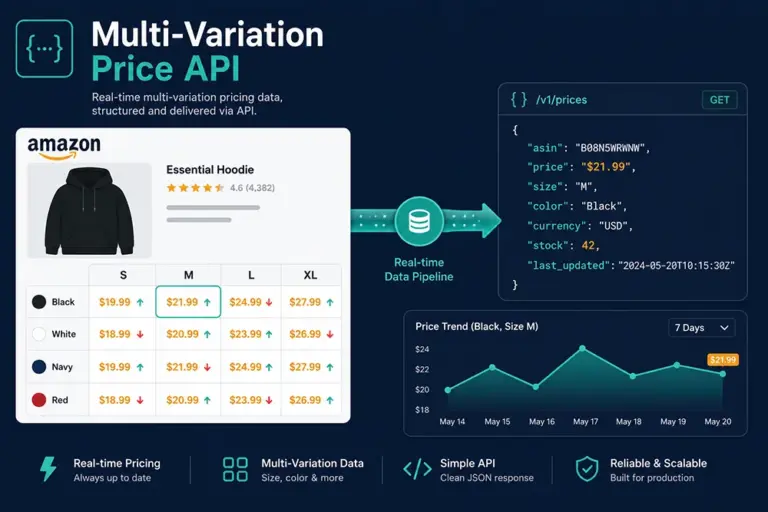
Another important correction is that AI is changing who can do this work. Agent frameworks have removed much of the old friction around API usage. A seller with no coding experience can now hand a Scrape API endpoint, the relevant API documentation, and an API key to an agent such as openclaw, then let the agent organize requests, fetch public Amazon data, and summarize the output. This is a major shift. Data access no longer belongs only to engineering teams. It increasingly belongs to operators who know what questions to ask and how to turn raw output into decisions.
For teams that want deeper cost forecasting, combining Scrape API with AMZ Data Tracker creates a stronger workflow. You can continuously monitor search pages, price bands, review velocity, and ad placement frequency rather than relying on one-time manual samples. That turns cost estimation from a static guess into a live curve.
Category Traffic Structure Analysis and Ad Layout Logic
Traffic structure is the missing layer in many category decisions. A category can look attractive in aggregate and still be unworkable if traffic is concentrated in a few expensive doors. To understand whether a market is attackable, you need to map where traffic comes from, who controls it, and whether any part of it can be entered with an acceptable payback period.
In practice, category traffic often breaks into four layers. First is core search traffic, usually the most expensive and the most contested. Second is long-tail and use-case traffic, where intent is often sharper and competition lighter. Third is recommendation traffic, including related product and detail-page placements. Fourth is brand and repeat traffic, which is the cheapest but only available once you have accumulated customer memory and listing authority. If a category depends almost entirely on expensive head terms and branded demand, entry risk is high. If long-tail terms are rich and recommendation paths are active, the category is usually easier to structure into.
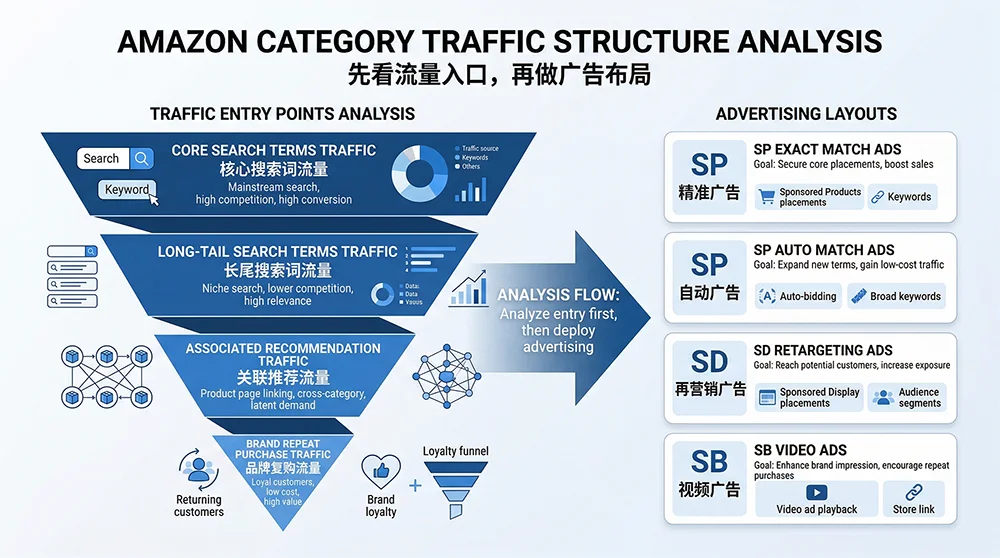
This is why ad architecture should follow traffic architecture. In a validation phase, broad coverage matters more than cosmetic efficiency. SP auto, SP broad and SP phrase help recover search term data quickly. Once signal quality improves, SP exact and product targeting can concentrate spend around higher-intent entry points. When the listing has enough review and conversion support, SB and SD can expand your reach, storytelling, and re-engagement. The mistake is not that sellers use too many ad types. The mistake is that they use the wrong ad objective for the stage they are in.
| Stage | Main Goal | Ad Structure | Budget Bias |
|---|---|---|---|
| Validation | Find terms, test clicks, test conversion | SP auto + SP broad + light product targeting | Distributed spend, heavy term recovery |
| Growth | Win rank and expand efficient volume | SP exact + SP phrase + core ASIN targeting | Concentrate around high-converting paths |
| Expansion | Take share while protecting margin | SP exact + SB + SD retargeting | Split by traffic layer and profit layer |
| Defense | Protect brand terms and hold TACoS | Brand defense + competitor targeting + SD revisit | Stable budget with efficiency discipline |
Correction four: SP is not automatically the most important ad type. It is the most foundational. In visually driven or scenario-heavy categories, SB video can create a faster edge than standard SP placements. Correction five: SB and SD are not only for mature brands. They become useful the moment your listing has enough content strength and audience path clarity to justify them.
For sellers who want deeper category visibility, AMZ Data Tracker can monitor ranking trends, competitor changes, and keyword movement. Teams that need continuous collection of search results, bestseller pages, detail pages, and public placements can use the API documentation to operationalize category traffic structure analysis instead of depending on manual snapshots.
Ad Optimization and Scale Up or Scale Down Strategy
Good ad optimization is not emotional micromanagement. It is the ability to distinguish noise from trend and trend from structural change. Many teams scale too early because they confuse a short spike with a repeatable model. Many teams cut too late because they keep hoping weak performance will reverse on its own.
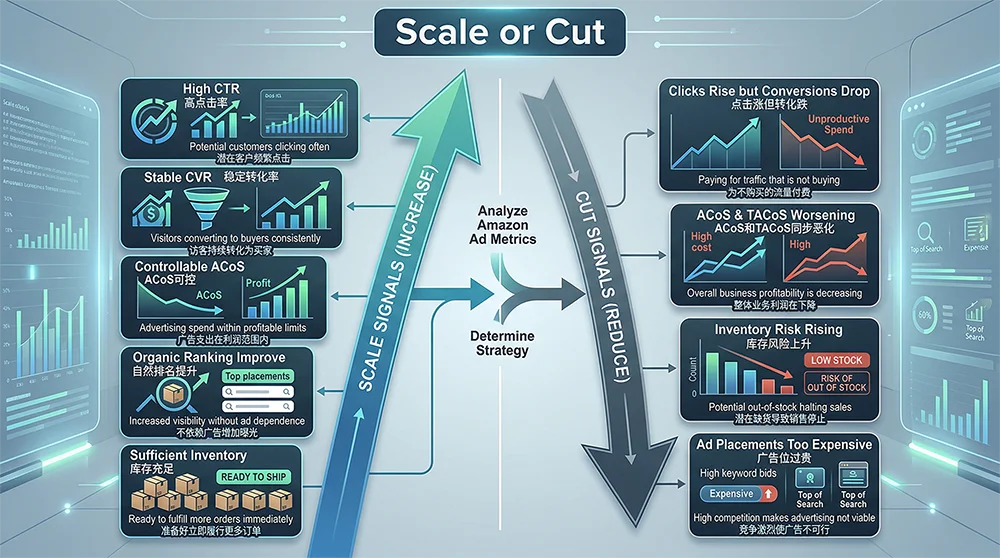
A useful operating rhythm looks at performance across three time horizons. 🔍 Daily review is for anomaly detection: broken bids, sudden conversion drops, inventory risk, or placement inflation. Weekly review is for trend confirmation: whether keywords and campaigns are actually stabilizing. Monthly review is for structural health: whether paid volume is helping organic rank and whether total advertising cost is improving the business rather than just the dashboard.
Before scaling, try to confirm four conditions. First, core terms convert consistently over several days and conversion does not collapse as clicks increase. Second, ACoS may rise slightly with higher placement, but TACoS does not deteriorate at the same pace. Third, inventory and replenishment can support incremental demand. Fourth, the listing can absorb colder traffic because image quality, pricing, reviews and offer structure are already competitive.
The safest scaling rule is controlled expansion. Raise daily budget 10% to 20%, observe for 48 to 72 hours, then decide whether to continue. If keyword-level economics are strong but the campaign average is only moderate, increase bids on the winning terms rather than doubling the whole campaign budget. When a placement drives clicks but the page cannot convert them, fix the page first. Aggressive budget jumps often force the system into a new auction environment too fast, making previous performance less reliable as a guide.
Scale-down logic also requires diagnosis. If the issue is query relevance, cut the keyword. If the issue is placement inflation, cut the placement. If the keyword still has strategic value but the listing temporarily under-converts, reduce traffic speed and repair the page. If category-wide CPC inflation makes the product economically weak, go back to the margin model and decide whether the fight is still worth funding.
| Signal | Better for Scaling | Better for Cutting |
|---|---|---|
| CTR | Click-through rate stays above group average | CTR fades, meaning relevance or creative weakens |
| CVR | Conversion holds while click volume increases | Clicks rise but conversion breaks down |
| ACoS / TACoS | ACoS is manageable and TACoS remains stable | Both worsen together |
| Organic Cooperation | Paid growth lifts organic rank | Paid orders rise but organic stays flat |
| Inventory Support | Stock coverage is healthy | Inventory is thin and rhythm will break |
Correction six: a high ACoS campaign is not always wrong if it is moving organic visibility and future profit pools. Correction seven: a low ACoS campaign is not automatically worth protecting if it cannot carry meaningful scale. The objective is not the lowest ACoS possible. The objective is the highest repeatable growth rate inside an acceptable profit range.
To speed up decision-making, build a working observation layer that tracks keyword CTR, CVR, CPC, ACoS, order volume, organic rank shifts, top-of-search share, paid-to-organic contribution, and SKU-level inventory turnover. Pair internal ad reports with public-page monitoring from AMZ Data Tracker so your team can tell whether the category is changing or only your listing is slipping.
Conclusion: The Best Opportunities Are the Ones You Can Measure, Enter, Scale and Exit Rationally
Amazon category opportunity analysis should not be a vague judgment call. The strongest decisions are built by putting demand, competition, margin, traffic structure, ad cost, and execution capability into one operating model. When that model works, advertising becomes a lever. When it does not, advertising only accelerates mistakes.
The most important upgrades for sellers and operators are clear. Move opportunity judgment earlier. Quantify budget instead of romanticizing it. Use structure, not mood, to decide when to scale and when to cut. Once you do that, “good advertising” stops meaning aggressive spending and starts meaning disciplined capital allocation.
And now that AI Agents have lowered the barrier to API usage, category intelligence is becoming accessible to a much broader group of operators. The edge will increasingly belong to teams that ask better questions, connect the right data sources, and turn insights into operating speed.
If you want to monitor category traffic, competitor placement shifts, and public Amazon page data at scale, start by connecting Scrape API and AMZ Data Tracker into your decision workflow instead of relying on manual snapshots.