
Amazon product dimensions weight data
Any experienced Amazon seller knows that looking at sales volume and profit margins alone during product selection is far from sufficient. A product’s dimensions and weight directly determine FBA fulfillment fees, storage costs, inbound logistics expenses, and even whether air shipping is economically viable. Yet most sellers enter the selection phase without precise dimension and weight data, relying instead on rough visual estimates or fragmented information pieced together from listing pages. The consequences of this crude data foundation are immediate: shipping cost estimates off by 30% or more, packaging plans requiring repeated adjustments, and distorted profit margin calculations. If you’re experiencing these issues, the root cause is the lack of a systematic, automated Amazon product dimension and weight data collection process.
Why Are Dimensions and Weight the Hidden Lifeline of Operational Decisions?
FBA Fee Precision Directly Impacts Profitability
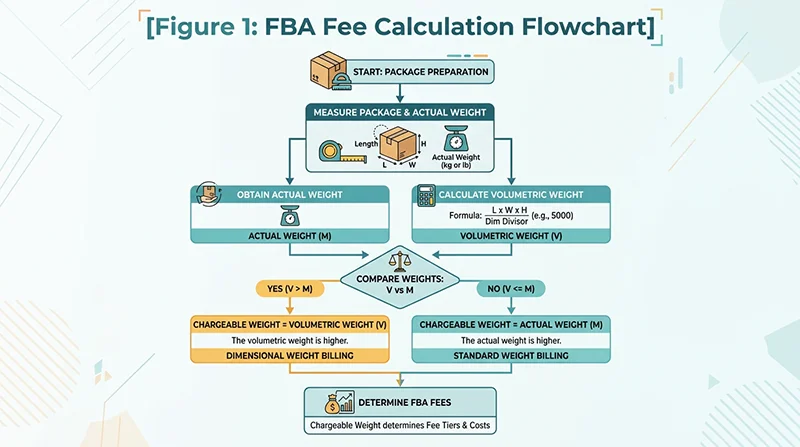
Amazon’s FBA fulfillment fee calculation is based on whichever is greater: the shipping weight or the dimensional weight. Shipping weight equals the product weight plus packaging weight, while dimensional weight is calculated from package dimensions using a specific formula. Take a common household small appliance as an example: if the actual product weighs 1.2kg but the package measures 40×30×25cm, the dimensional weight using Amazon’s divisor of 5000 reaches 6kg. FBA fees will be charged at the 6kg rate rather than 1.2kg. This means a small discrepancy in dimension data can potentially double fulfillment costs.
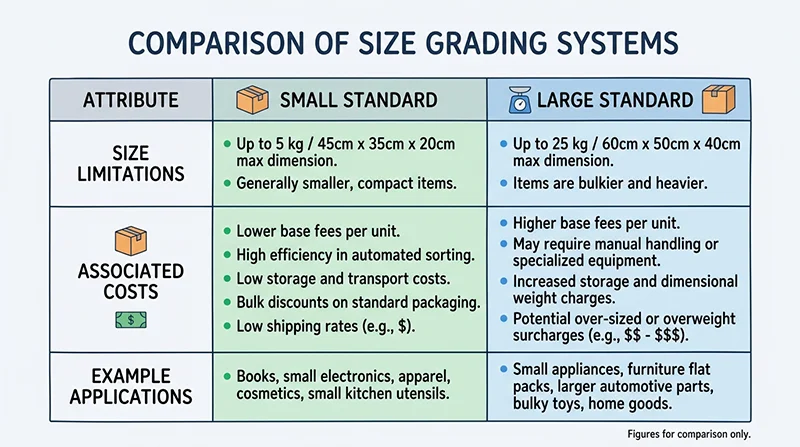
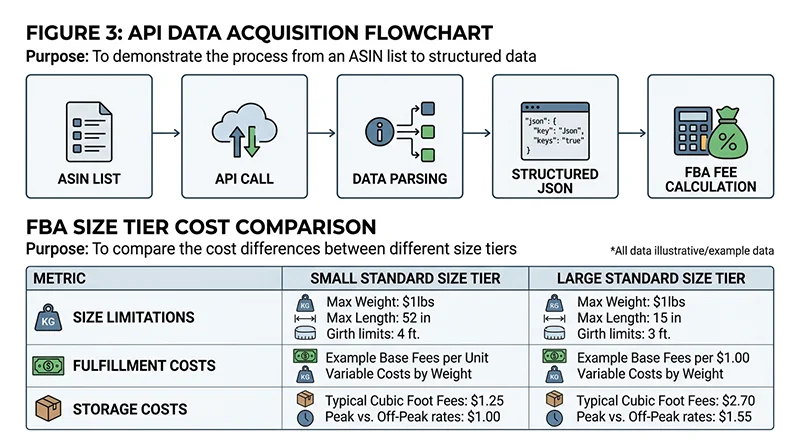
According to Amazon’s 2025 FBA rate card, the fee difference between Small Standard-Size (≤12×9×6 inches) and Large Standard-Size (≤18×14×8 inches) can reach $2-4 per unit. For a SKU selling 1,000 units monthly, that gap translates to $2,000-4,000 in monthly profit variance. Without precise dimension and weight data, your profit model is fundamentally flawed from the starting point.
Logistics and Warehouse Planning Depend on Accurate Parameters
Inbound logistics cost structures are extremely sensitive to weight. Air freight pricing typically charges whichever is greater between actual weight and dimensional weight, while sea freight bills by cubic volume. A product that is large in volume but lightweight—such as foam products or storage bins—may cost far more than expected if shipped by air. Only with precise dimension and weight data can you complete cost simulations for different logistics scenarios during the product selection phase, avoiding the awkward situation of “selling well but can’t afford to ship.”
Warehouse planning also depends on these parameters. Amazon’s storage capacity limits and Inventory Performance Index (IPI) scores are related to inventory turnover and storage utilization. Knowing each SKU’s exact volume enables precise calculation of per-unit storage costs and optimization of replenishment batch sizes and inventory distribution strategies.
The Data Blind Spot During Product Selection
Many sellers focus only on visible metrics like selling price, sales volume, and review count during product selection while overlooking dimensions and weight as hidden cost factors. The result is frequently encountering situations like this: a product priced at $25 with what appears to be a 40% gross margin actually incurs $8-10 in FBA fulfillment fees because it falls outside the standard-size category. After adding inbound logistics and storage costs, the actual margin shrinks to below 10%. If precise dimension and weight data had been available during selection, such “pseudo-profit” products could have been screened out in advance.
Why Manual Collection of Dimensions and Weight Data Doesn’t Work
The Hard Bottleneck of Collection Efficiency
Manually obtaining dimension and weight data for one ASIN from Amazon’s frontend takes an average of 2-3 minutes. The workflow is: search for ASIN, open the detail page, scroll to the Product Information or Additional Information section, locate dimension and weight information, and copy it into a spreadsheet. If you need to collect data for 100 competitor products, pure manual operation requires 4-5 hours—and that’s assuming stable page layouts and fixed data positions.
The reality is more complicated. Amazon product detail page layouts vary by category, and dimension/weight information may appear in “Product Information,” “Additional Information,” “Technical Details,” or “Item details” sections. Different marketplaces also have different page structures; field naming conventions on Amazon US versus Amazon Japan may be completely different. These uncertainties further drag down the efficiency and accuracy of manual collection.
Data Fragmentation and Variant Complexity
A single product listing may contain multiple variants (color, size, capacity, etc.), each with potentially different dimensions and weights. Manual collection easily misses some variants or accidentally attributes data from one variant to another. In the clothing category, for example, the weight difference between size S and XL can reach 30%. If unified data is incorrectly used to calculate shipping costs, the consequences speak for themselves.
Furthermore, dimension information on Amazon pages is not uniformly formatted. Some display as “10 x 8 x 6 inches,” others as “25.4 x 20.3 x 15.2 cm,” and some show both product dimensions and package dimensions in different sections. Manually organizing this heterogeneous data is not only time-consuming but also error-prone.
Data Timeliness Issues
Amazon sellers frequently adjust packaging to optimize FBA fees or improve the customer unboxing experience. This means the same ASIN’s dimension and weight data may change every few months. Data tables maintained through manual updates can hardly keep pace with this change rhythm. Once data becomes outdated, all decisions based on that data are contaminated.
How Pangolinfo Scrape API Enables Bulk Real-Time Collection of Dimension and Weight Data
Core Advantages of API Collection
Compared to manual collection, Pangolinfo Scrape API holds overwhelming advantages in efficiency, accuracy, and scale. A single API call can return complete product details for one ASIN within seconds, including all structured fields such as dimensions and weight. For batch requests, the system supports submitting dozens to hundreds of ASINs simultaneously, processing them in parallel and returning all results within minutes. This means work that originally required hours of manual labor can be completed in minutes.
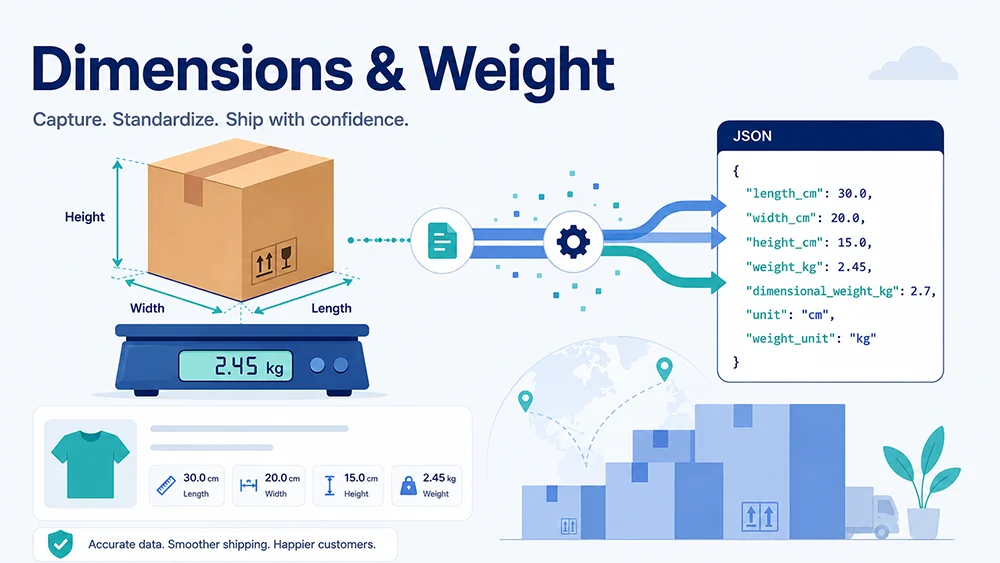
More importantly, the API returns standardized data. Regardless of whether the original page displays dimensions in inches, centimeters, or millimeters, the API uniformly converts them to standardized numerical formats. Product dimensions and package dimensions are clearly distinguished, preventing shipping cost calculation errors caused by confusing the two.
Covered Data Fields
The dimension and weight related fields returned by the API are comprehensively covered, including but not limited to: product dimensions (length, width, height), product weight, package dimensions, package weight, shipping weight, dimensional weight (DIM weight), and size tier. For specific categories, extended parameters are also returned such as clothing size charts, electronic product technical specifications, and furniture material information.
All dimension data is returned in centimeters and kilograms by default, while original unit information is retained for cross-verification. Weight fields clearly distinguish net weight, gross weight, and billable weight, ensuring the correct value is referenced when calculating costs for different stages.
Deep Integration with Product Research Workflows
The collected structured data can be directly imported into Google Sheets, Airtable, or proprietary product research databases. With simple formulas, you can achieve automatic FBA fee estimation, cross-comparison of inbound logistics costs, and logistics plan recommendations based on dimensional weight. For teams using AI Agents, this data can also be directly integrated through the MCP protocol into the Pangolinfo Amazon Scraper Skill, enabling AI to automatically factor dimensions and weight into profit margin models when analyzing product opportunities.
How to Bulk Collect Dimension and Weight Data via API
Basic API Call Example
Below is a typical Python call example demonstrating how to batch retrieve dimension and weight data for multiple ASINs:
import requests

API_KEY = "your-api-key"
endpoint = "https://api.pangolinfo.com/v1/amazon/product"

# Batch request dimension and weight data for multiple ASINs
payload = {
    "asins": ["B08N5WRWNW", "B08N5M7S6K", "B08N5LNQCX"],
    "marketplace": "amazon.com",
    "fields": [
        "title", "dimensions", "weight",
        "package_dimensions", "package_weight",
        "size_tier", "fba_fees_estimate"
    ]
}

response = requests.post(
    endpoint,
    headers={"Authorization": f"Bearer {API_KEY}"},
    json=payload
)

data = response.json()
for item in data["products"]:
    print(f"ASIN: {item['asin']}")
    print(f"Product Dimensions: {item['dimensions']}")
    print(f"Product Weight: {item['weight']}")
    print(f"Package Dimensions: {item['package_dimensions']}")
    print(f"Package Weight: {item['package_weight']}")
    print("---")
Sample Data Output Format
Example of structured JSON returned by the API:
{
  "asin": "B08N5WRWNW",
  "title": "Portable Blender, 16oz Personal Size Blender",
  "dimensions": {
    "length_cm": 8.5,
    "width_cm": 8.5,
    "height_cm": 22.0,
    "unit": "cm"
  },
  "weight": {
    "value_kg": 0.42,
    "unit": "kg"
  },
  "package_dimensions": {
    "length_cm": 12.0,
    "width_cm": 10.0,
    "height_cm": 25.0,
    "unit": "cm"
  },
  "package_weight": {
    "value_kg": 0.58,
    "unit": "kg"
  },
  "size_tier": "Small Standard-Size",
  "volume_weight_kg": 0.60
}
FBA Fee Estimation Based on Collected Data
With precise data in hand, you can directly interface with Amazon’s FBA rate card for automated fee calculation. Taking Amazon US standard-size non-apparel items in 2025 as an example, Small Standard-Size (≤12×9×6 inches, ≤12 oz) incurs a $3.86 fulfillment fee, while Large Standard-Size (≤18×14×8 inches, ≤1 lb) costs $5.77, increasing by weight tier. Through API-collected data, you can build a simple rule engine to automatically match rate tiers and achieve rapid profit calculation during the product selection phase.
From Data Blind Spots to Decision Advantages
The granularity of Amazon operations continues to increase, and dimension/weight data is no longer “nice-to-have” supplementary information—it has become a core variable affecting profit models. Manual collection methods face insurmountable bottlenecks in efficiency, accuracy, and timeliness. Scaled operations teams must establish automated data collection capabilities.
By bulk-collecting Amazon product dimension and weight data through Pangolinfo Scrape API, you can build precise cost models during the product selection phase, avoiding overestimated profits or underestimated costs caused by data blind spots. While competitors are still estimating shipping costs by eyeballing, you already possess a decision advantage based on real-time data.
Start your trial of Pangolinfo Scrape API today to bulk collect Amazon product dimension and weight data, and build your product selection decisions on a foundation of precise data.
Frequently Asked Questions
Why are product dimensions and weight data critical for Amazon sellers?
Dimensions and weight directly impact FBA fee calculations, shipping packaging plans, warehouse space allocation, and profit margin assessments during product selection. Missing accurate data leads to shipping cost estimation errors, packaging cost overruns, and potentially flawed product decisions.
What are the main pain points of manually collecting Amazon product dimensions and weight?
Manual collection faces three major pain points: extremely low efficiency at 2-3 minutes per ASIN; fragmented data scattered across different page sections; and variant confusion where different color or size variants may have different dimensions that are easily mixed up during manual recording.
What fields are typically included in Amazon product dimensions and weight data?
Typical fields include product dimensions (length x width x height), product weight, package dimensions, package weight, shipping weight, dimensional weight (DIM weight), compatible models, and material information. Different categories may have special fields such as clothing size charts or electronic product specifications.
How can I bulk collect Amazon product dimensions and weight data via API?
Through Pangolinfo Scrape API, you can batch request product detail data for multiple ASINs. The API automatically parses dimension and weight information from the page and returns it in structured JSON format. You can customize returned fields to only fetch dimension and weight related data, reducing call costs.
How can collected dimensions and weight data be used for FBA fee estimation?
Amazon FBA fees are calculated based on the greater of shipping weight (product weight + packaging weight) and dimensional weight. With accurate package dimensions and weights collected, you can directly apply Amazon’s FBA rate card for estimation, typically achieving within 5% error margin—far better than the 20-30% deviation from manual estimation.
Article Summary
This article deeply analyzes the core value of Amazon product dimension and weight data in operational decision-making, reveals three major pain points of manual collection in efficiency, accuracy, and timeliness, and details the technical solution and practical applications of bulk real-time collection through Pangolinfo Scrape API, helping sellers establish precise cost models during product selection.