
Introduction: E-Commerce Lead Generation and Legal Safeguards
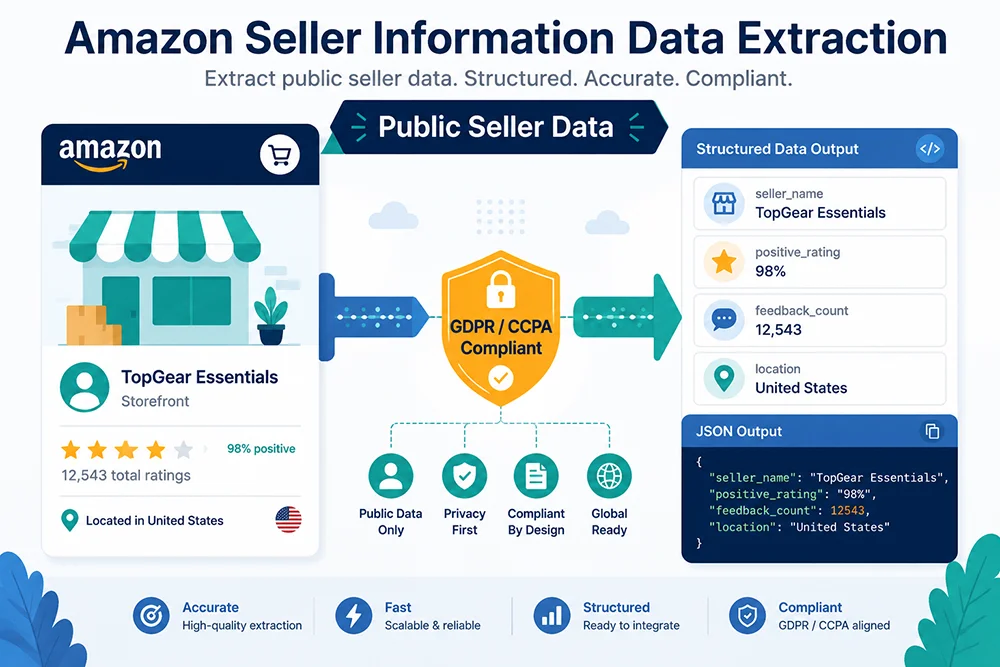
Amazon seller information data extraction is the process of collecting publicly available merchant details, including business name, registration ID, registered address, and feedback reviews, from Amazon storefront profiles to support B2B lead generation and competitor analysis. In the modern global e-commerce landscape, data is a primary weapon. For logistics agencies, financial service providers, and B2B SaaS corporations, finding active Amazon sellers is equivalent to acquiring top-tier customers. Similarly, retail brands need data to protect themselves from unauthorized seller copycats.
However, extracting seller profiles in bulk is no longer as simple as sending a few HTTP requests. Tech teams are caught between Amazon’s world-class anti-bot measures—including Cloudflare, Geoblocking, and CAPTCHAs—and international data privacy laws (like Europe’s GDPR and China’s PIPL). To safely leverage seller insights without getting blocked or sued, organizations must adopt an approach that balances technical efficiency with legal compliance. This article provides a comprehensive blueprint to achieve that balance.
What is Amazon Seller Information Data?
Amazon seller information refers to the organizational records, operational performance metrics, and public profile data of third-party (3P) merchants selling on the Amazon Marketplace. These 3P sellers generate more than 60% of all retail transactions on Amazon (according to Jungle Scout reports). In compliance with local consumer protection laws globally, Amazon publishes merchant details so that buyers can verify who they are purchasing from.
It is important to emphasize that this article focuses strictly on “public front-end data” available to any guest visitor. We do not cover private metrics hosted within Amazon Seller Central, such as internal inventory charts or customer shipment invoices. Restricting extraction to publicly displayed storefront fields is the cornerstone of legal compliance.
What Public Seller Information is Available on Amazon?
When you click on the “Sold by [Seller Name]” link on any Amazon product detail page, you are redirected to the Seller Profile storefront page. On this page, depending on the marketplace jurisdiction, Amazon displays several crucial data categories:
- Seller Identifiers: Storefront Display Name and the unique, immutable Merchant Token (commonly referred to as the Seller ID or Seller ID string).
- Business Registry Credentials: In markets like Europe and the US, Amazon enforces the display of the corporate entity’s legal name (Business Name), Business Representative, corporate registry number, and registered physical address (Business Address).
- Performance Indicators: Aggregated star ratings, total number of buyer reviews, and historical customer feedback content (spanning 30-day, 90-day, and lifetime horizons).
- Catalog Reach: Active product listings (ASINs) sold by the merchant and their fulfillment method (Fulfillment by Amazon – FBA vs. Merchant Fulfilled – FBM).
What are the Business Uses and Value of Extracted Seller Data?
Accessing structured merchant profiles at scale offers significant leverage across several business verticals:
1. Lead Generation for B2B E-Commerce Service Providers
Cross-border logistics carriers, trade financing agencies, VAT compliance advisors, and ERP developers rely on active Amazon merchants to drive business growth. Instead of buying outdated lists, developers can crawl seller directories, filter by country registry (e.g., matching Chinese manufacturers or European LLCs), and target organizations that fit their ideal customer profile (ICP).
2. Competitor Intelligence & Supply Chain Traceability
By extracting a competitor’s business entity name and registration address, product development teams can trace their physical supply chain. Understanding the precise factories, provinces, or cities supplying competitor products allows brands to negotiate better terms with alternative manufacturers. Additionally, monitoring changes in a competitor’s Feedback rating provides direct estimates of their daily sales velocity.
3. Anti-Counterfeiting and MAP Enforcement
E-commerce brands often face unauthorized resellers hijackers who copy listings and sell items below the Minimum Advertised Price (MAP). Bulk-scraping storefronts allows brand protection attorneys to automatically pull the legal business credentials of unauthorized sellers and send Cease & Desist letters directly to their real-world corporate headquarters.
Compliance Check: Does Extracted Seller Info Violate Privacy Laws?
Many developers assume that “if it’s on the web, it’s fair game.” In reality, bulk-extracting and storing Amazon merchant records requires careful navigation of international regulatory frameworks.
The Sole Proprietor Privacy Risk (GDPR / CCPA / PIPL)
Under the European Union’s GDPR and China’s Personal Information Protection Law (PIPL), Personally Identifiable Information (PII) is protected. While corporate entities (e.g., Inc., GmbH, Co., Ltd.) do not claim privacy rights, a large number of Amazon sellers are registered as **sole proprietors** or **individual business owners**.
For sole proprietors, their registered business address is often their **residential home address**, and the business phone number is their **personal mobile number**. When you scrape this data, you are collecting PII. If you compile this data into marketing directories without their explicit consent, or use it for unsolicited B2B cold calling, you risk severe regulatory penalties. To stay compliant, scrapers should clean their datasets, isolate sole proprietors, and desensitize residential address fields before database insertion.
Technical Scraping Boundaries
Beyond privacy, scrapers must remain mindful of the Computer Fraud and Abuse Act (CFAA) in the US and general tort laws regarding tortious interference and breach of contract. Scraping public pages without logging in generally remains protected (as seen in the HiQ Labs v. LinkedIn decision). However, trying to bypass login walls using fake accounts, overloading Amazon’s servers, or scraping non-public customer communications can lead to litigation.
How to Scrape Amazon Seller Storefront Information at Scale
Manual extraction is slow and inefficient for hundreds of ASINs. For bulk retrieval, teams typically evaluate two core engineering pathways:
Pathway A: Building Custom Web Scrapers (High TCO & Engineering Overhead)
A custom scraping stack using Scrapy, Puppeteer, or Playwright must constantly combat Amazon’s advanced defensive measures:
- IP Defenses: Amazon deploys real-time rate limiting. Scrapers must buy expensive residential proxy pools and script complex rotate patterns.
- CAPTCHA Challenges: High-volume requests prompt Amazon’s bot detection system to trigger CAPTCHA tests. Integrating third-party solver software increases latency and cost.
- Layout Variability: Amazon adjusts its HTML structure based on geolocation, browser fingerprints, and A/B test groups. This requires engineers to continuously update selector logic.
Pathway B: Leveraging Pangolinfo Scrape API (Zero-Maintenance & Compliant)
To bypass the engineering headaches of IP rotating and parser maintenance, enterprises use the Pangolinfo Scrape API. You simply submit the Merchant Token or storefront URL, and the API returns structured, parsing-ready JSON data in milliseconds.
For teams building autonomous workflows with AI Agents, integrating the Pangolinfo Amazon Scraper Skill allows models to call Amazon data directly using the MCP protocol, simplifying data extraction for developers.
Code Example: Extracting Amazon Seller Profiles via Python
The code block below demonstrates how to pull structured, compliant merchant profile data using Python. This implementation leverages Pangolinfo’s infrastructure, avoiding the need for manual proxy configurations or HTML parsing:
import requests
import json

def get_amazon_seller_details(seller_id, marketplace="US"):
    """
    Retrieves public business information for a specific Amazon seller
    via the Pangolinfo Scrape API.
    """
    # Replace with your actual Pangolinfo API key from the dashboard
    api_key = "YOUR_PANGOLINFO_API_KEY"
    api_url = "https://api.pangolinfo.com/v1/amazon/seller"

    headers = {
        "Authorization": f"Bearer {api_key}",
        "Content-Type": "application/json"
    }

    # Define payload containing targeted merchant token and region code
    payload = {
        "seller_id": seller_id,
        "marketplace": marketplace
    }

    try:
        response = requests.post(api_url, headers=headers, json=payload, timeout=12)
        if response.status_code == 200:
            return response.json()
        else:
            print(f"API Error (HTTP {response.status_code}): {response.text}")
            return None
    except Exception as e:
        print(f"Network error encountered: {str(e)}")
        return None

# Execution example for a US-based seller
if __name__ == "__main__":
    target_seller = "A3TXYZ123ABC"  # Replace with a real Amazon Merchant Token
    seller_details = get_amazon_seller_details(target_seller, "US")

    if seller_details:
        print("Successfully retrieved seller records:")
        print(json.dumps(seller_details, indent=4, ensure_ascii=False))

        # Accessing essential business credentials
        legal_name = seller_details.get("business_name", "N/A")
        phys_address = seller_details.get("business_address", "N/A")
        star_rating = seller_details.get("rating", "N/A")

        print("\n--- Merchant Profile Summary ---")
        print(f"Legal Entity Name: {legal_name}")
        print(f"Registered Address: {phys_address}")
        print(f"Storefront Rating: {star_rating}")
Conclusion & Strategic Takeaways
Amazon seller information data extraction serves as a powerful foundation for B2B outreach, competitive intelligence, and brand protection. However, when collecting storefront data, you must respect the compliance limits defined by privacy regulations like GDPR and PIPL, ensuring that sole proprietor PII is processed ethically. If your development team is weighed down by managing proxy rotation and CAPTCHA solvers, shifting to the Pangolinfo Scrape API allows you to bypass scraping bottlenecks and focus resources on analysis and revenue generation.
Ready to extract Amazon merchant details at scale without the proxy overhead? Register on the Pangolinfo Console to claim your free API credits, or visit the Developer Docs for quick setup.
Key Takeaway: In the era of big data, the winners are not those who build the fastest scrapers, but those who understand compliance boundaries and transform raw metrics into actionable business intelligence.