

The Operational Divide That’s Already Happening on Amazon
Amazon MCP data-driven operations are creating a measurable two-tier marketplace — and most sellers don’t realize which tier they’re in. A high-velocity cohort of technically sophisticated operators has begun connecting AI reasoning engines directly to live Amazon market data through two distinct but complementary infrastructure standards: MCP (Model Context Protocol) and Agent Skills. The result is a category of AI-assisted operations that is qualitatively different from anything that came before — not faster manual research, but genuinely different operational capability.
On the other side of this divide, the majority of sellers are still working with data that’s 24 to 72 hours stale, synthesizing it manually across three or four fragmented tools, and making decisions at a pace that fundamentally cannot match the speed at which Amazon’s algorithms generate and consume market signals. The gap isn’t a technology problem in the abstract — it’s a specific infrastructure gap, and it has a specific solution set.
But here’s where most guides on this topic fall short: they treat MCP and Skills as if they’re interchangeable, or as if one is simply the newer version of the other. They’re not. They represent fundamentally different design philosophies, serve different user populations, and solve different problems. Building an effective Amazon MCP data-driven operations stack requires understanding this distinction clearly — and then knowing how to combine them into a coherent whole.
This guide is an attempt to give you that clarity. We’ll start from the architectural foundations, work through the practical decision framework, and end with concrete operational templates you can apply to your own team’s situation.
MCP: What It Actually Is, and Why It Matters for Amazon Operations
The Model Context Protocol was released by Anthropic as an open standard in November 2024. By mid-2025, it had been adopted by most major AI platforms and agent frameworks. Understanding what MCP actually does — at an architectural level, not just a marketing level — is prerequisite to evaluating whether it belongs in your operations stack.
Large language models have a fundamental structural limitation that is worth being direct about: they are, architecturally, isolated reasoning engines. A model trained through October 2024 has no inherent ability to tell you what Amazon’s BSR rankings look like today. It can produce a plausible-sounding answer, but that answer draws on training data that may be many months stale. For most use cases, this is acceptable. For Amazon operations — where BSR shifts, keyword velocity inflections, and competitive entries happen in 48-hour windows — it’s a structural disqualifier.
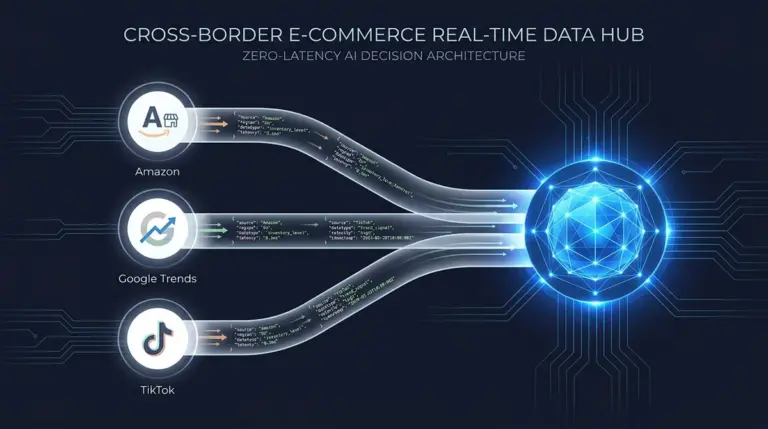
MCP solves this at the protocol level. It defines a standardized, secure interface through which AI models can make real-time calls to external data sources as part of their reasoning process. The architecture has three roles: the MCP Host (the environment running the AI model, like Claude Desktop or a custom application), the MCP Client (a module embedded in the host that manages connections to servers), and the MCP Server (a service that exposes tools and data resources according to the MCP specification). When you build Amazon MCP data-driven operations infrastructure, the central engineering task is building an MCP Server that wraps Pangolinfo’s data APIs as callable tools, so that AI models can pull live Amazon market data in real time as they reason through your questions.
Four design principles define MCP’s operational character, and all four matter for how you evaluate its fit:
Dynamic tool discovery: MCP servers declare their available tools at connection time. The AI model queries the server to find out what tools exist, what parameters they accept, and what they return — then decides at inference time which tools to call and with what inputs. This means your data tool library can evolve without retraining the model: add a new Pangolinfo data endpoint to your MCP Server, and the AI starts using it automatically.
True real-time data: Every MCP tool call is a live HTTP request to your data source. When you ask an AI with MCP access about current BSR trends in a category, it’s calling Pangolinfo’s API at that instant and returning data that’s current to within minutes. Not a weekly export. Not a 48-hour-delayed batch. The data the AI reasons from reflects what the market looks like right now.
Multi-step composability: Within a single conversation, an AI model can make sequential MCP tool calls, accumulating their results in context and reasoning across all of them. Ask about a category opportunity; the AI calls BSR data, builds a short list, then calls review data for the top candidates, then synthesizes across both datasets to produce a ranked recommendation. This kind of multi-step, multi-source analytical workflow is what enables genuinely deep market analysis rather than simple data retrieval.
Full programmability: Your MCP Server implementation is entirely under your control. You can apply business logic before returning data — filtering to only results that match your sourcing constraints, formatting outputs to match your internal reporting templates, combining data from multiple Pangolinfo endpoints into a single tool call. The MCP Server is where your operational logic lives, separate from the AI model itself.
These four properties together define MCP’s core use case: complex, automated, multi-source AI workflows where flexibility, real-time data access, and integration with existing systems are requirements.
Agent Skills: Packaged Capability vs. Programmable Infrastructure
Agent Skills represent a fundamentally different design philosophy. If MCP is about giving AI models programmable access to external data sources, Skills are about packaging specific capabilities into deployable units that non-technical users can install and invoke without code.
The Skill ecosystem emerged from agent platforms like OpenClaw, which allow third-party developers to publish specialized capabilities to a skill marketplace (ClawHub). Users browsing the marketplace find a Skill, click install, and the agent immediately gains that capability — without writing code, without configuring servers, without managing API credentials. From a user experience perspective, it’s the App Store model applied to AI capability extension.
Skills have four design properties that differentiate them from MCP:
Encapsulation: A Skill packages the entire data access layer — authentication, request formation, error handling, output formatting — inside the skill itself. Users interact only with the capability, not the mechanism. The Pangolinfo Amazon Scraper Skill, for example, encapsulates all the complexity of authenticating to Pangolinfo’s API, forming valid requests for different Amazon data types, handling pagination and rate limits, and returning clean structured output — none of which the end user needs to understand or manage.
Zero-code deployment: Skills are designed for operators and analysts, not engineers. Installation requires no development environment, no API credential management on the user side, no understanding of the underlying data infrastructure. The target user is a product selection manager or operations lead who knows Amazon well but has no Python background.
Standardized interfaces: Skills are built to platform specifications, with standardized input/output contracts that make them compatible with the agent platform’s orchestration layer. This standardization enables Skills to compose with other Skills within the same platform — your Amazon Scraper Skill can hand data to a data analysis Skill, for instance.
Narrow focus: Individual Skills typically do one thing well — retrieve specific data types from a specific source. They’re not responsible for analysis, synthesis, or multi-step reasoning. That’s the agent’s job. The Skill’s job is to be a reliable, well-structured data access primitive.
Skills’ natural use case is therefore: zero-code data access for non-technical users, or lightweight data retrieval primitives within an existing agent platform workflow.
MCP vs. Skills: The Decision Framework You Can Actually Use
Now that both architectures are clear, the practical question is: for any given Amazon operations use case, which approach is appropriate? The honest answer is that this isn’t primarily a technology question — it’s an organizational question. The right answer depends almost entirely on who is using the system, what they’re trying to accomplish, and what engineering resources are available to build and maintain the infrastructure.
Decision Dimension 1: Who is the primary user?
If the primary user is a non-technical operations team member — a product sourcing manager, a brand manager, a category analyst — Skills are almost certainly the right starting point. They require no technical knowledge to use, and the cognitive overhead is limited to learning how to invoke them through natural language in the agent interface. Install Pangolinfo’s Amazon Scraper Skill; from that point, the user can ask the agent “get me the details for ASIN B0XXXXXXXX” and receive a structured response without any further setup.
If the primary user is a data engineer or technical lead building automated workflows, MCP is the right architecture. The programmability and composability of MCP are assets only if someone can actually write and maintain the server code and integration logic. For this profile of user, the additional complexity of MCP is worth it because it unlocks capabilities that Skills cannot support: multi-step automated pipelines, custom business logic at the data layer, integration with internal systems like ERPs and BI dashboards.
Decision Dimension 2: Ad-hoc query or automated workflow?
Skills excel at on-demand, conversational data retrieval. “Check the current BSR rank for this competitor” or “Pull the reviews for these five ASINs and summarize the top complaints” — these are natural Skill use cases. The user drives each query through the conversation interface; the Skill responds with data; the agent synthesizes an answer. Fast, intuitive, zero infrastructure overhead.
MCP is the right architecture when you need data to flow automatically, on a schedule, without human initiation of each request. An automated daily opportunity scan that runs at 6am, processes BSR data for twelve categories, filters against configurable criteria, and pushes a formatted report to a Slack channel — this is MCP territory. The automation, scheduling, and system integration requirements are outside what agent Skills are designed to support.
Decision Dimension 3: Single-source retrieval or multi-source synthesis?
If you need data from one source for one analysis, Skills handle this cleanly. If you need to pull BSR data, then review data for the top candidates, then cross-reference against Google AI search results for the same keywords — and synthesize all three into a unified analysis — you need the multi-step composability of MCP. Skills can participate in multi-step agent workflows, but the orchestration complexity increases substantially, and the context management across multiple skill calls is inherently more constrained than MCP’s unified context window approach.
Decision Dimension 4: Standard data needs or custom business logic?
Skills provide a standardized capability surface. The Pangolinfo Amazon Scraper Skill returns product data in a well-structured format that covers most common use cases. If your analysis needs are standard — product details, BSR data, keyword search results — Skills cover them well.
If you need custom filtering, bespoke output formats, integration with proprietary data sources, or business logic that should run at the data layer before the AI receives it — for example, “automatically cross-reference against our internal whitelist of approved sourcing categories before returning results” — this logic belongs in an MCP Server implementation, where you control it completely.
When to combine MCP and Skills
The most powerful configurations use both. The combination pattern that works best in practice: MCP as the automation and orchestration layer, handling scheduled workflows, system integration, and complex multi-step analytical pipelines; Skills as lightweight data primitives within those workflows for standardized data retrieval tasks, or as the primary interface for non-technical team members running ad-hoc queries alongside the automated systems. The two approaches complement rather than replace each other — MCP for the infrastructure, Skills for the user-facing access points.
Pangolinfo Amazon Scraper Skill: Zero-Code Amazon Intelligence for Every Operations Team
The Pangolinfo Amazon Scraper Skill is the packaged form of Pangolinfo’s Amazon data access capabilities, built to the OpenClaw Skill specification and available through ClawHub for immediate installation. It makes the same underlying data infrastructure that powers Pangolinfo’s enterprise API — real-time BSR data, product detail extraction, keyword search results, ad placement intelligence — available to any Amazon seller team through a conversational agent interface, without requiring API credentials, server setup, or code.
Understanding what the Skill actually provides in practice is best done through the lens of the specific intelligent workflows it enables:
Competitive intelligence on demand: An operations team member suspects that a competitor is changing its pricing strategy. They open the agent, ask it to pull current product details for the competitor’s top five ASINs, and compare prices, variation offerings, and BSR positions against last week’s data. The Amazon Scraper Skill handles the data retrieval; the agent synthesizes the competitive picture. Total time: under two minutes, no spreadsheet involved.
Category entry evaluation: A sourcing manager is evaluating two potential new categories. She asks the agent to pull BSR data for both, focusing on products under 200 reviews with estimated monthly sales above $10,000. The Skill retrieves the current bestseller data for both categories; the agent compares competitive intensity, price points, and review barriers side by side. A decision that used to require an hour of manual tool-hopping now happens in a ten-minute conversation.
Keyword competitive landscape: Before launching a PPC campaign for a new product, the growth team asks the agent to pull the search results for five target keywords — including which positions are organic versus sponsored, which brands appear multiple times, and which ASINs have the highest BSR among the results. The Skill returns structured search result data; the agent maps the competitive landscape and suggests which keywords have more room for an aggressive spend and which are already dominated.
New product opportunity identification: “Find me the ten fastest-rising products in pet supplies over the past seven days that have fewer than 100 reviews.” This is a natural language request that the Skill and agent handle end-to-end — the Skill pulls the relevant BSR data with appropriate filters; the agent returns a ranked list with the context a sourcing manager needs to evaluate each candidate.
The Pangolinfo Amazon Scraper Skill’s data coverage for these workflows includes: real-time Best Seller Rankings with minute-level freshness, complete product detail pages (titles, pricing including variation matrices, inventory signals, ratings, review counts, A+ content structure, seller information, fulfillment type), keyword search result pages with organic and sponsored position identification, and Sponsored Product ad placement data. The underlying data infrastructure is Pangolinfo’s production-grade API, including the 98% SP ad capture rate that makes the ad placement data genuinely usable for competitive analysis rather than directionally vague.
For teams that are exploring AI-assisted operations but lack the engineering resources to build MCP infrastructure, the Pangolinfo Amazon Scraper Skill is the right starting point. Install today; start generating value from AI-assisted Amazon intelligence in the same session. The learning curve is a single conversation.
AI SERP Skill: The Google Intelligence Layer That Amazon Sellers Are Ignoring — At Their Peril
Here is a strategic blind spot that characterizes most Amazon sellers’ data practice: they treat Amazon as the entirety of their competitive intelligence surface. It isn’t. Consumer purchase journeys for most product categories begin outside Amazon — frequently with a Google search — and the dynamics of that pre-Amazon discovery layer directly affect which brands and products win on Amazon. In 2025, one development in particular made this external intelligence layer impossible to ignore: the widespread deployment of Google AI Overview.
Google AI Overview is the AI-generated summary that appears at the top of Google search results — above the traditional blue-link organic results — when Gemini determines it can synthesize a useful answer from indexed content. For product-related searches, AI Overview often functions as a de facto product recommendation: “best wireless earbuds under $50” may trigger an AI summary that names three specific brands, with brief explanatory text for each. Users who receive a confident AI recommendation before they even see the organic results have a meaningfully different decision path than users who scroll through ten traditional links.
The competitive implications for Amazon sellers are direct and significant. A brand that appears consistently in Google AI Overview summaries for its category’s top keywords has a discovery-layer advantage that doesn’t show up in any Amazon metric — but eventually does show up in branded search volume, external traffic conversion, and the velocity signals that Amazon’s own algorithms use to reward products. A brand that is absent from AI Overview, even while ranking well for organic search results, is losing ground in the most visible real estate on the Google results page.
Systematically tracking Google AI Overview at scale — which keywords trigger it, which brands and products are mentioned, what content sources are being cited — is not something that can be done manually. That’s exactly what Pangolinfo’s AI SERP Skill (Google AI Overview API) enables.
The AI SERP Skill provides structured extraction of Google search results pages, with specific focus on the AI Overview module: the full text of the AI-generated summary, citations (which websites are being referenced as sources), brands and products mentioned within the summary, and metadata about whether and how AI Overview appears for a given keyword. This data, captured systematically across your category’s keyword set, creates an external intelligence layer that complements Amazon-side data in ways that are genuinely difficult to replicate through any other means.
Three specific use cases illustrate where this intelligence has the sharpest operational value:
Brand discovery gap analysis: Run AI SERP queries for the top 50 keywords in your category. Map which brands appear in AI Overview summaries and with what frequency. If your brand is absent and two of your competitors are present for 80% of the keywords you care about, that’s not a ranking problem — it’s a content ecosystem problem, and the specific citations within the AI summaries tell you which content sources Gemini is drawing from, which tells you where to invest in external content or PR. This analysis, done manually, would take weeks. Done through the AI SERP Skill, it’s an agent conversation.
Competitor momentum detection: AI Overview presence correlates with content-layer authority. A brand that moves from appearing in 10% of relevant AI Overviews to 40% in a three-month period is building external discovery momentum that will eventually manifest in Amazon performance metrics. Tracking this longitudinal trend across your competitive set gives you early warning of competitive threats that Amazon data alone won’t surface until it’s too late to respond effectively.
Content strategy direction: The citations within AI Overview summaries are a direct signal about which types of content (and which specific publications) Google’s AI system treats as authoritative for your category. If Wirecutter, a specific subreddit, and one Amazon review aggregation site are consistently appearing in AI Overview citations for your category’s top keywords, these are your highest-leverage external content channels. The AI SERP Skill surfaces this information systematically rather than requiring you to manually inspect results across hundreds of keyword queries.
When used in combination with the Amazon Scraper Skill through an agent, the AI SERP Skill enables a genuinely two-dimensional competitive picture: external discovery dynamics (Google AI Overview presence, content source authority, brand mention patterns) alongside internal Amazon competitive dynamics (BSR, ad position, review velocity). This dual-layer view represents a level of competitive intelligence sophistication that was operationally impractical before these tools existed.
Scrape API + MCP: The Programmable Foundation for Enterprise-Grade Amazon Operations
For teams with engineering capacity, Pangolinfo’s Scrape API in combination with MCP represents the highest-ceiling configuration in the Amazon MCP data-driven operations stack. The Scrape API is the direct access layer to Pangolinfo’s full data production capability — the same infrastructure that powers the Skills, but accessible programmatically with full control over request parameters, filtering logic, output formatting, and integration architecture.
The data coverage of Pangolinfo’s Scrape API for Amazon is the most comprehensive in its category:
Best Seller Rankings with minute-level freshness: Real-time BSR data across all Amazon categories, queryable by category node, time window, and rank change magnitude. This is the primary signal source for opportunity identification — a new product entering the BSR top 30 is a market signal, and catching it within hours rather than 48 hours is the difference between a first-mover advantage and arriving at a crowded party.
New Releases and Movers & Shakers tracking: The two forward-looking signals on Amazon’s marketplace. New Releases surfaces products that entered the market recently and are gaining traction early; Movers & Shakers captures the most dramatic BSR rank improvements over 24-hour periods. Connected to an automated surveillance workflow, these feeds let you detect market velocity shifts within hours of when they begin. BSR changes that would take a weekly manual review process to catch become actionable intelligence in near-real-time.
Complete product detail page extraction: Not just title and price. Pangolinfo’s product parsing covers variation matrices (including pricing by variation combination), inventory depth signals, A+ content structure, seller information and ratings, FBA/FBM fulfillment indicators, Buy Box eligibility details, and shipping options. For competitive analysis and Listing optimization, many of these second-level data fields are as important as the headline metrics. An A+ content structure analysis, for example, can reveal exactly how a category leader is organizing its conversion-oriented product storytelling.
98% SP ad placement capture rate: This is Pangolinfo’s most distinctive technical differentiator. Sponsored Product ad placement data is available from multiple data providers, but capture rates vary dramatically — particularly for mobile placements and the specific position-within-page granularity that matters most for bid strategy. Most providers achieve 50-65% capture rates, leaving substantial blind spots in ad competitive analysis. Pangolinfo’s 98% rate means the ad competitive landscape you’re analyzing reflects the actual state of the marketplace, not a significantly incomplete sample of it.
Zip-code-specific data: Amazon’s pricing, shipping times, Prime eligibility, and search result ordering can vary by delivery zip code. Pangolinfo supports specifying target zip codes in data requests, enabling localized pricing research, regional competitive analysis, and demand-side pricing strategy. For sellers with significant regional concentration in their customer base, this granularity has direct strategic value.
Complete Customer Says extraction: Amazon’s AI-generated review summary feature (“Customer Says”) compresses hundreds of reviews into a set of high-consensus quality signals. Pangolinfo is among a very small number of data providers capable of extracting this summary in full — most products and categories now display it, and it’s one of the highest-density single datapoints for understanding what buyers consistently value or criticize about a product at scale. When an AI is reasoning about product improvement priorities, Customer Says is often the most efficient input for identifying the changes that will have the broadest positive effect on review sentiment.
Building this data access layer into an MCP Server enables automated operational workflows that represent genuine step changes over manual practice:
Automated opportunity intelligence: A workflow that runs each morning at 6am, pulling BSR data across your defined category watchlist, filtering against configurable criteria (max review count, min monthly sales estimate, minimum BSR improvement threshold), generating a ranked opportunity list, and pushing it to your team’s communication channel. Operations managers start the day with processed intelligence rather than raw data that requires hours to synthesize.
Continuous competitive monitoring: Weekly automated deep pulls on a defined competitor ASIN set — price changes, BSR trajectory, review velocity, A+ content changes — generating a structured competitive delta report for distribution to the relevant stakeholders. Changes that matter get surfaced; the absence of changes is equally informative. This kind of surveillance at weekly granularity, applied to 30-50 competitors simultaneously, is operationally impossible to maintain manually.
Launch evaluation pipelines: When a sourcing candidate clears initial screening, trigger an automated deep analysis: full BSR history for the category, complete review extraction for the top 10 competitors (parsed through the Reviews Scraper API), SP ad placement landscape for the primary keywords, and Google AI Overview presence data for the same keywords through the AI SERP API. Output: a structured launch evaluation report that covers market size, competitive intensity, differentiation opportunities, ad spend landscape, and external discovery dynamics. A report that might take a skilled analyst two full days of manual research now takes 20 minutes of automated data gathering and AI synthesis.
Dynamic pricing intelligence: For sellers managing active price optimization, an MCP workflow that continuously pulls Buy Box status and competitor pricing across a defined product set, flagging situations where your pricing position has shifted relative to Buy Box thresholds or where competitors have made significant price moves. Pricing decisions that currently lag market changes by hours or days can compress to a near-real-time response loop.
Reviews Scraper API and AMZ Data Tracker: The Analytical and Visualization Complement
A complete Amazon MCP data-driven operations stack has two additional components worth examining: the Reviews Scraper API for deep review intelligence, and AMZ Data Tracker as the visualization and monitoring layer for teams that need operational data dashboards without API integration.
The Reviews Scraper API’s value in the MCP context is concentrated in two use cases, both of which require the kind of full dataset extraction that most data providers don’t support at the depth Pangolinfo provides.
The first use case is product iteration intelligence. When a flagship product is showing rating deterioration or accelerating negative review volume, the traditional response involves manually reading through hundreds of reviews, manually categorizing issues, and producing an analysis that reflects one person’s subjective reading of the pattern. Connected to MCP, the workflow changes fundamentally: the AI pulls the full negative review dataset for the affected ASIN — not a sample, the full dataset — processes it to identify issue clusters by frequency and severity, and returns a structured output: “Complaint category distribution: battery life (38%), magnetic connector reliability (27%), language support (17%), packaging damage in transit (11%), other (7%). Product revision priority recommendation: ① Battery cell upgrade to achieve 100+ hour continuous operation; ② Magnetic module supplier replacement or component-level redesign; ③ Multilingual documentation expansion. Estimated review impact of addressing top two issues: 0.3-0.5 star rating improvement based on complaint volume analysis.” That’s not a report for further analysis. That is a product requirements document, ready for the development team.
The second use case is competitive differentiation research. Systematically extracting the one-star review corpus for your top five competitors in a category, clustering it by issue type, and cross-referencing against your own product specifications — this process identifies the “competitor weakness + our solvable gap” intersections that are the most defensible differentiation opportunities available. Customers are explicitly telling you what the market leader is getting wrong. The Reviews Scraper API, combined with AI reasoning over the extracted data, makes this systematic at scale, rather than an occasional art project that happens when someone has a free afternoon.
AMZ Data Tracker serves a different function in the stack: it’s the no-code, visual monitoring layer that makes operational data accessible to team members who don’t interact with AI agents or API tooling. BSR tracking dashboards, price change alerts, keyword ranking movement, competitor comparison views — AMZ Data Tracker covers these through a visual interface with configurable alert rules and automated report scheduling. It doesn’t replace MCP or API integration; it complements them by providing a data consumption layer for the operational users who need to stay informed but aren’t building analytical workflows themselves. A brand manager who needs to know when a competitor drops price by more than 10% doesn’t need access to the MCP infrastructure — they need an alert in their email. AMZ Data Tracker is what delivers that without requiring engineering involvement.
Practical Framework: Which Configuration Is Right for Your Team?
With all four product types and both infrastructure paradigms covered, the practical question is how to configure them for your specific team situation. The following framework organizes this by team maturity and resource availability.
Stage 1: Early-Stage Sellers and Small Teams (1-10 people, no dedicated technical resources)
Recommended configuration: AMZ Data Tracker + Pangolinfo Amazon Scraper Skill
AMZ Data Tracker provides the foundational data monitoring layer: set up BSR tracking for your products and primary competitors, configure price change and review velocity alerts, and establish a weekly competitive report. This gives the team structured market awareness without any technical setup requirement.
Install the Pangolinfo Amazon Scraper Skill in OpenClaw to enable conversational data queries — ask the agent about competitor details, BSR snapshots, keyword search results. This covers 80-90% of ad-hoc research needs without any API integration work. Total engineering time required: zero. Total time to first value: two hours of setup.
Stage 2: Established Sellers and Growing Teams (10-50 people, 1-2 technical team members)
Recommended configuration: Scrape API + MCP for automated workflows + Skill for ad-hoc queries + AI SERP Skill
The technical team member builds MCP Server infrastructure wrapping Pangolinfo’s Scrape API, implementing the two or three highest-value automated workflows: daily BSR opportunity scanning, weekly competitive monitoring report, and review-triggered product analysis. These run automatically; outputs flow to team channels. The operations team uses Amazon Scraper Skill for on-demand queries alongside the automated systems.
At this stage, adding the AI SERP Skill to the agent toolkit enables external discovery intelligence — tracking Google AI Overview presence for key category keywords — which can be incorporated into the weekly competitive report the MCP workflow generates. The combination gives you both Amazon-internal and Google-external competitive visibility.
Stage 3: Brand Companies and Mature Operations Teams (50+ people, dedicated data and technical teams)
Recommended configuration: Full MCP architecture + full Pangolinfo product stack + AMZ Data Tracker as visualization layer
At this stage, the Amazon MCP data-driven operations stack is a core piece of business infrastructure, not a tool used by individual team members. Automated workflows run continuously across all managed categories, feeding processed intelligence into the systems and dashboards that operational decision-makers use. The data layer integrates Scrape API, Reviews Scraper API, and AI SERP API data through the MCP framework. AMZ Data Tracker serves as the visual interface for operational and management-level users who need data visibility without API or agent access. The Skills layer provides access for individual team members who need conversational data queries alongside the automated infrastructure.
At full maturity, this configuration enables what we’d describe as genuine Amazon MCP data-driven operations: the kind of real-time, multi-source, AI-synthesized market intelligence that makes 90-second opportunity identification and machine-speed competitive response actually operational rather than theoretical.
Algorithm vs. Algorithm: Why the Competitive Window Is Now
Amazon’s platform is, at its core, an enormously complex algorithmic system. A9/A10 ranking algorithms, auction-based ad bidding algorithms, Buy Box allocation algorithms, review display and weighting algorithms — all of these systems continuously process seller behavior signals and consumer engagement signals to allocate marketplace visibility. Sellers who understand and adapt to these algorithmic dynamics faster than their competitors hold a structural advantage. The speed of that adaptation loop is the competitive variable that Amazon MCP data-driven operations directly addresses.
Traditional operations practice built adaptation loops measured in days: weekly BSR reviews, monthly competitive analyses, quarterly strategy updates. Amazon’s algorithms generate and consume signals at hourly and sub-hourly intervals. The mismatch between these two tempos is the fundamental source of the operational disadvantage that most sellers are operating under — they’re always responding to last week’s version of the market, while the algorithms have already processed this week’s data and adjusted accordingly.
The configuration we’ve described here — Pangolinfo’s real-time data infrastructure, connected through MCP for automated multi-source analysis, with Skills providing zero-code access for non-technical team members and AI SERP giving you the external discovery intelligence layer — compresses the adaptation loop from days to minutes. This isn’t an improvement in the same operational paradigm. It’s a system that operates in a fundamentally different time resolution than manual practice.
The window for competitive advantage from this infrastructure is real and present, but it will not stay open indefinitely. As these tools become more widely adopted, the advantage shifts from possessing the capability to having it better implemented, more deeply integrated into operations processes, and generating more accurate analytical outputs through better data infrastructure. Pangolinfo’s investment in data quality — the minute-level freshness, the 98% SP ad capture completeness, the Customer Says extraction depth — is the foundation layer that makes AI reasoning on Amazon market data actually reliable rather than directionally vague. An AI working from high-quality, structurally clean, real-time data produces conclusions you can act on. An AI working from delayed, incomplete, or poorly-parsed data produces conclusions that sound confident and are wrong in ways that cost money.
Amazon MCP data-driven operations begins with the first data layer decision: where is the AI going to get its information? For Amazon market data, that question now has a clear answer. The build begins with that foundation.
Explore Pangolinfo Amazon Scraper Skill for zero-code Amazon data access. Build programmatic AI workflows with Scrape API and MCP. Add Google AI Overview intelligence with AI SERP Skill. Monitor Amazon metrics visually with AMZ Data Tracker. Review integration documentation at docs.pangolinfo.com, or start a free trial at the console.